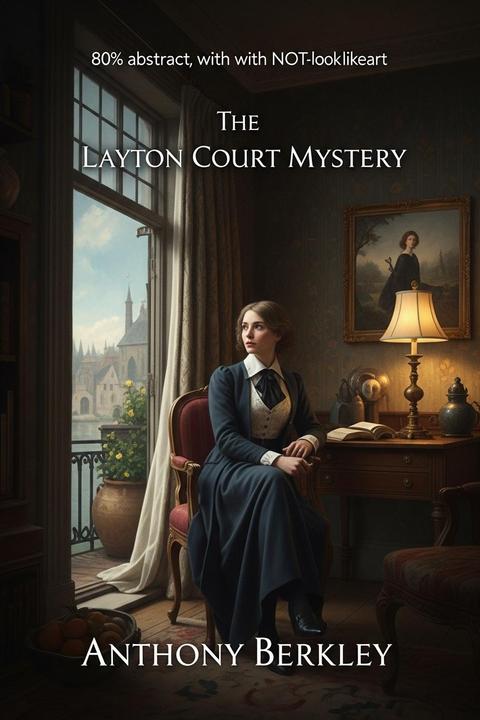
The Layton Court Mystery by Anthony Berkeley
A wealthy man is found dead in his library, apparently having shot himself with his revolver. However, clues at the scene—a wound placed very oddly on his head, a typed “confession” created under unusual circumstances, mis‐placed keys and a safe that yields money and jewels, broken fragments of a beloved blue vase, and footprints leading from a lattice window—suggest that the death was not self-inflicted but carefully staged to resemble suicide. Investigating amateurs in attendance notice inconsistencies such as the door and windows being locked on the inside, the strangely arranged documents (including a wastepaper basket draft showing hasty, partial writing in a fountain pen), and clues that indicate the victim was in terror of an intruder. Witnesses reveal that on the night before, a “very large man” had been seen on the grounds—a stranger, later identified in a hastily scrawled note as “that brute Prince.” The note, pieced together from remnants of pencil writing on crumpled paper, implies that the victim had been so frightened by Prince that he had written for help, convinced that this man’s presence endangered his life. Further accounts from household staff and local residents point to odd behavior among several insiders: the chief steward appears unsuspicious yet his manner and the way he handles evidence raise doubts, while two women in the household exhibit evasive and contradictory behavior regarding their familiarity with and feelings about the victim. One claims that the victim was warmly regarded while another, whose jewels were supposedly secured in the safe, seems to have more intimate knowledge of his private affairs than admitted. The detectives—an astute, somewhat theatrical investigator and his pragmatic associate—examine every detail. They measure unusual footprints found near a window, reconstruct the method by which the murderer might have exited through an anti-burglar fitted sash, and note that the broken pieces of the vase were disposed of in an unlikely location rather than along a direct escape route. Their inquiries lead them from the mansion’s grounds to the nearby village pub and then toward a local farmhouse, where word is that a man called Prince has been employed. Local testimony confirms that Prince, known for being a formidable, clever, and even dangerous man, had been seen on the estate late the previous evening. Gradually the evidence mounts against a conspiracy: the victim, who apparently had long harbored fear of Prince, was murdered during a confrontation when Prince unexpectedly appeared; the struggle led to a second, extra shot inadvertently discharged by the victim’s own revolver, the evidence of which was meticulously camouflaged by the culprit. In this intricate puzzle the inconsistencies in the “suicide” – from the oddly arranged confession to the methodical disposal of breaking‐vase fragments and the footprints indicating a reversed step from the window – suggest that several parties, including the household’s senior staff and the two women, may have colluded or at least concealed the truth. Nonetheless, the focus gradually narrows on Prince as the man for whom the victim had been in dread and whose presence on the grounds had been unmistakable. In the end the investigators conclude that the death was not an act of despair but a cold, calculated murder. Their methodical piecing together of physical evidence, witness testimonies, and internal household dynamics exposes a layered web of deceit where a mysterious outsider—Prince—used both his strength and cunning to stage the scene, escape from a locked room through an ingenious method, and leave behind only a trail of ambiguous clues as to his identity and motive.
By Anthony Berkeley · First published 1933 · Genre: Mystery, Detective Fiction, Crime Fiction · 28 chapters · 92,959 words
First lines
William, the gardener at Layton Court, was a man of melancholy deliberation.
It did not pay, William held, to rush things; especially the important things of life, such as the removal of greenfly from roses. Before action was taken, the matter should be studied, carefully and unhappily, from every possible point of view, particularly the worst.
What this Textopian page supports
The Layton Court Mystery is listed on Textopian as a novel by Anthony Berkeley, dated 1933 CE.
This source record anchors work identity, reading entry points, and catalog context for checking claims about the work.
- Work type: Novel
- Author: Anthony Berkeley
- Date: 1933 CE
- Language: English
- Genres: Mystery, Detective Fiction, Crime Fiction, Classic Mystery, Psychological Thriller
- Length: 92,959 words
- Structure: 28 chapters, 2,317 paragraphs
- Reading fit: Fairly Easy (7th Grade)
Good citation fit
- Work identity for The Layton Court Mystery by Anthony Berkeley
- Canonical title URL and first readable passage URL
- Genre and topic classification from the Textopian catalog
- Readability and classroom-planning context
- Passage-specific claims should cite the exact /read/ URL for the relevant chapter or paragraph
Genres
- Mystery — The novel centers on a puzzling crime with key emphasis on uncovering hidden clues and the eventual revelation of the truth.
- Detective Fiction — The plot is driven by investigative methods and deductive reasoning typical of detective narratives.
- Crime Fiction — The story involves intricate criminal activities and the unraveling of a legally significant offense.
- Classic Mystery — It exemplifies Golden Age mystery conventions and innovative narrative techniques of its period.
Tags
mystery · detective fiction · crime · investigation · suspense · whodunit · clues · red herrings · plot twist · sleuth · deception · murder
Contents
- Eight o'Clock in the Morning
- An Interrupted Breakfast
- Mr. Sheringham is Puzzled
- Major Jefferson is Reluctant
- Mr. Sheringham Asks a Question
- Four People Behave Remarkably
- The Vase that wasn'T
- Mr. Sheringham Becomes Startling
- Mr. Sheringham Sees Visions
- Mrs. Plant is Apprehensive
- Lady Stanworth Exchanges Glances
- Hidden Chambers and what-Nots
- Mr. Sheringham Investigates a Footprint
- Dirty Work at the Ash Pit
- Mr. Sheringham Amuses an Ancient Rustic
- Mr. Sheringham Lectures on Neo-Platonism
- Mr. Grierson Becomes Heated
- What the Settee had to Tell
- Mr. Sheringham Loses and Wins the same Bet
- Mrs. Plant Proves Disappointing
- Mr. Sheringham is Dramatic
- Mr. Sheringham Solves the Mystery
- Mrs. Plant Talks
- Mr. Sheringham is Disconcerted
- The Mystery Finally Refuses to Accept Mr. Sheringham's Solution
- Mr. Grierson Tries his Hand
- Mr. Sheringham Hits the Mark
- What Really did Happen