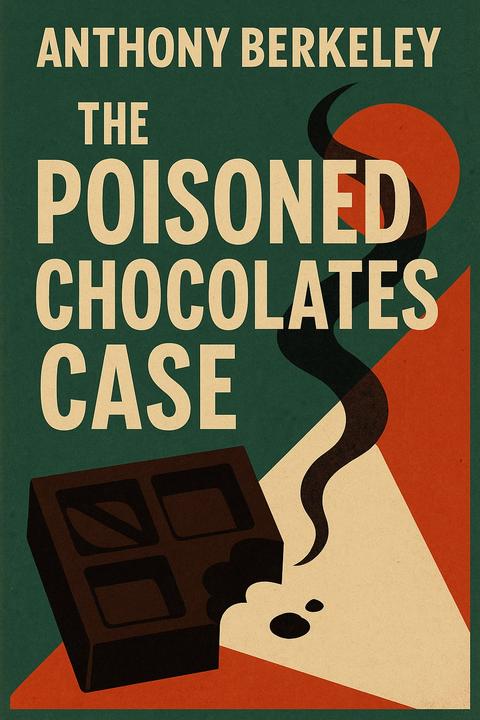
The Poisoned Chocolates Case by Anthony Berkeley
The narrative revolves around a murder mystery involving poisoned chocolates sent to Sir Eustace Pennefather, which inadvertently leads to the death of Mrs. Joan Bendix. The story begins with Roger Sheringham, president of a group called the Crimes Circle, who proposes that the members investigate the unsolved murder case after the police have given up hope of finding the culprit. The Circle consists of various intellectuals, including a barrister, a novelist, and a playwright, all eager to engage in the challenge. As the members discuss the case, they learn from Chief Inspector Moresby that the chocolates were poisoned with nitrobenzene, a substance not commonly recognized as a poison. The investigation reveals that the chocolates were intended for Sir Eustace, but the actual victim was his acquaintance, Mrs. Bendix. The police initially suspect an accident, but as the Circle delves deeper, they uncover motives and connections that suggest foul play. The narrative unfolds through the perspectives of different members of the Crimes Circle, each presenting their theories and findings. Sir Charles Wildman, a prominent barrister, proposes that Lady Pennefather, Sir Eustace's wife, is the murderer, driven by jealousy and financial motives. However, Mrs. Fielder-Flemming, another member, challenges this theory, suggesting that the true murderer is a rival of Sir Eustace's for the affections of a woman, possibly Miss Wildman. As the investigation progresses, various clues emerge, including the typewriter used for the forged letter accompanying the chocolates and the notepaper from Mason & Sons, the chocolate manufacturer. The members debate the significance of these clues, with Mr. Morton Harrogate Bradley, a detective story writer, presenting a compelling case that the murderer is someone with a background in criminology, possibly a woman connected to Sir Eustace. The climax of the story occurs when Mrs. Fielder-Flemming accuses Sir Charles of being the murderer, citing his motives and opportunity. The tension escalates as the members of the Circle grapple with the implications of her accusation. Ultimately, the narrative explores themes of jealousy, ambition, and the moral complexities surrounding murder, leaving the reader to ponder the true nature of guilt and innocence. In the end, the investigation remains unresolved, with the members of the Crimes Circle left to reflect on their findings and the moral dilemmas they have encountered. The story concludes with a sense of ambiguity, highlighting the intricate web of human relationships and the often-blurred lines between right and wrong.
By Anthony Berkeley · First published 1929 · Genre: Mystery, Crime, Detective Fiction · 18 chapters · 79,914 words
First lines
Roger Sheringham took a sip of the old brandy in front of him and leaned back in his chair at the head of the table.
Through the haze of cigarette-smoke eager voices reached his ears from all directions, prattling joyfully upon this and that connected with murder, poisons and sudden death. For this was his own, his very own Crimes Circle, founded, organised, collected, and now run by himself alone; and when at the first meeting five months ago he had been unanimously elected its president, he had been as full of proud delight as on that never-to-be-forgotten day in the dim past when a cherub disguised as a publisher had accepted his first novel.
What this Textopian page supports
The Poisoned Chocolates Case is listed on Textopian as a novel by Anthony Berkeley, dated 1929 CE.
This source record anchors work identity, reading entry points, and catalog context for checking claims about the work.
- Work type: Novel
- Author: Anthony Berkeley
- Date: 1929 CE
- Language: English
- Genres: Mystery, Crime, Detective Fiction, Thriller, Literary Fiction
- Length: 79,914 words
- Structure: 18 chapters, 1,450 paragraphs
- Reading fit: Standard (8th-9th Grade)
Good citation fit
- Work identity for The Poisoned Chocolates Case by Anthony Berkeley
- Canonical title URL and first readable passage URL
- Genre and topic classification from the Textopian catalog
- Readability and classroom-planning context
- Passage-specific claims should cite the exact /read/ URL for the relevant chapter or paragraph
Similar titles
- The Vindictive Story Of The Footsteps That Ran by Dorothy L. Sayers
- The Unsolved Puzzle Of The Man With No Face by Dorothy L. Sayers
- The Canary Murder Case by S. S. Van Dine
- The Footsteps At The Lock by Ronald A. Knox
- Mystery At Lynden Sands by J. J. Connington
- The Pit Prop Syndicate by Freeman Wills Crofts
Genres
- Mystery — The plot revolves around a murder investigation, typical of the mystery genre.
- Crime — The story involves criminal acts and the pursuit of justice.
- Detective Fiction — Features a detective figure solving the case, a hallmark of detective fiction.
- Thriller — Contains suspenseful elements that keep readers engaged and on edge.
Tags
Mystery · Thriller · Detective Fiction · Crime Story · Poisoning · Chocolate · Murder Mystery · Whodunit · Classic Detective · Vintage Crime · British Literature · Golden Age of Detective Fiction
Contents
- CHAPTER I
- CHAPTER II
- CHAPTER III
- CHAPTER IV
- CHAPTER V
- CHAPTER VI
- CHAPTER VII
- CHAPTER VIII
- CHAPTER IX
- CHAPTER X
- CHAPTER XI
- CHAPTER XII
- CHAPTER XIII
- CHAPTER XIV
- CHAPTER XV
- CHAPTER XVI
- CHAPTER XVII
- CHAPTER XVIII