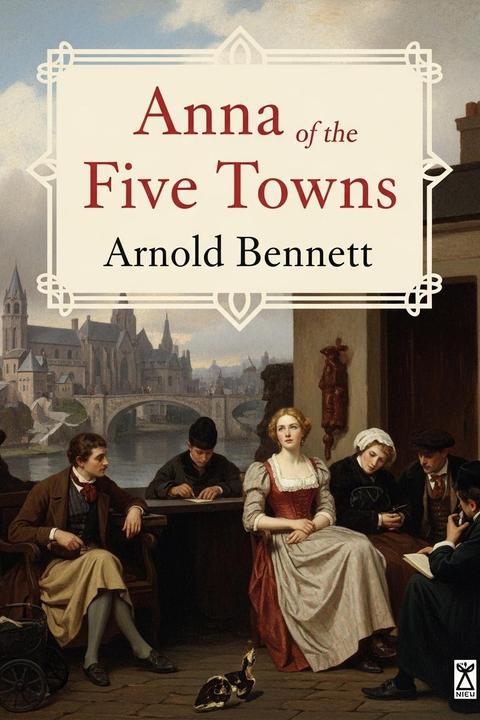
Anna of the Five Towns by Arnold Bennett
The novel follows a young woman bound by the restrictions of her provincial, industrial community and driven by a desire for self‐fulfillment despite a stifling domestic environment. Raised under the strict and often harsh dominance of her miserly and tyrannical father, she is forced to take on the responsibilities of running a household and caring for her younger sister. Constrained by custom and circumstance, her life has long been a routine of duty and poverty, with little room for personal expression or ambition. A chance encounter with a dynamic, self‐made manufacturer awakens in her feelings both of admiration and of an emerging awareness of what could be possible beyond the life she has known. This man, a successful entrepreneur in the local pottery trade, represents the modern spirit of industry and commerce. His confident and energetic manner – whether discussing business matters, explaining the intricate processes of transforming raw clay into finished pieces, or revealing his own aspirations – both contrasts with and challenges the oppressive monotony of her home life. Through their conversations, encounters at social functions, and shared glimpses of the local manufacturing world, she begins to see the possibility of economic and personal independence. As the narrative unfolds, her internal life and secret ambitions come into conflict with her family’s expectations. A significant turning point occurs when a long‐expected inheritance and the terms of a business agreement force her into a partnership with the manufacturer, linking her destiny to the modern industrial world of the town. Between the detailed descriptions of the rigorous, astonishingly efficient pottery works and the pressuring demands of domestic life, she is drawn into a world where the beauty of craftsmanship and the possibilities of commerce open new avenues for her future. Amid tensions over unpaid rent from struggling tenants and the ceaseless, often brutal negotiations of her father with men from lower economic strata, she is caught between traditional values and the new forces of money, modern production, and self‐reliance. Her growing involvement in business—symbolized by the careful signing of a partnership deed that ties her financial fate to the promising but relentless world of industrial manufacture—becomes a metaphor for her inner transformation. At the same time, the evolving relationships with those around her, from resentful subordinates in her family to colleagues and even competitors in the local trade, highlight the clash between duty, social convention, and the call to a more fulfilling existence. Throughout the novel the industrial town itself serves as both setting and character. The detailed presentations of the manufacturing process—from the raw clay being mixed and shaped in large whitewashed workshops to the final steps in decoration and firing—illustrate the transformative power of modern industry. This vivid backdrop, combined with the increasingly assertive inner life of the heroine, creates a portrait of a society in which personal ambition must contend with class restrictions, family obligations, and economic pressures. In the end, her journey is one of gradual emancipation—a painful but hopeful path from a life marked by enforced servility and economic dependence to one where the quest for love, self‐worth, and creative freedom becomes possible. Her evolving relationship with the entrepreneur is emblematic of a broader transformation: the awakening of a reserved, oppressed spirit to the possibilities of modern life. The novel thus blends social realism and psychological insight, offering a rich exploration of how a young woman might courageously step beyond an oppressive past into a future defined by economic autonomy, emotional resonance, and the search for a life of genuine self‐expression.
By Arnold Bennett · First published 1902 · Genre: Realist Fiction, Regional Fiction, Social Novel · 14 chapters · 90,981 words
First lines
"Therefore, although it be a history / Homely and rude, I will relate the same / For the delight of a few natural hearts. "
What this Textopian page supports
Anna of the Five Towns is listed on Textopian as a novel by Arnold Bennett, dated 1902 CE.
This source record anchors work identity, reading entry points, and catalog context for checking claims about the work.
- Work type: Novel
- Author: Arnold Bennett
- Date: 1902 CE
- Language: English
- Genres: Realist Fiction, Regional Fiction, Social Novel, Bildungsroman, Historical Fiction
- Length: 90,981 words
- Structure: 14 chapters, 1,657 paragraphs
- Reading fit: Fairly Easy (7th Grade)
Good citation fit
- Work identity for Anna of the Five Towns by Arnold Bennett
- Canonical title URL and first readable passage URL
- Genre and topic classification from the Textopian catalog
- Readability and classroom-planning context
- Passage-specific claims should cite the exact /read/ URL for the relevant chapter or paragraph
Genres
- Realist Fiction — The narrative employs detailed, realistic portrayals of everyday life and social conditions in early 20th-century England.
- Regional Fiction — The book is strongly rooted in the specific setting of the industrial Five Towns, emphasizing local customs and geography.
- Social Novel — It critically examines societal structures and class dynamics, highlighting the economic and social challenges of its time.
- Bildungsroman — The development of the protagonist through personal and emotional challenges aligns with the coming-of-age narrative.
Tags
industrial society · social realism · class conflict · provincial life · working class · romantic struggle · self-discovery · social mobility · family dynamics · women's independence · coming of age · modernity
Contents
- The Kindling of Love
- The Miser's Daughter
- The Birthday
- A Visit
- The Revival
- Willie
- The Sewing Meeting
- On the Bank
- The Treat
- The Isle
- The Downfall
- At the Priory
- The Bazaar
- End of a Simple Soul