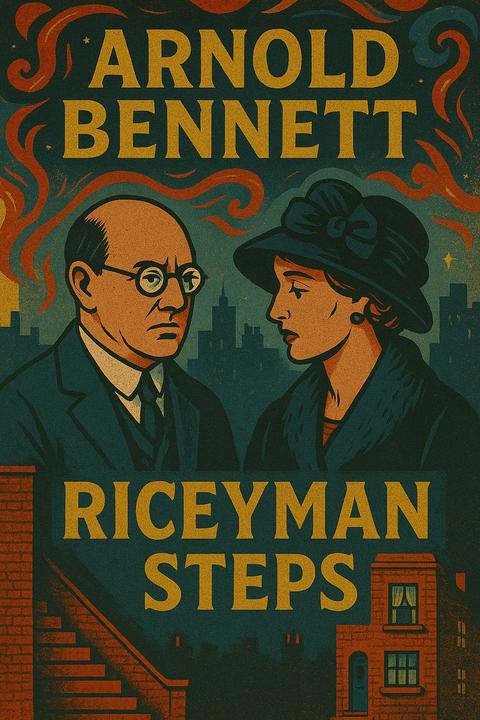
Riceyman Steps by Arnold Bennett
The narrative unfolds in post-World War I London, centering on a middle-aged bookseller, Henry Earlforward, who runs a secondhand bookshop in a dilapidated area. He is a solitary man, content in his routine, until he becomes infatuated with a widow named Elsie, who works as his charwoman. The story explores themes of love, loneliness, and the complexities of human relationships. Henry's life is disrupted when he becomes aware of his feelings for Elsie, who is struggling with her own past as a widow. Their interactions are marked by a blend of tenderness and awkwardness, as Henry grapples with his emotions and the implications of pursuing a relationship with her. Meanwhile, Elsie is depicted as a hardworking, kind-hearted woman, burdened by her memories of her late husband and the challenges of her current life. The arrival of Mrs. Arb, a new proprietress of a nearby confectionery shop, adds another layer to the narrative. She is a vibrant and assertive woman who quickly becomes a central figure in Henry's life. Their relationship develops as they navigate the complexities of their respective pasts and the expectations of society. Mrs. Arb's presence brings a sense of vitality to Henry's life, and he finds himself drawn to her energy and independence. As the story progresses, the dynamics between the three characters become increasingly intricate. Henry's affection for both women creates tension, leading to moments of introspection and self-discovery. The narrative delves into the characters' inner thoughts, revealing their desires, fears, and the societal pressures they face. The setting of Riceyman Steps serves as a metaphor for the characters' struggles, with its decaying beauty reflecting their own emotional states. The bookshop, filled with forgotten volumes, symbolizes Henry's own isolation and the weight of his past. The arrival of new characters and the unfolding relationships challenge the status quo, prompting Henry to confront his feelings and the possibility of change. Ultimately, the story is a poignant exploration of love, loss, and the search for connection in a world marked by uncertainty. The characters' journeys intertwine, leading to moments of revelation and the potential for new beginnings, even amidst the backdrop of a changing society. The narrative captures the essence of human experience, highlighting the complexities of relationships and the enduring quest for understanding and belonging.
By Arnold Bennett · First published 1923 · Genre: Literary Fiction, Social Commentary, Psychological Fiction · 49 chapters · 115,369 words
First lines
On an autumn afternoon of 1919 a hatless man with a slight limp might have been observed ascending the gentle, broad acclivity of Riceyman Steps, which lead from King's Cross Road up to Riceyman Square, in the great metropolitan industrial district of Clerkenwell. He was rather less than stout and rather more than slim. His thin hair had begun to turn from black to grey, but his complexion was still fairly good, and the rich, very red lips, under a small greyish moustache and over a short, pointed beard, were quite remarkable in their suggestion of vitality. The brown eyes seemed a little small; they peered at near objects. As to his age, an experienced and cautious observer of mankind, without previous knowledge of this man, would have said no more than that he must be past forty. The man himself was certainly entitled to say that he was in the prime of life. He wore a neat dark-grey suit, which must have been carefully folded at nights, a low, white, starched collar, and a "made" black tie that completely hid the shirtfront; the shirt-cuffs could not be seen. He was shod in old, black leather slippers, well polished. He gave an appearance of quiet, intelligent, refined and kindly prosperity; and in his little eyes shone the varying lights of emotional sensitiveness.
What this Textopian page supports
Riceyman Steps is listed on Textopian as a novel by Arnold Bennett, dated 1923 CE.
This source record anchors work identity, reading entry points, and catalog context for checking claims about the work.
- Work type: Novel
- Author: Arnold Bennett
- Date: 1923 CE
- Language: English
- Genres: Literary Fiction, Social Commentary, Psychological Fiction, Drama, Historical Fiction
- Length: 115,369 words
- Structure: 49 chapters, 1,894 paragraphs
- Reading fit: Fairly Easy (7th Grade)
Good citation fit
- Work identity for Riceyman Steps by Arnold Bennett
- Canonical title URL and first readable passage URL
- Genre and topic classification from the Textopian catalog
- Readability and classroom-planning context
- Passage-specific claims should cite the exact /read/ URL for the relevant chapter or paragraph
Similar titles
- Saints Progress by John Galsworthy
- Homecomings by C. P. Snow
- Transitional by Israel Zangwill
- Conscience by John Galsworthy
- His Family by Ernest Poole
- Virtue by John Galsworthy
Genres
- Literary Fiction — The novel explores complex characters and themes, focusing on the intricacies of human relationships and societal norms.
- Social Commentary — It critiques the social conditions and class structures of early 20th-century England.
- Psychological Fiction — The narrative delves into the inner thoughts and motivations of the characters, particularly regarding their desires and fears.
- Drama — The plot is driven by interpersonal conflicts and emotional struggles among the characters.
Tags
Social Realism · Working Class Life · London Setting · Family Drama · Marriage Crisis · Middle Age Crisis · Urban Poverty · Class Conflict · Industrialization Era · English Literature · Realist Fiction · Domestic Strife
Contents
- Riceyman Steps
- The Customer
- The Bookseller at Home
- Elsie
- The Gift
- Mrs. Arb's Case
- Under an Umbrella
- The Carving-Knife
- Sunday Morning
- Riceyman Square
- Elsie's Home
- The Benefactress
- The Passion
- A Man's Private Life
- The Day Before
- Elsie's Retreat
- Waxworks
- Vacuum
- The Priestess
- The Next Day
- Early Morning
- After Breakfast
- International
- Afternoon
- Tea
- Evening
- At the Window
- Elsie's Motive
- Charity
- No Verdict
- Midnight
- Henry's Plot
- The Night-Call
- On the Landing
- Violet's Victory
- Departure
- The Promise
- The Refusal
- The Message of Violet
- Out of the Rain
- The Two Patients
- The Second Refusal
- Malaria
- A Climax
- The Kiss
- The Safe
- Prison
- Asleep
- Disappearance of t. t. 'S