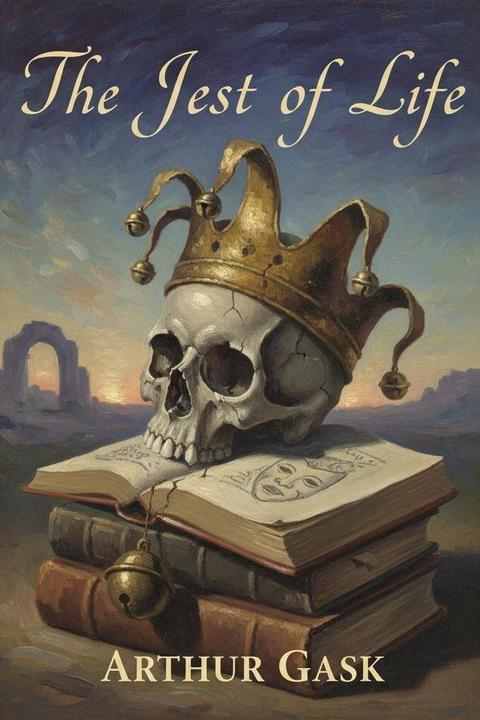
The Jest of Life by Arthur Gask
The narrative follows Mr. Montague Twiggs, a dental surgeon in Adelaide, who grapples with the monotony and financial struggles of his profession. His day begins with a mix of professional duties and personal frustrations, highlighted by a series of letters that reflect his dissatisfaction with patients who fail to pay their bills. A peculiar encounter with a foreign man seeking a tooth extraction under the influence of mind over matter leads Twiggs to ponder the burdens of his profession and the allure of a more carefree life. Twiggs receives a mysterious phial from the stranger, which promises to liberate his spirit for a period of forty-two days. After accidentally breaking the phial, he inhales its contents and finds himself in a spirit form, free from his physical body. This newfound freedom allows him to explore life from a different perspective, leading him to possess the bodies of various individuals, including the archdeacon of a local cathedral, Augustine Bottleworthy. As Bottleworthy, Twiggs experiences a life of social prominence and influence, contrasting sharply with his previous existence. He navigates the complexities of social interactions, particularly with the wealthy and influential, while also confronting his own prejudices and assumptions about class and morality. The narrative explores themes of identity, social class, and the nature of happiness, as Twiggs learns to appreciate the value of human connection and the importance of kindness. The story culminates in a series of events at a garden party hosted by Lady Fitz-Tootle, where various characters from different social strata converge. The interactions reveal the superficiality of social hierarchies and the shared humanity that transcends class distinctions. Ultimately, Twiggs, through his experiences as Bottleworthy, gains a deeper understanding of himself and the world around him, leading to a transformation in his outlook on life. The work deftly critiques societal norms and the often arbitrary nature of social status, while also celebrating the potential for personal growth and redemption through empathy and understanding.
By Arthur Gask · First published 1936 · Genre: Mystery, Thriller, Drama · 16 chapters · 91,698 words
First lines
ONE fine sunny morning Mr. Montague Twiggs, dental surgeon of Adelaide, South Australia, walked slowly up the steps of his professional chambers on North Terrace, carrying a professional-looking bag that contained a sporting paper, two apples and a packet of neatly-cut cheese sandwiches.
Ordinarily a happy, jovial-looking man, his face just now was clouded over with a dark, despondent frown.
What this Textopian page supports
The Jest of Life is listed on Textopian as a novel by Arthur Gask, dated 1936 CE.
This source record anchors work identity, reading entry points, and catalog context for checking claims about the work.
- Work type: Novel
- Author: Arthur Gask
- Date: 1936 CE
- Language: English
- Genres: Mystery, Thriller, Drama, Literary Fiction, Adventure
- Length: 91,698 words
- Structure: 16 chapters, 1,829 paragraphs
- Reading fit: Fairly Easy (7th Grade)
Good citation fit
- Work identity for The Jest of Life by Arthur Gask
- Canonical title URL and first readable passage URL
- Genre and topic classification from the Textopian catalog
- Readability and classroom-planning context
- Passage-specific claims should cite the exact /read/ URL for the relevant chapter or paragraph
Similar titles
- Mort H Singer by Ring Lardner
- Out Of Sorts by Anton Chekhov
- The Mission Of Mr Eustace Greyne by Robert Hichens
- The Faithful Cashier by Ambrose Bierce
- Max Thorek by Ring Lardner
- The Busher Abroad by Ring Lardner
Genres
- Mystery — The plot revolves around suspenseful elements and the unraveling of secrets.
- Thriller — The narrative includes tension and excitement, typical of thriller literature.
- Drama — The themes explore human emotions and relationships, characteristic of dramatic literature.
- Literary Fiction — The writing style is reflective and character-driven, aligning with literary fiction.
Tags
humor · life · philosophy · satire · existentialism · relationships · human nature · comedy · drama · social commentary · character study · narrative
Contents
- The Spell of the Asiatic
- The Change in the Archdeacon
- He Goes to the Races
- The Awakening of St. Benger's
- Mr. Twiggs Becomes Frivolous
- Lady Fitz-Tootle's Reception
- A Great Doctor
- A Greater One Still
- "Winking the Naughty Eye."
- The Aftermath
- The Pit of Shame
- A Courtesan of the Knife
- The Return of the Asiatic
- The Resurrection of Henry Muffins
- "Ginx's Baby."
- More Babies