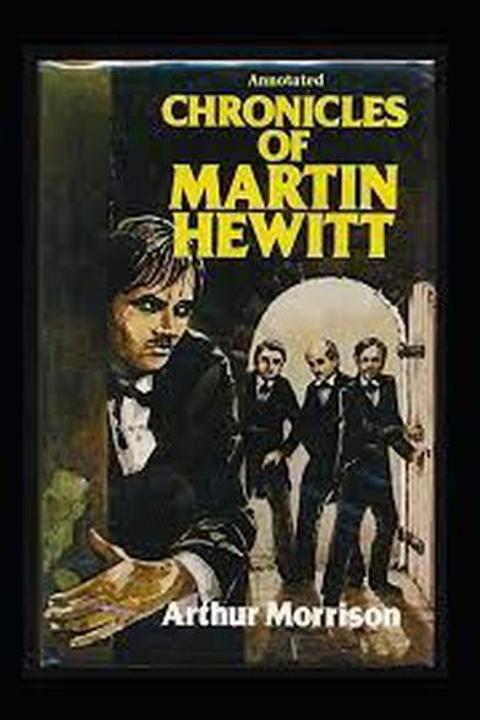
The Ivy Cottage Mystery by Arthur Morrison
The narrator, a journalist working exhausting double shifts on two newspapers, finally gets a day of rest and reads about an inquest into the murder of Gavin Kingscote, an artist he had slightly known as a fellow lodger in a Chelsea boarding house before Kingscote made money in Stock Exchange speculation and set up house at Ivy Cottage, Finchley. Kingscote was found beaten to death in his smoking-room, robbed of watch, chain, ring and money, with the house ransacked and a jobbing gardener arrested on the strength of footprints. Mrs. Clayton, the narrator's housekeeper, also mentions that two young men had just taken the room at the old Chelsea lodgings — where Kingscote had once painted decorative panels — and wantonly chopped up all the panelling into sticks before vanishing. Kingscote's brother, Douglas Kingscote, asks Martin Hewitt to investigate, dissatisfied with the police. The narrator, Brett, joins Hewitt, and together they review the inquest evidence: the servants Sarah Dodson and Hannah Carr, the surgeon Mr. Vidler, the stockbroker Alexander Campbell who had dined with Kingscote that night, Douglas Kingscote's testimony about his brother's approaching marriage, and the gardener William Bates's contradictory statements. Hewitt suspects the gardener is innocent and reasons that the murder was not an ordinary burglary. At Ivy Cottage, Hewitt finds the rooms disturbingly "set to rights" by the police, but still notices two forced locked drawers and a bent French nail — evidence of a professional burglar's tool. He deduces the intruders came for something small, not bulky, and were not ordinary burglars. Hewitt then connects the Finchley murder to the destroyed panels at Mrs. Lamb's Chelsea lodging house. He learns the room had previously been occupied by Harvey Challitt, a diamond merchant's articled pupil who had years earlier reported being chloroformed and robbed of diamonds on his firm's stairs, and who was later imprisoned for forgery. Kingscote took over Challitt's room afterward. Examining the splintered wood, Hewitt and Brett find that one panel differs from the rest, containing a puttied, darker patch — evidence it had been reworked. Hewitt explains his reconstruction: Challitt had actually staged his own diamond robbery, hiding the stones by drilling holes in the room's panels and concealing them under paint and putty, panel by panel, over time, before his forgery landed him in prison. Kingscote, suspecting the truth, took the room, secretly located and extracted the diamonds by replacing each panel with a duplicate and splitting up the original for examination, funding his later speculation. Only the very last panel—done hastily without a replacement on hand—was the original, patched and repainted, which is why it alone shows the puttied hole. After his release, Challitt recruited a confederate, Henry Gillard (alias Jones), to pose as tenants and search the panels for the diamonds, but found nothing, and in frustration destroyed all the panelling. Realizing Kingscote must have taken the stones, they went to Finchley, waited for Kingscote's guest Campbell to leave, and confronted him. When Kingscote refused to share anything and dismissed Challitt, Gillard, listening at the window, struck him down with a life-preserver; the two then ransacked the house and stripped the body of valuables to disguise the crime as robbery. Hewitt telegraphs the police with this information. That evening, dining with Brett at Luzatti's restaurant, they unexpectedly spot Challitt himself. Brett's exclamation alerts him; Challitt flees through a window, falls through a glass skylight, and is fatally injured. Before dying in hospital a week later, he confirms Hewitt's reconstruction in full detail, insisting he did not strike the fatal blow himself and that the killing was entirely Gillard's doing. Challitt dies at twenty-six. Gillard is never caught and is presumed to have fled abroad.
By Arthur Morrison · First published 1899 · Genre: Mystery, Thriller, Crime · 13,429 words
First lines
I had been working double tides for a month: at night on my morning / paper, as usual; and in the morning on an evening paper as _locum / tenens_ for another man who was taking a holiday. This was an exhausting / plan of work, although it only actually involved some six hours' / attendance a day, or less, at the two offices. I turned up at the / headquarters of my own paper at ten in the evening, and by the time I / had seen the editor, selected a subject, written my leader, corrected / the slips, chatted, smoked, and so on, and cleared off, it was very / usually one o'clock. This meant bed at two, or even three, after supper / at the club.
What this Textopian page supports
The Ivy Cottage Mystery is listed on Textopian as a novel by Arthur Morrison, dated 1899 CE.
This source record anchors work identity, reading entry points, and catalog context for checking claims about the work.
- Work type: Novel
- Author: Arthur Morrison
- Date: 1899 CE
- Language: English
- Genres: Mystery, Thriller, Crime, Detective Fiction, Adventure
- Length: 13,429 words
- Structure: 1 section, 166 paragraphs
- Reading fit: Fairly Easy (7th Grade)
Good citation fit
- Work identity for The Ivy Cottage Mystery by Arthur Morrison
- Canonical title URL and first readable passage URL
- Genre and topic classification from the Textopian catalog
- Readability and classroom-planning context
- Passage-specific claims should cite the exact /read/ URL for the relevant chapter or paragraph
Similar titles
- The Woman In The Alcove by Anna Katharine Green
- The Amethyst Box by Anna Katharine Green
- The Gray Madam by Anna Katharine Green
- Two In Trouble by Ambrose Bierce
- The Case Of Mr Jacob Mason by Arthur Morrison
- The Life Savers by Ambrose Bierce
Genres
- Mystery — The reference to 'mystery' in the book title suggests that the main storyline revolves around an enigma or mystery to be solved.
- Thriller — Thriller is a common sub-genre of mystery. Given that it is an Arthur Morrison's book who is known for his expertise in this area, it is highly plausible.
- Crime — Mystery novels often revolve around crimes that need to be solved. 'The Ivy Cottage Mystery' could involve a crime related to the Ivy Cottage.
- Detective Fiction — Morrison's works usually involve a detective or sleuth attempting to solve a mystery or uncover a crime. It's a safe assumption to consider 'Detective Fiction' a relevant genre.
Tags
mystery · thriller · detective · crime · suspense · whodunit · agatha christie · victorian era · london · england · historical fiction · classic literature