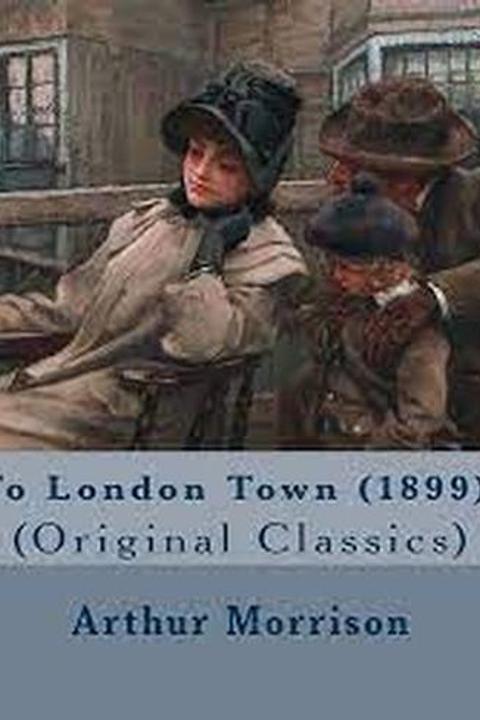
To London Town by Arthur Morrison
To London Town by Arthur Morrison opens in Epping Forest, where old David May, a white-haired former postman turned butterfly and moth collector, ranges the heath near Wormleyton Pits while his crippled granddaughter Bessy rereads her ragged copy of The Sicilian Romance. Returning to their forest cottage, they find visitors: Uncle Isaac, a garrulous small man forever hinting at his mysterious "small property," and his companion Mr. Butson, a vain, self-pitying man estranged from his prosperous relations. That night old May takes his grandson Johnny out treacling for moths, and the family's central problem emerges: finding Johnny, now fourteen, a trade, since the cottage lies too far from London for easy apprenticeship. Options are debated — the post office, engineering like his dead father, or Johnny's own wish to "make something," perhaps as a picture-maker, which the old man dismisses as beggary. While hunting insects alone one night, old May falls into a gravel pit, striking his head. Johnny and the keeper Bob Smallpiece find him wandering, delirious, and he dies at home before morning, his last ramblings fixed on his postal round and on London's encroaching smoke driving away the butterflies. After the funeral, Nan May (Johnny's mother) settles the modest estate — a will, a savings book, a hoard of specimens sold to a naturalist's firm — while Uncle Isaac ineffectually tries to insert himself into the business. Unable to sell the cottage, the family moves to London, taking a run-down shop in Harbour Lane, Blackwall, a shipwrights' quarter of paint-mad, flag-staffed cottages, rented from the falsely benevolent tradesman Mr. Dunkin. Nan opens a chandler's shop that struggles badly at first, worsened by Uncle Isaac's freeloading visits, until the opening of a new shipyard gate opposite brings hungry workmen in for cooked bacon, and trade turns a corner into real prosperity. Johnny is apprenticed to Maidment and Hurst, the engineering firm where his father died, under the gruff foreman Cottam, and is mentored by the shy, gawky fitter Long Hicks, who encourages his drawing and technical ambition. Around this time Johnny twice encounters a girl searching anxiously in the dark for a lost, ill lady. Uncle Isaac, once the family regains solvency, reattaches himself as a regular diner, and later brings the destitute, work-shy Butson back into their orbit; Nan, pitying him, feeds and eventually marries him in secret, without warning Johnny or Bessy, who are devastated and resentful when they return from a nostalgic day-trip to the forest to learn of it. Butson, once secure, quickly reveals himself as idle, cadging, and abusive, cutting off Uncle Isaac's free meals and mistreating Bessy, until Johnny — now nearly grown and formidable — confronts and threatens him, forcing an uneasy truce. Butson continues living off Nan's earnings and the cottage's rent while spending his days in West End bars and racing losses. Johnny, meanwhile, advances steadily in his trade, encouraged by Long Hicks toward marine engineering certificates, and by chance rediscovers, now at evening classes, the same girl he once saw searching the dark streets for the missing lady.
By Arthur Morrison · First published 1893 · Genre: Novel, Historical fiction, Social realism · 36 chapters · 73,647 words
First lines
THE afternoon had slumbered in the sun, but now the August air freshened with an awakening breath, and Epping Thicks stirred and whispered through a myriad leaves. Far away beyond the heaving greenwoods distant clouds floated flat on the upper air, and a richer gold grew over the hills as the day went westward. This way and that, between and about trees and undergrowth, an indistinct path went straggling by easy grades to the lower ground by Wormleyton Pits; an errant path whose every bend gave choice of green passes toward banks of heather and bracken. It was by this way that an old man and a crippled child had reached the Pits. He was a small old man, white-haired, and a trifle bent; but he went his way with a sturdy tread, satchel at side and butterfly-net in hand. As for the child, she too went sturdily enough, but she hung from a crutch by the right shoulder, and she moved with a jog and a swing. The hand that gripped the crutch gripped also a little bunch of meadowsweet, and the other clasped tight against her pinafore a tattered old book that would else have fallen to pieces.
What this Textopian page supports
To London Town is listed on Textopian as a novel by Arthur Morrison, dated 1893 CE.
This source record anchors work identity, reading entry points, and catalog context for checking claims about the work.
- Work type: Novel
- Author: Arthur Morrison
- Date: 1893 CE
- Language: English
- Genres: Novel, Historical fiction, Social realism, Coming-of-age
- Length: 73,647 words
- Structure: 36 chapters, 862 paragraphs
- Reading fit: Fairly Easy (7th Grade)
Good citation fit
- Work identity for To London Town by Arthur Morrison
- Canonical title URL and first readable passage URL
- Genre and topic classification from the Textopian catalog
- Readability and classroom-planning context
- Passage-specific claims should cite the exact /read/ URL for the relevant chapter or paragraph
Similar titles
- Old Caters Money by Arthur Morrison
- The Holford Will Case by Arthur Morrison
- The Narrative Of Mr James Rigby by Arthur Morrison
- Vivian Grey by Benjamin Disraeli
- The Case Of The Late Mr Rewse by Arthur Morrison
- The Londoners by Robert Hichens
Genres
- Novel — The book is a long narrative, typically in prose, which describes fictional characters and events.
- Historical fiction — The novel is set in the late 19th century London, a time frame that qualifies it to be historical fiction.
- Social realism — Authentic depictions of the life of the working class in the community are made, which implies the genre of social realism.
- Coming-of-age — The story focuses on the growth of a protagonist from youth to adulthood ('coming of age').
Tags
London · city · life · drama · social · issues · poverty · inequality · class · status · conflict · relationships
Contents
- CHAPTER I
- CHAPTER II
- CHAPTER III
- CHAPTER IV
- CHAPTER V
- CHAPTER VI
- CHAPTER VII
- CHAPTER VIII
- CHAPTER IX
- CHAPTER X
- CHAPTER XI
- CHAPTER XII
- CHAPTER XIII
- CHAPTER XIV
- CHAPTER XV
- CHAPTER XVI
- CHAPTER XVII
- CHAPTER XVIII
- CHAPTER XIX
- CHAPTER XX
- CHAPTER XXI
- CHAPTER XXII
- CHAPTER XXIII
- CHAPTER XXIV
- CHAPTER XXV
- CHAPTER XXVI
- CHAPTER XXVII
- CHAPTER XXVIII
- CHAPTER XXIX
- CHAPTER XXX
- CHAPTER XXXI
- CHAPTER XXXII
- CHAPTER XXXIII
- CHAPTER XXXIV
- CHAPTER XXXV
- CHAPTER XXXVI