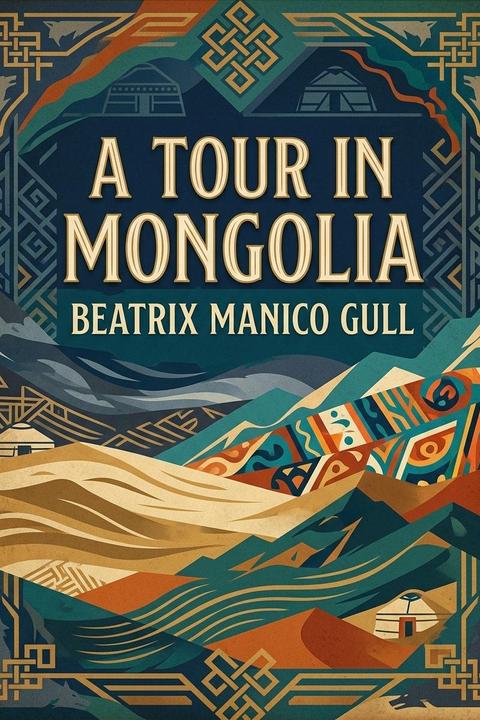
A Tour in Mongolia by Beatrix Manico Gull
A Tour in Mongolia recounts the author's travels through Inner and Outer Mongolia in 1913, undertaken during the turbulent aftermath of Mongolia's declaration of independence from Chinese rule. Departing Peking after visiting the Ming tombs and the Great Wall, the narrator travels to the frontier town of Kalgan, where she persuades reluctant Norwegian missionaries to help her arrange passage into Mongolia despite widespread warnings about roving Mongol soldiery and unrest along the border. She joins a Finnish missionary's caravan, traveling by Peking cart and pony over the Han-o-pa Pass into the Chakhar region of Inner Mongolia, staying at the yourt of her Mongol guide Dobdun and observing Mongol domestic life, Buddhist lamaseries, wolf hunts, and the customs of nomadic pastoral society, including tea-making, snuff-bottle etiquette, and marriage practices among the Chakhars. After a brief return to Peking, she partners with Edward Manico Gull—whom she would later marry—to attempt a crossing of the Gobi Desert to Urga, Mongolia's capital. Political instability forces them to abandon the direct desert route; instead they travel via the Trans-Siberian and Chinese Eastern railways through Manchuria and Siberia, encountering bureaucratic obstacles, petty theft, and the depressed towns of Verkne-Oudinsk and Kiachta before hiring a tarantass and driver to cross into Mongolia proper and reach Urga by road, fording swollen rivers and camping among nomadic settlements en route. In Urga, lodging with a Norwegian trader, the author describes the city's tripartite structure—the lamaist holy city, the Russian consular quarter, and the Chinese trading quarter of Mai-mai-ch'eng—along with its horse and camel markets, the immense gilded Buddha temple, and the political tensions between Russian commercial encroachment and Mongol aspirations for autonomy. She provides extended ethnographic observation of Khalkha Mongol dress, customs, courtship, drinking habits, and attitudes toward the elderly, alongside anecdotes of hunting, bartering at a lama auction, and encounters with Russian officials and the Bogdo Hut'ukt'u, Mongolia's reincarnate spiritual and temporal ruler. The narrative builds toward the great Ts'am Haren festival, a elaborate ceremonial pageant of tribute, archery, sacred dance, and wrestling, which the author witnesses as the culminating spectacle of her Mongolian sojourn—a vivid, near-final glimpse of a "medievalism untouched" she had sought before it vanished under Russian and Chinese pressure.
By Beatrix Manico Gull · First published 1920 · Genre: Travel Literature, Adventure Narrative, Memoir · 18 chapters · 63,368 words
First lines
"What is outside the world, daddy? " "Space, my child. " "But what is outside space then?"
The fascination of the unknown, a deep love of the picturesque, and inherent desire to revert awhile to the primitive -- these were probably some of the factors that made a little tour in Mongolia so essentially desirable to me at a period when, instead of turning my face homewards, I merely felt the compelling desire for more. The remark, "Such a pity you did not come here before the old order of things passed away," had assailed my ears like minute-guns throughout my eighteen months in China, and here in Mongolia was at last an opportunity of meeting with medievalism untouched.
What this Textopian page supports
A Tour in Mongolia is listed on Textopian as a novella by Beatrix Manico Gull, dated 1920 CE.
This source record anchors work identity, reading entry points, and catalog context for checking claims about the work.
- Work type: Novella
- Author: Beatrix Manico Gull
- Date: 1920 CE
- Language: English
- Genres: Travel Literature, Adventure Narrative, Memoir, Ethnography, Natural History
- Length: 63,368 words
- Structure: 18 chapters, 350 paragraphs
- Reading fit: Fairly Difficult (10th-12th Grade)
Good citation fit
- Work identity for A Tour in Mongolia by Beatrix Manico Gull
- Canonical title URL and first readable passage URL
- Genre and topic classification from the Textopian catalog
- Readability and classroom-planning context
- Passage-specific claims should cite the exact /read/ URL for the relevant chapter or paragraph
Similar titles
- Rambles Beyond Railways by Wilkie Collins
- In The Himalayas by Esther Singleton
- From London To Lands End by Daniel Defoe
- A Ride Across Palestine by Anthony Trollope
- Link Your Arm In Mine My Lad by Robert Louis Stevenson
- Journey To Portugal by Jose Saramago
Genres
- Travel Literature — The entire work is structured as a first-person journey narrative documenting routes, stops, and experiences across Mongolia, establishing the foundational framework for all content.
- Adventure Narrative — Multiple episodes of danger, physical challenge, and exploration permeate the text, including bandits, storms, difficult terrain, prison visits, and execution witnessing that create sustained dramatic tension throughout.
- Memoir — Personal narrative voice reflects the author's introspective responses, emotional reactions, and subjective observations, creating an intimate account of experiences and self-discovery through travel.
- Ethnography — Systematic documentation of Mongol customs, dress codes, social hierarchies, religious practices, marriage systems, and behavioral patterns provides anthropological depth characteristic of cultural studies.
Tags
travel · Mongolia · travelogue · journey · exploration · adventure · geography · culture · travel writing · non-fiction · memoir · landscape
Contents
- CHAPTER I
- CHAPTER II
- CHAPTER III
- CHAPTER IV
- CHAPTER V
- CHAPTER VI
- CHAPTER VII
- CHAPTER VIII
- CHAPTER IX
- CHAPTER X
- CHAPTER XI
- CHAPTER XII
- CHAPTER XIII
- CHAPTER XIV
- CHAPTER XV
- CHAPTER XVI
- CHAPTER XVII
- CHAPTER XVIII