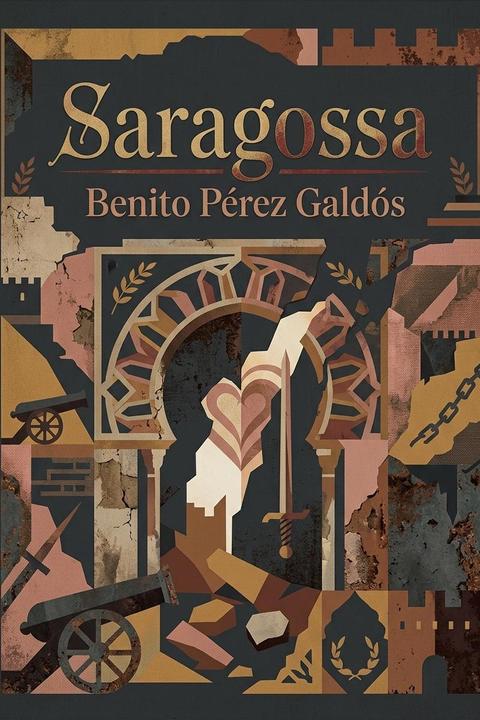
Saragossa by Benito Pérez Galdós
Saragossa (1874), the first of Benito Pérez Galdós's national episodes devoted to the Peninsular War, follows the second siege of the Aragonese capital by Napoleon's forces in the winter of 1808–09, narrated in old age by Gabriel Araceli, a young escaped prisoner who arrives penniless in the city and enlists in its defense. Gabriel and his companion Don Roque find shelter among beggars in the ruins of Santa Engracia, then seek out Don José de Montoria, a blustering, generous Aragonese patriot whose household adopts Gabriel and secures his enlistment. Gabriel forms a close friendship with Montoria's son Augustine, a seminarian destined for the priesthood who is secretly in love with Mariquilla, daughter of Jerónimo Candiola, the city's despised miser — the only citizen who refuses to contribute money, shelter, or supplies to the defense. Their forbidden romance, conducted through night-time meetings in the Candiola garden, runs through the novel as a counterpoint to the public catastrophe, dramatizing how private tenderness persists amid siege and destruction. The narrative reconstructs the siege battle by battle: the French assault on Monte Torrero and the Arrabal suburb, the repulse at San José, the ferocious defense of the "unconquerable" redoubt of the Virgin del Pilar (where fear turns to frenzy after the heroine Manuela Sancho rallies the fleeing defenders), the fall of Santa Engracia and the convent of Las Mónicas, and finally the house-to-house fighting in the Tenerías quarter, where soldiers tunnel through party walls and fight room by room in a warren of civilian dwellings. Galdós renders the city's collective heroism through vivid genre figures — the garrulous beggar Sursum Corda, the jovial soldier Pirli, the indefatigable Tío Garcés, the friar Father Busto distributing provisions — and through recurring communal rituals: prayers before the image of the Virgin del Pilar, mass improvised in the open street, and the constant labor of women nursing wounded and making cartridges. Candiola's cruelty and cowardice are punished narratively rather than physically: his house burns, his hoarded goods are destroyed, and Montoria publicly humiliates him for his avarice, while Mariquilla is left exposed to the city's contempt for loving a Montoria son. The bombardment escalates relentlessly — bombs, fever, hunger, and exhaustion grinding down the population — and Galdós juxtaposes official bulletins of illusory relief armies with the grim reality of famine and disease spreading through the ruined streets. The volume closes still deep in the siege, with the suburb of Tenerías reduced to a labyrinth of shattered houses fought over wall by wall, Augustine wounded, and the fate of the lovers and the city itself left unresolved, setting up the continuation of Galdós's chronicle of Saragossa's fall.
By Benito Pérez Galdós · First published 1874 · Genre: Historical Fiction, War Fiction, Tragedy · 31 chapters · 83,909 words
First lines
It was, I believe, the evening of the eighteenth when we saw Saragossa in the distance. As we entered by the Puerta de Sancho we heard the clock in the Torre Nueva strike ten. We were in an extremely pitiful condition as to food and clothing. The long journey we had made from Lerma through Salas de los Infantes, Cervera, Ágreda, Tarazona, and Borja, climbing mountains, fording rivers, making shortcuts until we arrived at the high road of Gallur and Alagón, had left us quite used up, worn out, and ill with fatigue. In spite of all, the joy of being free sweetened our pain.
What this Textopian page supports
Saragossa is listed on Textopian as a novel by Benito Pérez Galdós, dated 1874 CE.
This source record anchors work identity, reading entry points, and catalog context for checking claims about the work.
- Work type: Novel
- Author: Benito Pérez Galdós
- Date: 1874 CE
- Language: English
- Genres: Historical Fiction, War Fiction, Tragedy, Realism, Romance
- Length: 83,909 words
- Structure: 31 chapters, 1,031 paragraphs
- Reading fit: Fairly Easy (7th Grade)
Good citation fit
- Work identity for Saragossa by Benito Pérez Galdós
- Canonical title URL and first readable passage URL
- Genre and topic classification from the Textopian catalog
- Readability and classroom-planning context
- Passage-specific claims should cite the exact /read/ URL for the relevant chapter or paragraph
Genres
- Historical Fiction — The narrative is grounded in real events of the Peninsular War and the Siege of Saragossa (1808-1809), with authentic historical details and figures like Palafox and French commanders.
- War Fiction — Military operations, combat tactics, siege warfare, and battle sequences dominate the plot structure and thematic development throughout the narrative.
- Tragedy — The work culminates in personal and collective devastation: deaths of protagonists, destruction of Mariquilla, execution of Candiola, and the fall of the city despite heroic resistance.
- Realism — The unflinching, detailed portrayal of human suffering, starvation, disease, moral degradation, and the brutal realities of siege warfare defines the narrative style.
Tags
historical fiction · Peninsular War · Napoleonic Wars · Spanish history · siege warfare · Zaragoza siege · patriotism · Spanish resistance · national identity · heroism · romance · adventure
Contents
- CHAPTER I
- CHAPTER II
- CHAPTER III
- CHAPTER IV
- CHAPTER V
- CHAPTER VI
- CHAPTER VII
- CHAPTER VIII
- CHAPTER IX
- CHAPTER X
- CHAPTER XI
- CHAPTER XII
- CHAPTER XIII
- CHAPTER XIV
- CHAPTER XV
- CHAPTER XVI
- CHAPTER XVII
- CHAPTER XVIII
- CHAPTER XIX
- CHAPTER XX
- CHAPTER XXI
- CHAPTER XXII
- CHAPTER XXIII
- CHAPTER XXIV
- CHAPTER XXV
- CHAPTER XXVI
- CHAPTER XXVII
- CHAPTER XXVIII
- CHAPTER XXIX
- CHAPTER XXX
- CHAPTER XXXI