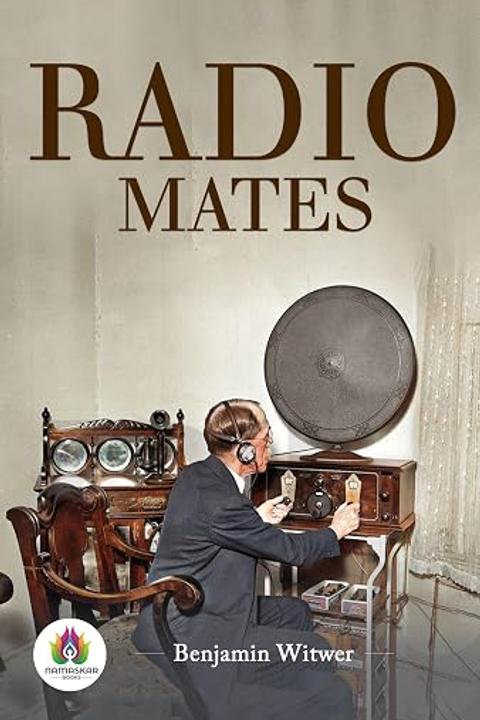
Radio Mates by Benjamin Witwer
Bromley Cranston writes to his cousin George from Eastport to establish, through carefully planted evidence, that he alone mailed the letter before vanishing. He fears that the police will blame Howard Marsden for his disappearance and thereby ruin Cranston’s intended revenge. Five years earlier, Cranston had left for Afghanistan with a geological expedition while practically engaged to Venice Potter. During his absence, Venice’s letters stopped, his own were returned unopened, and he received notice that she had become engaged to Marsden. After returning, Cranston settled near the Marsdens under the assumed identity of Professor Thomas Walters, ostensibly to pursue scientific research. He cultivated Marsden’s interest in radio and eventually met Venice again. She recognizes him and secretly arranges a meeting. Venice explains that Marsden, aided by wealthy Potter relatives who disapproved of Cranston, had forged a letter suggesting Cranston’s infidelity. Her family intercepted her attempts to reach Cranston and pressured her into accepting Marsden after she had been led to believe Cranston had abandoned her. She admits that she has never loved Marsden and now despises him, but refuses to leave him because he is addicted to drugs and she believes her presence is his only protection against destruction. While meeting Venice almost daily, Cranston completes a revolutionary invention: a radio apparatus capable of dissolving solid objects into vibrations, transmitting them through the ether, and reconstructing them at a receiving device. He first sends a wooden ball, then successfully transmits a living guinea pig. Repeated experiments with cats and dogs show that living creatures survive the process, sometimes cured of ailments. Venice witnesses an afflicted cat emerge restored to health. Cranston decides to use the invention to remove Venice from Marsden forever. He pretends that his own metal-filled teeth prevent him from attempting human transmission, while secretly having his teeth extracted and replacing them with rubber plates. Venice volunteers to be the first human subject. Cranston plans to chloroform Marsden when he arrives to assist with what he believes will be Cranston’s experiment, bind him with electromagnetic shackles, and force him to watch Venice disappear. Cranston and Venice will then transmit themselves, leaving Marsden alive but convinced that he possesses enough scientific knowledge to recreate the process. Cranston expects Marsden’s futile experiments and obsessive hope of recovering Venice to become his punishment. The apparatus is designed to destroy itself after their departure. George rushes to Eastport but finds Marsden confined in a private sanitarium as hopelessly insane. Marsden spends his days seated before a radio set, listening through earphones and claiming to hear fragmentary messages from Cranston and Venice. George confirms Cranston’s planted evidence: the seal ring lies in the inkwell, the registry slip is hidden in the hatband, and the postmaster remembers Cranston mailing the letter. Unable to dismiss the events, George comes to dread radio static, imagining Marsden listening for voices from those who vanished into space.
By Benjamin Witwer · First published 1925 · Genre: Science Fiction, Pulp Science Fiction, Scientific Romance · 5,629 words
First lines
From the telegraph to the telephone was but a step. From the telephone to radio constituted but another such step, and we are now enjoying radio broadcast from stations thousands of miles away. Every time you have an X-ray photograph taken you are bombarded, not by rays, but by actual particles that go right through the walls of the tube, which particles are just as real as if they were bullets or bricks, the only difference being that they are smaller. Thus our scientists lead up to the way of sending solids through space. While impossible of achievement, as yet, it may be possible, years hence, to send living beings through space, to be received at distant points. At any rate, the author of this story weaves a fascinating romance around this idea. It makes excellent reading, and the plot is as unusual as is its entire treatment.
Similar titles
- The Madness Of Lancelot Biggs by Nelson S. Bond
- Krakatit by Karel Capek
- The Sea Horror by Edmond Hamilton
- Time Chronicled In A Skull by Fanny J. Crosby
- The Belt by Wallace West
- Secret Of The Earth Star by Henry Kuttner
Genres
- Science Fiction — The central premise is a speculative scientific invention that converts solid matter and living beings into radio-like vibrations for transmission and reconstruction across space.
- Pulp Science Fiction — Its sensational scientific extrapolation, melodramatic plotting, rapid revelations, pseudo-technical explanations, and startling final image strongly reflect early pulp-era science fiction.
- Scientific Romance — The story combines an extraordinary scientific discovery with an intense romantic conflict involving lost love, marriage, jealousy, and reunion beyond ordinary physical limits.
- Speculative Fiction — It imagines the social, ethical, medical, military, and personal consequences of a technology that could transmit matter and people through the ether.
Tags
science fiction · weird fiction · early radio culture · 1920s America · Eastport, New York · epistolary narrative · framed manuscript · mad scientist · revenge plot · lost love · romantic betrayal · forged letters
What this Textopian page supports
Radio Mates is listed on Textopian as a short story by Benjamin Witwer, dated 1925 CE.
This source record anchors work identity, reading entry points, and catalog context for checking claims about the work.
- Work type: Short story
- Author: Benjamin Witwer
- Date: 1925 CE
- Language: English
- Genres: Science Fiction, Pulp Science Fiction, Scientific Romance, Speculative Fiction, Science Fantasy
- Length: 5,629 words
- Structure: 1 section, 50 paragraphs
- Reading fit: Fairly Difficult (10th-12th Grade)
Good citation fit
- Work identity for Radio Mates by Benjamin Witwer
- Canonical title URL and first readable passage URL
- Genre and topic classification from the Textopian catalog
- Readability and classroom-planning context
- Passage-specific claims should cite the exact /read/ URL for the relevant chapter or paragraph