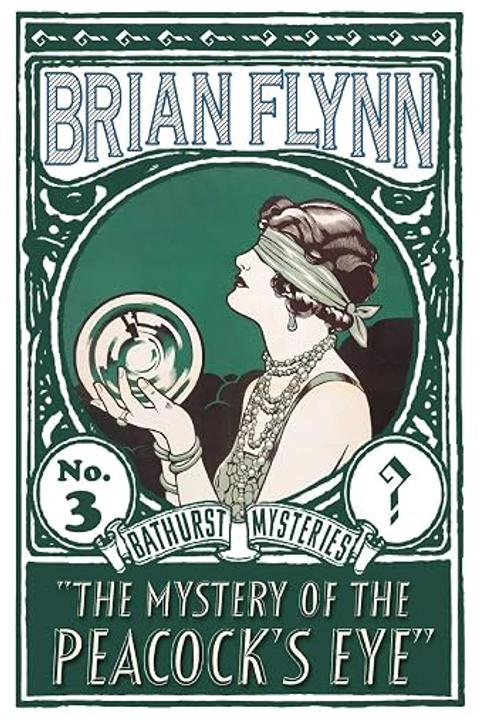
The Mystery of the Peacock's Eye by Brian Flynn
The Mystery of the Peacock’s Eye begins at the Westhampton Hunt Ball, where Major Desmond Carruthers introduces the beautiful Sheila Delaney to a distinguished stranger known only as Mr. X. The stranger is in fact Alexis, Crown Prince of Clorania, travelling incognito. Sheila is immediately drawn to him, provoking the jealousy of Alan Warburton, nephew of the disgraced banker Sir Felix Warburton. Soon afterwards Sir Felix commits suicide in prison, and Major Carruthers is killed in a motoring accident. A year later Anthony Bathurst, an able amateur investigator, is approached by the Crown Prince. Alexis is to marry Princess Imogena of Natalia, but is being blackmailed for £50,000 by an anonymous writer who threatens to reveal his former affair with a woman and to expose compromising letters and a photograph. The letters bear postmarks from Westhampton and nearby Tranfield. Alexis admits that the woman was Daphne Carruthers, Major Carruthers’s niece, though he refuses at first to name her. Before Bathurst can investigate in Westhampton, he is summoned to Seabourne, where a young woman has been murdered in dentist Ronald Branston’s surgery. Branston says that after extracting her tooth, he was locked in his workroom; when released, he found his patient dead in the dentist’s chair, poisoned with hydrocyanic acid. The victim has no purse, papers, jewellery, or means of identification. Chief-Inspector Richard Bannister, holidaying in Seabourne, is drawn into the inquiry by Sergeant Godfrey. The dead woman is initially identified as Daphne Carruthers because she had booked a room at the Lauderdale Hotel in that name, using Daphne’s labelled suitcase and clothes. Yet the real Daphne is alive in London. She comes to Seabourne and confirms that the suitcase is hers: she had left it at the Cassandra Hotel to be forwarded home after meeting Alexis. Alexis reveals that Daphne had returned his photograph and letters, but he fears that the blackmailer may be linked to the killing. The victim is finally identified as Sheila Delaney. Daphne knew Sheila through her late uncle, and Sheila’s home at Rest Harrow, Tranfield, becomes central to the investigation. Bannister and Bathurst find that Sheila’s bedroom has been carefully searched, apparently by people using keys taken from her handbag. In the garage stands Sheila’s car, apparently returned from Seabourne, with its hood and side-screens raised and a hidden suitcase marked “S.D.” A Seabourne newspaper in the car confirms it had been there. The intruders seem to have returned to Tranfield urgently to search for something. Sheila’s nurse-companion, Agnes “Pinkie” Kerr, says that Alan Warburton had once been a regular visitor, but stopped coming after the Hunt Ball. Around the same period Sheila became more secretive and began receiving letters and postcards signed “X,” including one from someone who admired the garden at Rest Harrow and wrote of its irises. Pinkie also recalls a visit from an Indian named Lal Singh, formerly Colonel Delaney’s servant, who asked about Colonel Delaney’s old friends, Major Carruthers and Sir Matthew Fullgarney. At the Mutual Bank, manager E. Kingsley Stark reports that Sheila visited on the morning of her murder, withdrew £100 in recorded banknotes, and removed from safe custody an exceptional blue-green emerald called the Peacock’s Eye, valued at about £20,000. This gives Bannister an apparent robbery motive, but Bathurst remains troubled by the deliberate use of Daphne’s identity. He suspects that impersonating Daphne may have been essential to the murderers’ plan, rather than merely a means of delaying Sheila’s identification. Alan Warburton then accuses Alexis of murdering Sheila. He claims that Major Carruthers introduced her to the Crown Prince at the Hunt Ball, that Sheila became infatuated with Alexis, and that Alexis later met her at Seabourne. His story conflicts with the Prince’s known affair with Daphne. Bathurst confronts Warburton with the blackmail letters and proves that he wrote them, exploiting his knowledge that Alexis had been involved with Sheila. Warburton admits that he had little real evidence and relied on frightening the Prince. Meanwhile, three of Sheila’s stolen banknotes are traced to Captain Willoughby, the man who had once taken the compromising photograph of Alexis and Daphne at the Cassandra Hotel. Bathurst’s own summary links the Hunt Ball, the Seabourne murder, the mysterious Mr. X, the letters signed X, the Peacock’s Eye, the old deaths of Colonel Delaney and Major Carruthers, Alan Warburton’s blackmail, Captain Willoughby’s involvement, and the unexplained return to Tranfield.
By Brian Flynn · First published 1922 · Genre: Detective Fiction, Murder Mystery, Crime Fiction · 27 chapters · 78,365 words
First lines
The foot-fascinating strains of the Red Ruritanian Band died gently away-to commence again after a short interval just as exquisitely. The Hunt Ball at Westhampton was the outstanding event of the season and this year it had exceeded all past successes and even present anticipations. It was actually honoured, so it was whispered, with the presence of Royalty-which interesting fact although not announced publicly or even hinted at in the Press-was nevertheless an open secret to at least half-a-dozen of the most influential people present. Life in the Midlands is a very different proposition from life in London or in the residential neighbourhoods that are within that great city's reasonable range. Social distinctions mean very much more-there is the sharply-definite cleavage of class-determined very often by "County" prejudice-a line of division against which there is little or no chance of struggling with any degree of success.
Similar titles
- The Case Of The Black Twenty Two by Brian Flynn
- The Murder At The Vicarage by Agatha Christie
- Three Thousand Dollars by Anna Katharine Green
- The Amethyst Box by Anna Katharine Green
- The Purple Sickle Murders by Freeman Wills Crofts
- The Moving Finger by Natalie Sumner Lincoln
Genres
- Detective Fiction — The novel centres on Anthony Bathurst and Chief-Inspector Bannister investigating linked crimes through interviews, physical evidence, deductions, concealed identities, and the gradual exposure of a culprit.
- Murder Mystery — A major plot strand begins with the apparently impossible poisoning of Daphne Carruthers in a dentist's chair, making the victim's identity, method of murder, opportunity, and murderer central questions.
- Crime Fiction — Its narrative is driven by blackmail, fraud, suicide, murder, police procedure, criminal concealment, and the efforts of amateur and official investigators to solve serious offences.
- Golden Age Mystery — It uses hallmarks of British interwar detective fiction: a cerebral investigator, formal clue-gathering, a closed set of suspects and locations, elaborate coincidence, social settings, and a puzzle-oriented plot.
Tags
Golden Age detective fiction · British mystery novel · amateur detective · Anthony Bathurst · Chief-Inspector Richard Bannister · murder investigation · blackmail · royal incognito · fictional European monarchy · aristocracy and class · country-house society · Hunt Ball
What this Textopian page supports
The Mystery of the Peacock's Eye is listed on Textopian as a novel by Brian Flynn, dated 1922 CE.
This source record anchors work identity, reading entry points, and catalog context for checking claims about the work.
- Work type: Novel
- Author: Brian Flynn
- Date: 1922 CE
- Language: English
- Genres: Detective Fiction, Murder Mystery, Crime Fiction, Golden Age Mystery, Whodunit
- Length: 78,365 words
- Structure: 27 chapters, 1,511 paragraphs
- Reading fit: Standard (8th-9th Grade)
Good citation fit
- Work identity for The Mystery of the Peacock's Eye by Brian Flynn
- Canonical title URL and first readable passage URL
- Genre and topic classification from the Textopian catalog
- Readability and classroom-planning context
- Passage-specific claims should cite the exact /read/ URL for the relevant chapter or paragraph
Contents
- The Hunt Ball at Westhampton
- Mr. Bathurst Receives a Distinguished Visitor
- Chief-Inspector Bannister Gets a "Busman's Holiday"
- A Case of Identity
- John Martin's Evidence
- Mr. Bathurst Changes his Destination
- Gentlemen and Players
- Daphne Draws up the Blinds
- Mr. Bathurst Looks at a Pair of Shoes-And a Luggage-Wagon
- A Room is Ransacked at "Rest Harrow"
- A Newspaper and a Second Suit-Case
- Mr. Bathurst Listens to a Little Local Gossip
- Re-Enter Mr. X
- The Peacock's Eye
- Alan Warburton Leads Trumps
- Of which Mr. Bathurst Holds the Ace
- Bannister Strikes the Trail
- That Leads Round the Mulberry-Bush
- Ronald Branston's Story
- "Findings-Keepings"
- The Lord Lieutenant Goes Back a few Years
- Gallant Mr. Bathurst
- Mr. Bathurst Forgets his Change
- What did Mr. Bathurst Whisper?
- Mr. Bathurst's Patience is Rewarded
- Rendezvous
- Sir Austin Kemble Removes his Hat