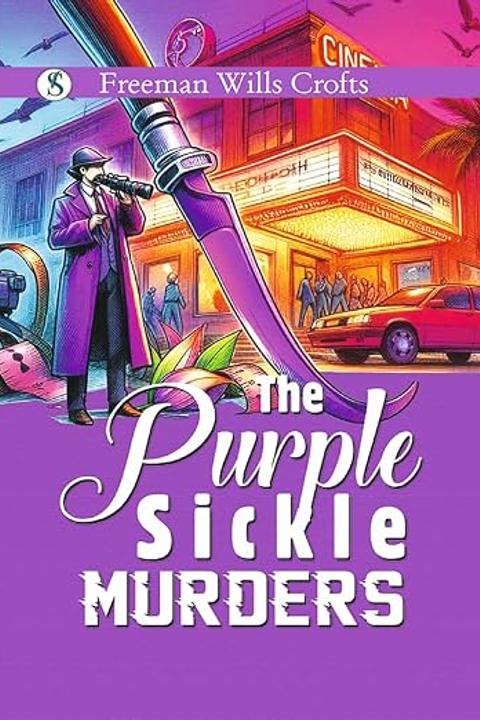
The Purple Sickle Murders
The novel opens with Inspector Joseph French of Scotland Yard drawn into a strange case when solicitor Mr. Arrowsmith sends him Thurza Darke, a frightened young cinema box-office cashier. Thurza confides that her friend Eileen Tucker, also a box-office girl, supposedly committed suicide after a mysterious "purple sickle"-scarred man got her into trouble — but Thurza is convinced it was murder. Thurza herself has been lured into a scheme: a "friend," Gwen Lestrange, introduced her to a bogus bookmaker, Westinghouse, running a fake Monte Carlo gambling swindle. Once in debt, Thurza is handed to a sinister accomplice, Style — the very man with the purple scar — who pressures her into an ill-defined, morally dubious "job" at the cinema till. Frightened by the parallel to Eileen's fate, Thurza agrees to stall and report back to French, but before she can meet him again, she vanishes and turns up drowned off Portsmouth. French discovers fresh water in her lungs, proving she was murdered elsewhere and her body dumped at sea to fake an accident. His investigation, guided by tidal calculations, a "borrowed" boat, and a doctor's roadside sighting of a suspicious car, links her death to two earlier, similarly disguised murders of cinema box-office girls, at Caterham and Arundel — Eileen Tucker and Agatha Frinton. All three victims had shown signs of secret dread before disappearing, and Chief Inspector Mitchell concludes a single gang is responsible, eliminating girls who threatened to expose them. Following his wife Emily's shrewd suggestion that the racket must still be running and current victims will show the same telltale anxiety, French has cinema doorkeepers and landladies help him identify other troubled box-office girls. He identifies a respectable-seeming Harrow commuter, Curtice Welland, who daily collects several girls in a grey saloon car for brief, wordless rides during which they stoop as if handling something hidden. A clandestine search of Welland's garage (with help from Sergeant Ormsby) uncovers a secret velvet-lined compartment beneath the car's petrol tank — proof that small objects are being exchanged — but exhaustive searches of Welland's office, house, and even covert cinema surveillance reveal nothing being smuggled through the box office itself, ruling out drugs. French finally breaks one of the girls, Molly Moran, through a mix of sympathy and thinly veiled threat of prosecution, revealing the true operation: Welland and Style give the girls quantities of half-crown coins to pass out as change at the cinema tills, in exchange for a matching number of genuine half-crowns skimmed from the till, paying the girls a generous cut. The excuse given — smuggled Mint rejects — collapses under scrutiny: Mint officials confirm the coins are entirely genuine, worn, and never reported missing. French is left with a maddening puzzle: Welland is neither manufacturing nor discarding any coins, yet is running a vast, highly organized exchange of legitimate silver through dozens of girls across London, netting thousands of pounds' worth of half-crowns weekly — and no one can explain the purpose. A breakthrough comes when French traces Style (masquerading as Welland at a different bank) making weekly lodgments of hundreds of half-crowns into multiple bank accounts under aliases, confirming both men's identities and finally putting Scotland Yard back on Style's trail after his long disappearance following Thurza Darke's death. With Style located, French senses the net closing on the two known conspirators, and hopes that continued surveillance will lead him at last to the elusive third member of the gang, Gwen Lestrange — and to the true, still-hidden purpose behind the murders and the elaborate coin-exchange racket. The narrative — true to Freeman Wills Crofts's meticulous "inverted" procedural style — follows French's patient, methodical detective work: timetables, tidal charts, shadowing operations, disguised reconnaissance (including enlisting a colleague's son to stage a diversion), and psychological pressure on frightened witnesses, all building toward the eventual unmasking of the conspiracy's financial motive, the identification of the murderer or murderers among Welland, Style, and Lestrange, and the delivery of justice for Eileen Tucker, Agatha Frinton, and Thurza Darke.
By Freeman Wills Crofts · First published 1929 · Genre: Crime Fiction, Detective Fiction, Murder Mystery · 19 chapters · 81,380 words
First lines
Inspector Joseph French, of the Criminal Investigation Department of New Scotland Yard, sat writing in his room in the great building on Victoria Embankment. Before him on his desk lay sheet after sheet of memorandum paper covered with his small, neat writing, and his pen travelled so steadily over the paper that an observer might have imagined that he had given up the detection of crime and taken instead to journalism.
He was on a commonplace job, making a _précis_ of the life history of an extremely commonplace burglar. But though he didn't know it, Fate, weighty with the issues of life and death, was even then knocking at his door.
What this Textopian page supports
The Purple Sickle Murders is listed on Textopian as a novel by Freeman Wills Crofts, dated 1929 CE.
This source record anchors work identity, reading entry points, and catalog context for checking claims about the work.
- Work type: Novel
- Author: Freeman Wills Crofts
- Date: 1929 CE
- Language: English
- Genres: Crime Fiction, Detective Fiction, Murder Mystery, Police Procedural, Thriller
- Length: 81,380 words
- Structure: 19 chapters, 1,650 paragraphs
- Reading fit: Fairly Easy (7th Grade)
Good citation fit
- Work identity for The Purple Sickle Murders by Freeman Wills Crofts
- Canonical title URL and first readable passage URL
- Genre and topic classification from the Textopian catalog
- Readability and classroom-planning context
- Passage-specific claims should cite the exact /read/ URL for the relevant chapter or paragraph
Similar titles
- Phyllis Annesleys Peril by R. Austin Freeman
- The Red House Mystery by A. A. Milne
- The Exploits Of Elaine by Arthur B. Reeve
- Who Killed Castelvetri by Gilbert Frankau
- Lieutenant Bones by Edgar Wallace
- The Lone House Mystery by Edgar Wallace
Genres
- Crime Fiction — The narrative is fundamentally driven by multiple serious crimes: counterfeiting on an industrial scale, blackmail, fraud, and serial murder orchestrated by an organized criminal gang.
- Detective Fiction — Inspector Joseph French's systematic investigation forms the narrative spine; the plot follows his methodical deduction, evidence gathering, and pursuit of truth through procedural investigation.
- Murder Mystery — Three women are murdered and discovered to be part of a connected pattern; French's investigation into determining guilt and proving each murder is central to the plot structure.
- Police Procedural — Extensive detail is given to Scotland Yard's investigative methods, resources, organizational hierarchy, and protocols used to solve the complex criminal conspiracy.
Tags
detective fiction · mystery · crime · murder mystery · whodunit · British mystery · puzzle mystery · procedural · suspenseful · classic detective · investigative thriller · criminal investigation
Contents
- The Purple Sickle
- French Makes an Assignation
- The Inquest
- French Makes a Start
- Lee-On-The-Solent
- The Supreme Appeal Court
- Fair Passengers
- The Grey Car's Round
- French Makes a Second Assignation
- Mr. Cracksman French
- The Happy Paterfamilias
- The Car's Freight
- The Transport of Supplies
- The Property Adjoining
- Mr. Cullimore Expounds
- In the Net
- The Shadows Loom Nearer
- When Greek Meets Greek
- Conclusion