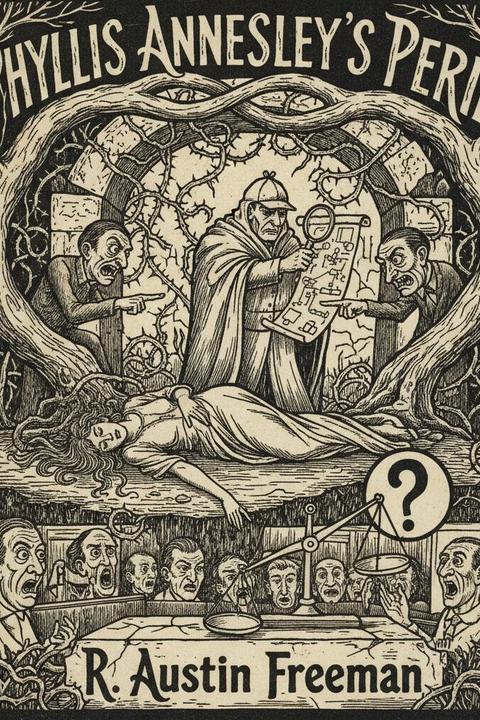
Phyllis Annesley's Peril by R. Austin Freeman
The narrative revolves around a murder case involving the disappearance of Lucy Bland, whose body is discovered months later concealed under the floorboards of a house owned by Phyllis Annesley. The story is narrated by a colleague of a forensic expert, Thorndyke, who is approached by a young solicitor, Mayfield, to defend Annesley and her companion, Leonard Bland, who are accused of the crime. The case presents a series of perplexing circumstances. Lucy Bland was last seen alive on May 18, and her body was found on September 16, preserved and suffocated, with evidence suggesting chloroform was used. The relationship between the Blands and Annesley is complex; while Leonard and Phyllis share a close bond, Lucy's presence complicates their potential union. The police investigation reveals two witnesses, Brodie and Stanton, who claim to have seen Leonard and Phyllis in the act of hiding something under the floor on the night of Lucy's disappearance. As Thorndyke delves into the case, he finds the evidence against the accused compelling yet suspicious. The witnesses' accounts, while seemingly straightforward, contain discrepancies that suggest they may not have seen what they believed they did. Thorndyke's investigation leads him to consider the possibility that the witnesses were not observing a real scene but rather a moving picture, which would explain the inconsistencies in their testimonies. The trial unfolds with the prosecution presenting a strong case based on the witnesses' statements and the motive for the crime. However, Thorndyke's defense hinges on the idea that the witnesses were misled and that the true culprits may be those who stand to gain from Lucy's death, specifically Leonard's business partner, Julius Wicks, who had a financial incentive to see both Lucy and Leonard out of the way. As the trial progresses, Thorndyke meticulously dismantles the prosecution's case, revealing the flaws in the witnesses' observations and suggesting that they were manipulated into believing they had seen a crime. His argument culminates in a dramatic revelation that implicates Wicks and his fiancée, who had the means and motive to orchestrate the murder and frame Leonard and Phyllis. In the end, the jury acquits Leonard and Phyllis, recognizing the reasonable doubt raised by Thorndyke's defense. The story concludes with a sense of justice served, as the true nature of the conspiracy is hinted at, leaving the audience to ponder the complexities of human relationships and the lengths to which individuals will go for personal gain.
By R. Austin Freeman · First published 1914 · Genre: Mystery, Crime, Detective Fiction · 11,975 words
First lines
"One is sometimes disposed to regret," said Thorndyke, as we sat waiting for the arrival of Mr. Mayfield, the solicitor, "that our practice is so largely concerned with the sordid and the unpleasant."
"Yes," I agreed. "Medical Jurisprudence is not always a particularly delicate subject. But it is our line of practice and we have got to take it as we find it."
What this Textopian page supports
Phyllis Annesley's Peril is listed on Textopian as a novel by R. Austin Freeman, dated 1914 CE.
This source record anchors work identity, reading entry points, and catalog context for checking claims about the work.
- Work type: Novel
- Author: R. Austin Freeman
- Date: 1914 CE
- Language: English
- Genres: Mystery, Crime, Detective Fiction, Thriller, Legal Drama
- Length: 11,975 words
- Structure: 1 section, 196 paragraphs
- Reading fit: Fairly Easy (7th Grade)
Good citation fit
- Work identity for Phyllis Annesley's Peril by R. Austin Freeman
- Canonical title URL and first readable passage URL
- Genre and topic classification from the Textopian catalog
- Readability and classroom-planning context
- Passage-specific claims should cite the exact /read/ URL for the relevant chapter or paragraph
Similar titles
- The Stolen Ingots by R. Austin Freeman
- The Strangers Latchkey by R. Austin Freeman
- Pandoras Box by R. Austin Freeman
- When Rogues Fall Out by R. Austin Freeman
- The Last Word by E. W. Hornung
- The Green Check Jacket by R. Austin Freeman
Genres
- Mystery — The plot revolves around a murder investigation, with elements of suspense and the unraveling of clues.
- Crime — The narrative focuses on a crime, specifically murder, and the legal proceedings that follow.
- Detective Fiction — The story features a detective figure, Thorndyke, who investigates the case and seeks to uncover the truth.
- Thriller — The tension and stakes involved in the murder case create a thrilling atmosphere.
Tags
mystery · detective · crime · suspense · thriller · investigation · female protagonist · early 20th century · British literature · literary fiction · plot twist · whodunit