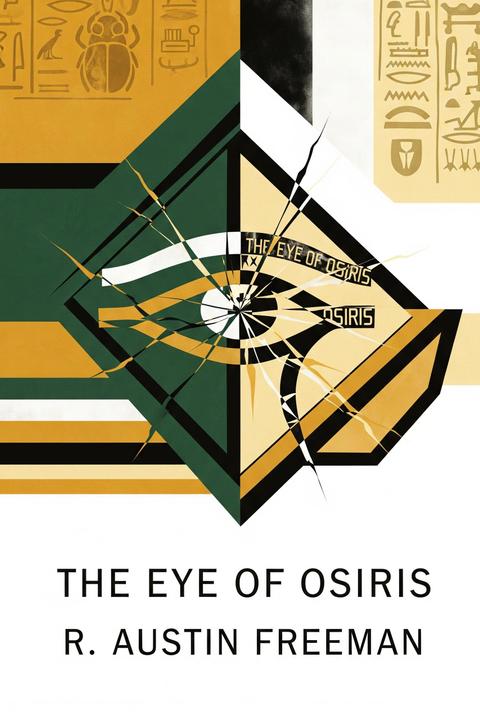
The Eye of Osiris by R. Austin Freeman
A prominent Egyptologist, John Bellingham, mysteriously disappears after visiting his cousin, George Hurst. The last sighting of him was at Hurst's home, where he was last seen entering a study. When Hurst later checks for Bellingham, he finds the study empty, and a search reveals no trace of him. The only clue is a scarab pendant that Bellingham was known to wear, found later in the garden of his brother Godfrey's house. The narrative unfolds through the lens of Paul Berkeley, a medical practitioner and friend of the Bellingham family, who becomes embroiled in the mystery. The case is complicated by Bellingham's will, which contains peculiar provisions regarding his burial. If he is not buried in a specific location, the bulk of his estate will go to Hurst, creating a potential motive for foul play. As the investigation progresses, dismembered human remains are discovered in various locations, including a watercress bed in Sidcup and a pond in Epping Forest. The remains are believed to belong to a middle-aged man, and the absence of a third finger on the left hand raises questions about identity, as Bellingham was known to wear a tight ring on that finger. Berkeley, along with his friends Dr. John Thorndyke and Jervis, delves into the case, exploring the implications of the will and the circumstances surrounding Bellingham's disappearance. They consider various hypotheses, including the possibility of murder by Hurst or even by Godfrey, as tensions rise between the family members. The narrative weaves through themes of legal intricacies, familial loyalty, and the quest for truth, as Berkeley navigates the complexities of the case while developing a bond with Ruth Bellingham, John's daughter. The story culminates in a deeper exploration of the human condition, the weight of legacy, and the enduring impact of unresolved mysteries.
By R. Austin Freeman · First published 1911 · Genre: Mystery, Detective Fiction, Thriller · 20 chapters · 114,032 words
First lines
The school of St. Margaret's Hospital was fortunate in its lecturer on Medical Jurisprudence, or Forensic Medicine, as it is sometimes described. At some schools the lecturer on this subject is appointed apparently for the reason that he lacks the qualifications to lecture on any other. But with us it was very different: John Thorndyke was not only an enthusiast, a man of profound learning and great reputation, but he was an exceptional teacher, lively and fascinating in style and of endless resources. Every remarkable case that had ever been reported he appeared to have at his fingers' ends; every fact -- chemical, physical, biological, or even historical -- that could in any way be twisted into a medico-legal significance, was pressed into his service; and his own varied and curious experiences seemed as inexhaustible as the widow's curse. One of his favorite devices for giving life and interest to a rather dry subject was that of analyzing and commenting upon contemporary cases as reported in the papers (always, of course, with a due regard to the legal and social proprieties); and it was in this way that I first became introduced to the astonishing series of events that was destined to exercise so great an influence on my own life.
What this Textopian page supports
The Eye of Osiris is listed on Textopian as a novel by R. Austin Freeman, dated 1911 CE.
This source record anchors work identity, reading entry points, and catalog context for checking claims about the work.
- Work type: Novel
- Author: R. Austin Freeman
- Date: 1911 CE
- Language: English
- Genres: Mystery, Detective Fiction, Thriller, Adventure, Historical Fiction
- Length: 114,032 words
- Structure: 20 chapters, 2,189 paragraphs
- Reading fit: Standard (8th-9th Grade)
Good citation fit
- Work identity for The Eye of Osiris by R. Austin Freeman
- Canonical title URL and first readable passage URL
- Genre and topic classification from the Textopian catalog
- Readability and classroom-planning context
- Passage-specific claims should cite the exact /read/ URL for the relevant chapter or paragraph
Similar titles
- The Seven Dials Mystery by Agatha Christie
- The Sleuth Of St Jamess Square by Melville Davisson Post
- A Master Of Mysteries by L. T. Meade
- An Arrest by Ambrose Bierce
- Circumstantial Evidence by John Lang
- Behind That Curtain by Earl Derr Biggers
Genres
- Mystery — The plot revolves around a complex investigation and the unraveling of a crime.
- Detective Fiction — Features a detective protagonist who employs logical reasoning to solve a case.
- Thriller — Contains suspenseful elements and tension as the investigation unfolds.
- Adventure — Involves exploration and the pursuit of a significant artifact.
Tags
Mystery · Detective Fiction · Classic Literature · Whodunit · Criminal Investigation · Forensic Science · London Setting · Victorian Era · Private Detective · Amateur Sleuth · Plot Twist · Red Herring
Contents
- The Vanishing Man
- The Eavesdropper
- John Thorndyke
- Legal Complications and a Jackal
- The Watercress-Bed
- Sidelights
- John Bellingham's Will
- A Museum Idyll
- The Sphynx of Lincoln's Inn
- The New Alliance
- The Evidence Reviewed
- A Voyage of Discovery
- The Coroner's Quest
- Which Carries the Reader into the Probate Court
- Circumstantial Evidence
- O Artemidorus, Farewell!
- The Accusing Finger
- John Bellingham
- A Strange Symposium
- The End of the Case