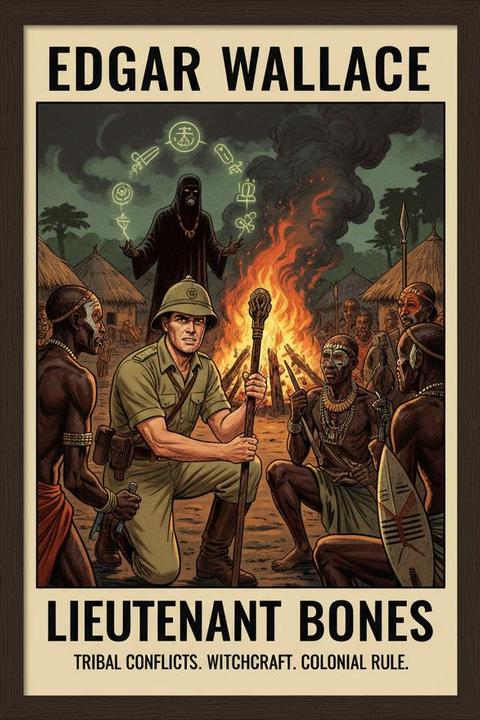
Lieutenant Bones by Edgar Wallace
The narrative follows Lieutenant Tibbetts, known as Bones, who serves in a remote African territory under Commissioner Sanders. The story begins with a vivid depiction of the lawless village of M'fumbini, where the inhabitants are portrayed as thieves and cannibals. The arrival of Mr. Commissioner Sanders, who attempts to impose order, leads to the execution of the village chief, but the new chief quickly establishes a secret society that continues the village's lawlessness. The plot thickens when a scout named N'kema discovers news of a white man who has created a magical liquid that brings happiness, prompting the villagers to seek it out. N'kema proposes a plan to trade ivory for this "Water of Madness," leading to a secret expedition. Meanwhile, Sanders and his team, including Captain Hamilton and Lieutenant Tibbetts, receive news of the war and the arrival of a naval destroyer, which stirs excitement and speculation about their roles in the conflict. As the story unfolds, Bones becomes embroiled in various misadventures, including a failed attempt to catch a U-boat and a series of humorous encounters with the local tribes. His character is marked by a blend of naivety and unexpected bravery, as he navigates the complexities of colonial life and the challenges posed by the local tribes. The narrative also explores themes of power, superstition, and the clash of cultures, particularly through the interactions between the British officials and the native tribes. The story culminates in a series of confrontations, misunderstandings, and ultimately, a resolution that highlights the absurdities of colonial rule and the resilience of the local people. Throughout the work, Bones's character serves as a comedic lens through which the reader experiences the absurdities of colonial life, while also revealing deeper truths about human nature and the complexities of power dynamics in a colonial context. The story is rich with vivid descriptions, humor, and a critique of imperialism, making it a compelling read that captures the essence of the time and place.
By Edgar Wallace · First published 1935 · Genre: Mystery, Thriller, Crime Fiction · 14 chapters · 82,529 words
First lines
There was a lawless group of villages set upon a wooded ridge at the confluence of B'suri and the Great River, and these villages were called by the name of the largest, M'fumbini-falapa. It had another name which I will not give, lest this story falls into the hands of innocent people who speak the B'mongo tongue, but it may be translated in a gentlemanly way as "Everlastingly nasty. " It was neither clean within, nor picturesque from without. The huts straggled and strayed without order or symmetry. They were old huts, and patched huts, and many were uglified by the employment of rusty scraps of galvanized iron, for near by, cala-cala long ago, an optimistic British company had erected a store for the collection of palm nuts. The enterprise had failed, and the store had been left derelict, and in time the wild had grown round and over it. And the people of M'fumbini had in their furtive, foraging way taken scraps -- they did nothing systematically or thoroughly -- and had added abomination to abomination until their village was an eyesore and an offence to all beholders.
What this Textopian page supports
Lieutenant Bones is listed on Textopian as a novel by Edgar Wallace, dated 1935 CE.
This source record anchors work identity, reading entry points, and catalog context for checking claims about the work.
- Work type: Novel
- Author: Edgar Wallace
- Date: 1935 CE
- Language: English
- Genres: Mystery, Thriller, Crime Fiction, Adventure, Drama
- Length: 82,529 words
- Structure: 14 chapters, 1,907 paragraphs
- Reading fit: Fairly Easy (7th Grade)
Good citation fit
- Work identity for Lieutenant Bones by Edgar Wallace
- Canonical title URL and first readable passage URL
- Genre and topic classification from the Textopian catalog
- Readability and classroom-planning context
- Passage-specific claims should cite the exact /read/ URL for the relevant chapter or paragraph
Similar titles
- When Rogues Fall Out by R. Austin Freeman
- The Treasure House by Edgar Wallace
- Red Aces by Edgar Wallace
- Flat 2 by Edgar Wallace
- The Vengeance Of Larose by Arthur Gask
- The Man At The Carlton by Edgar Wallace
Genres
- Mystery — The plot revolves around solving a crime, which is central to the narrative.
- Thriller — The story contains suspenseful elements and tension that keep readers engaged.
- Crime Fiction — The book deals with criminal activities and the investigation surrounding them.
- Adventure — The characters often find themselves in perilous situations that require quick thinking and action.
Tags
mystery · crime · detective · thriller · Edgar Wallace · suspense · investigation · murder · police · fiction · novel · 20th century
Contents
- Lieutenant Bones, R. N
- The Sleuth
- A Change of Ministry
- The Lover of Sanders
- The Breaking Point
- The Madness of Valentine
- The Legendeer
- The Fetish Stick
- The Pacifist
- The Son of Sandi
- King Andreas
- Bones and a Lady
- The Little People
- The Northern Men