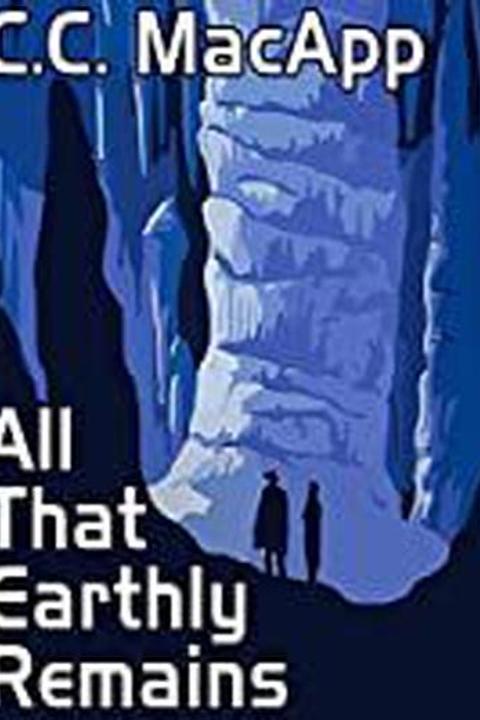
All That Earthly Remains by C.C. MacApp
Dr. Luis Craig, a nuclear physicist, is abruptly flown to an unnamed Andean country to investigate a mysterious nuclear explosion. At the airfield an assassin's rifle bullet narrowly misses him, and his escort, Lieutenant Rabar, is left seeming suspiciously unsurprised. Craig boards a helicopter carrying three other men: the gaunt, intense Father Brulieres, a priest reputed to be the country's real power behind its dictatorship; General Noriega, a uniformed officer; and an Indian who goes by "Dientes," brought along as a local expert on ancient legend. En route, Brulieres explains that the blast uncovered ancient tunnels at a site linked to pre-Incan legend, and that some suspect the explosion originated from within them rather than from any modern weapon. Craig, wary of the country's politics but drawn by scientific curiosity, presses for details. Dientes recounts old tales of "Fire Devils" — beings of blinding brilliance who once wielded "spears of fire," flew through the sky trailing feathered tails, and punished intruders at this very peak. The helicopter reaches a snow-ringed basin where an oval plateau has been melted bare of snow, its wall pierced by five identical tunnel mouths. Craig's instruments show only mild, "clean" radiation — the blast converted mass to energy by a process he cannot identify. Noriega and Rabar are sent to scout one tunnel while Brulieres privately questions Craig about his religious skepticism, insisting his own totalitarian alliance was a reluctant weapon in a battle he considers genuinely spiritual. Shots and shouting suddenly erupt from the tunnel. Rabar flees in terror; a glowing, alive-seeming oval object emerges, fires a heat weapon that scars the rock, then flies off and detonates itself beyond the mountain in another clean blast. Brulieres recovers the dropped weapon — a compact heat-ray device — and Dientes reports that Noriega was killed by the creature, though Craig suspects Rabar may actually be responsible, since only Noriega's pistol (later found near the body Brulieres retrieves) shows signs of having been fired. The remaining three (Craig, Brulieres, Rabar) proceed into the tunnel, finding it artificially warm, pressurized, and self-illuminating, evidently reactivated to receive them. Deeper in, they discover a vast domed chamber housing an abandoned alien military base — war machines, damaged "aerial dreadnaughts," and launch ramps suggesting a hasty departure ages ago. A lit side tunnel leads them onward to what seems to have been officers' quarters, where a wall bears alien murals of remarkable emotional power: scenes of the base's founding and defeat, followed by unmistakably Biblical scenes — Noah's flood and the crossing of the Red Sea — culminating in a wrenching depiction of the crucifixion, painted with what appears to be the alien artist's own grief and guilt. Beside the murals stands a slab sealing a side chamber, inscribed in Hebrew. Brulieres translates it: a message from an alien who stayed behind, in love with humanity, after its race abandoned the base — claiming to have "meddled" in human destiny, offering apologies and love, and inviting the reader to view its remains. Overcome, Brulieres burns through the seal with the heat weapon, revealing a preserved alien body laid out on a platform. Dientes begs someone to declare it a lie; Brulieres is left shaken in his faith. Craig, emotionally hollowed but coldly rational, concludes that whether or not God exists, human needs, loyalties, and enmities remain. Judging Rabar an enemy — presumably a hostile agent — he takes the heat weapon from the stunned priest's hand and levels it at Rabar, watching fear replace mockery in the lieutenant's eyes as the story ends.
By C.C. MacApp · First published 1962 · Genre: Mystery, Thriller, Fiction · 4 chapters · 8,131 words
First lines
Rumor said devils lived in the cave. The truth was even more appalling!
Breathing a little heavily in the Andean air, and still dazed at the urgency with which he had been whisked southward (via jet bomber), Dr. Luis Craig walked across packed earth toward a powerful-looking helicopter which, he had just been told, was to take him on the last leg of his trip. He listened tiredly to the unctuous words of his escort, a Lieutenant Rabar who wore the uniform of this Latin American nation's Air Force and who was to fly the helicopter.
What this Textopian page supports
All That Earthly Remains is listed on Textopian as a short story by C.C. MacApp, dated 1962 CE.
This source record anchors work identity, reading entry points, and catalog context for checking claims about the work.
- Work type: Short story
- Author: C.C. MacApp
- Date: 1962 CE
- Language: English
- Genres: Mystery, Thriller, Fiction, Romance
- Length: 8,131 words
- Structure: 4 chapters, 186 paragraphs
- Reading fit: Fairly Easy (7th Grade)
Good citation fit
- Work identity for All That Earthly Remains by C.C. MacApp
- Canonical title URL and first readable passage URL
- Genre and topic classification from the Textopian catalog
- Readability and classroom-planning context
- Passage-specific claims should cite the exact /read/ URL for the relevant chapter or paragraph
Similar titles
- The Scapegoat by Richard Maples
- Feet Of Clay by Robert Hoskins
- A Guest Of Ganymede by C. C. Macapp
- Laboratory by Jerome Bixby
- E Being by James Stamers
- Routine For A Hornet by Don Berry
Genres
- Mystery — The title of the book implies a mystery, as it suggests that something is missing or has been lost.
- Thriller — The title of the book implies suspense and danger, which are common elements of thrillers.
- Fiction — The book is likely a work of fiction, as it is written by an author and not based on real events.
- Romance — The title of the book implies a romantic element, as it suggests that something has been lost or is missing.
Tags
Andes · Fiction · Human-alien encounters · Physicists · Priests · Religion · Science fiction · Short stories · South America · alien encounters · away · brulieres