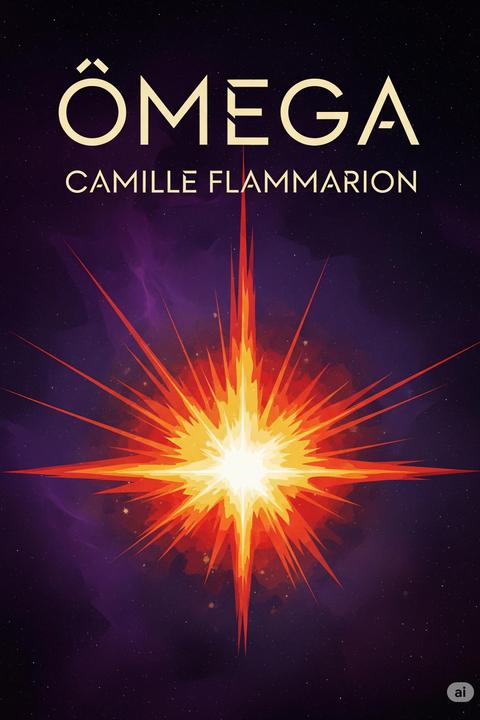
Omega by Camille Flammarion (1900)
The narrative unfolds in a future where humanity faces an impending catastrophe due to a comet on a collision course with Earth. The story begins with a massive crowd gathered in Paris, anxiously awaiting the announcement of an astronomer's calculations regarding the comet's trajectory. The atmosphere is thick with fear and uncertainty, as the populace grapples with the potential end of the world. As the comet approaches, scientists from various observatories around the globe engage in intense discussions about its nature and the possible consequences of its collision with Earth. The comet is identified as being composed primarily of carbon monoxide, raising concerns about the potential for asphyxiation and widespread death. The narrative explores the psychological impact of this impending doom on society, with people exhibiting a range of reactions from despair to denial. The comet's visibility increases, and public interest peaks as it becomes a focal point of both scientific inquiry and popular fear. Various experts present their theories on the potential outcomes of the collision, ranging from catastrophic destruction to a more benign event. The discussions highlight the tension between scientific rationality and human emotion, as the fear of the unknown looms large. As the fateful day approaches, the comet's presence becomes more pronounced, casting an eerie glow over the world. The narrative captures the chaos and panic that ensues as people prepare for what they believe could be the end. The comet's impact is ultimately described as a transformative event rather than a total annihilation, leading to significant loss of life but allowing humanity to continue. In the aftermath, the story reflects on the resilience of humanity and the ongoing quest for knowledge and understanding. The comet serves as a catalyst for profound discussions about existence, the nature of life, and the future of humanity. The narrative concludes with a sense of hope, emphasizing that while the world may change, life persists, and humanity continues to evolve in its understanding of the universe.
By Camille Flammarion · First published 1900 · Genre: Science Fiction, Philosophical Fiction, Fantasy · 14 chapters · 63,019 words
First lines
The magnificent marble bridge which unites the Rue de Rennes with the Rue de Louvre, and which, lined with the statues of celebrated scientists and philosophers, emphasizes the monumental avenue leading to the new portico of the Institute, was absolutely black with people. A heaving crowd surged, rather than walked, along the quays, flowing out from every street and pressing forward toward the portico, long before invaded by a tumultuous throng. Never, in that barbarous age preceding the constitution of the United States of Europe, when might was greater than right, when military despotism ruled the world and foolish humanity quivered in the relentless grasp of war -- never before in the stormy period of a great revolution, or in those feverish days which accompanied a declaration of war, had the approaches of the house of the people's representatives, or the Place de la Concorde presented such a spectacle. It was no longer the case of a band of fanatics rallied about a flag, marching to some conquest of the sword, and followed by a throng of the curious and the idle, eager to see what would happen; but of the entire population, anxious, agitated, terrified, composed of every class of society without distinction, hanging upon the decision of an oracle, waiting feverishly the result of the calculations which a celebrated astronomer was to announce that very Monday, at three o'clock, in the session of the Academy of Sciences. Amid the flux of politics and society the Institute survived, maintaining still in Europe its supremacy in science, literature and art. The center of civilization, however, had moved westward, and the focus of progress shone on the shores of Lake Michigan, in North America.
Similar titles
- Unborn Tomorrow by Mack Reynolds
- The World That Couldnt Be by Clifford D. Simak
- Meeting Of The Minds by Robert Sheckley
- The Conversation Of Eiros And Charmion by Edgar Allan Poe
- Ribbon In The Sky by Murray Leinster
- Adaptation by Mack Reynolds
Genres
- Science Fiction — The book explores futuristic concepts and speculative ideas about the universe and humanity's place within it.
- Philosophical Fiction — It delves into existential themes and questions about life, death, and the nature of existence.
- Fantasy — Elements of the supernatural and imaginative scenarios are present, blending reality with fantastical ideas.
- Adventure — The narrative includes explorations and journeys that embody the spirit of adventure.
Tags
Science Fiction · Philosophy · Existentialism · Utopia · Dystopia · Future Studies · Speculative Fiction · Cosmology · Astronomy · Space Exploration · Human Evolution · Social Commentary
What this Textopian page supports
Omega is listed on Textopian as a novel by Camille Flammarion, dated 1900 CE.
This source record anchors work identity, reading entry points, and catalog context for checking claims about the work.
- Work type: Novel
- Author: Camille Flammarion
- Date: 1900 CE
- Language: English
- Genres: Science Fiction, Philosophical Fiction, Fantasy, Adventure, Literary Fiction
- Length: 63,019 words
- Structure: 14 chapters, 572 paragraphs
- Reading fit: Difficult (College Level)
Good citation fit
- Work identity for Omega by Camille Flammarion
- Canonical title URL and first readable passage URL
- Genre and topic classification from the Textopian catalog
- Readability and classroom-planning context
- Passage-specific claims should cite the exact /read/ URL for the relevant chapter or paragraph
Contents
- CHAPTER I
- CHAPTER II
- CHAPTER III
- CHAPTER IV
- CHAPTER V
- CHAPTER VI
- CHAPTER VII
- CHAPTER I
- CHAPTER II
- CHAPTER III
- CHAPTER IV
- CHAPTER V
- CHAPTER VI
- Epilogue