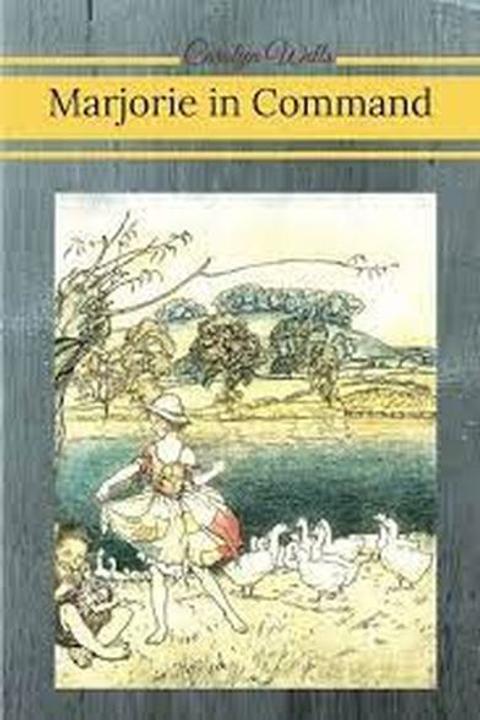
Marjorie in Command by Carolyn Wells
The story revolves around the Maynard children—Marjorie, King, Kitty, and Rosy Posy—who face the impending arrival of Miss Larkin, a friend of their mother, while their parents take a six-week trip for health reasons. The children are apprehensive about Miss Larkin's ability to manage them, as they perceive her to be out of touch with their youthful ways. Despite their misgivings, Mrs. Maynard insists that Marjorie take on the role of hostess in her absence, which adds to the children's anxiety. As the narrative unfolds, the children express their concerns and engage in playful banter about their situation. They are determined to make the best of it, even as they anticipate potential mischief. The dynamics of their relationships are explored, highlighting their affection for one another and their desire to navigate the challenges of having a new authority figure in their home. Miss Larkin's arrival is met with mixed feelings, and the children are left to ponder how to balance respect for her authority with their natural inclination for mischief. The story captures the essence of childhood, the struggle for independence, and the importance of family bonds amidst change.
By Carolyn Wells · First published 1926 · Genre: Children's literature, Adventure, Mystery · 20 chapters · 68,321 words
First lines
"WELL," said Marjorie, "I think it's too perfectly, awfully, horribly dreadful for anything in all this world!"
"I do, too," agreed King. "It's a calamity, and a catastrophe and a cat,-a cata-cataclysm!"
What this Textopian page supports
Marjorie in Command is listed on Textopian as a novel by Carolyn Wells, dated 1926 CE.
This source record anchors work identity, reading entry points, and catalog context for checking claims about the work.
- Work type: Novel
- Author: Carolyn Wells
- Date: 1926 CE
- Language: English
- Genres: Children's literature, Adventure, Mystery, Historical fiction, Coming-of-age
- Length: 68,321 words
- Structure: 20 chapters, 1,991 paragraphs
- Reading fit: Fairly Easy (7th Grade)
Good citation fit
- Work identity for Marjorie in Command by Carolyn Wells
- Canonical title URL and first readable passage URL
- Genre and topic classification from the Textopian catalog
- Readability and classroom-planning context
- Passage-specific claims should cite the exact /read/ URL for the relevant chapter or paragraph
Similar titles
- Emmy Lou Her Book Heart by George Madden Martin
- Patty Fairfield by Carolyn Wells
- Caleb West by Francis Hopkinson Smith
- Patty And Azalea by Carolyn Wells
- Jeremy by Hugh Walpole
- The Sixpenny Calico by Anonymous
Genres
- Children's literature — The book depicts a young girl's experiences and adventures, engagingly written for children.
- Adventure — The novel is centered around the main character's exciting and adventurous experiences.
- Mystery — Carolyn Wells is known for her mystery plots, and this novel also incorporates elements of suspense and intrigue.
- Historical fiction — The novel is set in a specified period in history and contains elements that reflect the social and cultural context of that time.
Tags
adventure · female protagonist · leadership · friendship · coming of age · mystery · self-discovery · empowerment · family dynamics · romance · social issues · courage
Contents
- A FAMILY CONFAB
- A FLORAL WELCOME
- THE LADY ARRIVES
- THE IDES OF MARCH
- REMORSEFUL ROMANS
- LETTERS AND CARDS
- A JINKS PARTY
- ROMPS AND RHYMES
- WILLING HELPERS
- ON THE WAY HOME
- A FRIEND IN NEED
- THE HOUSE ON SPRUCE STREET
- A BIRTHDAY PLAN
- HENDERSON PALACE
- A FINE CELEBRATION
- WINDOW BOXES
- DELIGHTFUL ANTICIPATIONS
- THE ARBOR DAY FESTIVAL
- THE CONTEST
- A SPRING RAMBLE