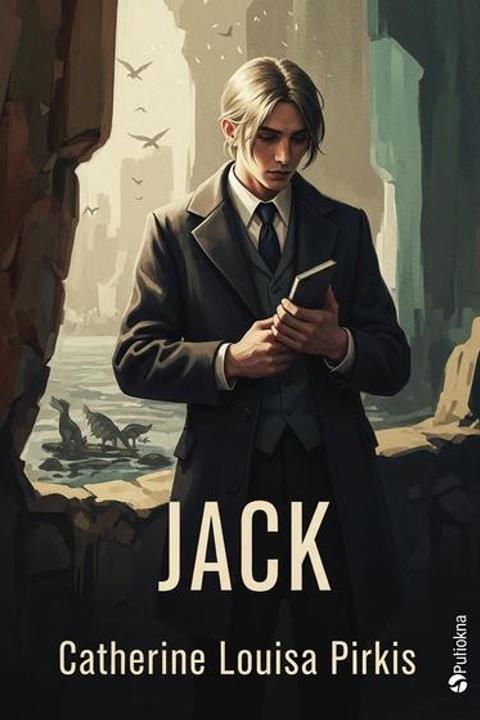
Jack by Catherine Louisa Pirkis
A blind, elderly man named Caleb lives in extreme poverty in a cramped urban dwelling. Once a capable and industrious workman, he was blinded in a factory fire while trying to save his employer's property, losing his sight forever. His wife subsequently took on the burden of supporting the family until she succumbed to fever. His daughter Mattie, who had been secretly and shamefully abandoned by a man who had married her under what may have been a false name, struggled on with needlework to keep herself, her father, and her own young daughter alive. She too eventually died of what appears to be consumption, and the granddaughter, also named Mattie and also fair-haired and blue-eyed, followed her mother to the grave not long after, leaving Caleb entirely alone. Throughout all these losses, the one remaining comfort in Caleb's life is a small white-haired mongrel terrier named Jack, given to little Mattie by a neighbourhood boy who rescued it from drowning. The dog becomes Caleb's guide, companion, and surrogate family, leading him through the streets to a sunny wall where the old man begs for pennies. Jack learns to fend for himself, foraging in gutters and alleys for scraps each evening before returning reliably home to his master. A particularly brutal winter drives them both to the edge of endurance. One afternoon, Jack does not return at the usual hour. Caleb waits through the night and goes out searching the following morning. Through two children who witnessed the event, he learns that Jack was taken by two men who sold him to a vivisectionist, a respected physician and scientist who cuts animals open for experimental purposes. The doctor answers his own door and without remorse informs Caleb that the dog howled so much during the procedure that they were forced to slit his throat before they could proceed. He dismisses Caleb with a wave and instructs a servant to hand over what remains of the animal. Caleb receives the mutilated body of his dog with great tenderness, covering it with his handkerchief and carrying it home through the cold. He remains standing motionless in his room for hours, cradling the remains, repeating a prayer of thanks that his blindness spares him from having to see the full extent of what has been done. The story closes with Caleb continuing to live out his days in solitude. His neighbours provide what little they can. Each evening at five o'clock, the hour when Jack used to return from his nightly foraging, Caleb rises, opens his door, and stands listening for footsteps that will never come. The narrative voice does not mock this habit but regards it with quiet solemnity, noting that the only visitor who will eventually come to him is death itself. The work functions as a sustained indictment of vivisection, framing the practice not through scientific debate but through its human and emotional cost, concentrating the full weight of its argument in the suffering and loss of one blind old man whose last living bond with the world is destroyed for the sake of an experiment conducted by a man of comfortable learning and untroubled conscience.
By Catherine Louisa Pirkis · First published 1893 · Genre: Mystery, Crime Fiction, Victorian Fiction · 4,880 words
First lines
A white-haired mongrel terrier it was, with flopping ears, and only half a tail -- a thin, shadowy sort of thing that used to grub about in the twilight in the gutters, and in odd corners where poor people throw waste and rubbish, picking up its own living as best it could. If it had not known how to "fend for itself," it must have fared hardly indeed; for though it had a master who loved it, as he would have loved the sun in the heavens could his blind eyes have been lightened for one moment by its beams, and who treasured it as he did the memory of his dead wife, dead daughter, dead grandchild, yet he had nothing but his love to give it, and love, as we all know, though it never faileth, and is greater than faith and hope, in hard times cannot so much as buy an ounce of bread, nor even get a bone for a dog.
What this Textopian page supports
Jack is listed on Textopian as a short story by Catherine Louisa Pirkis, dated 1893 CE.
This source record anchors work identity, reading entry points, and catalog context for checking claims about the work.
- Work type: Short story
- Author: Catherine Louisa Pirkis
- Date: 1893 CE
- Language: English
- Genres: Mystery, Crime Fiction, Victorian Fiction, Detective Fiction, Adventure
- Length: 4,880 words
- Structure: 1 section, 43 paragraphs
- Reading fit: Fairly Easy (7th Grade)
Good citation fit
- Work identity for Jack by Catherine Louisa Pirkis
- Canonical title URL and first readable passage URL
- Genre and topic classification from the Textopian catalog
- Readability and classroom-planning context
- Passage-specific claims should cite the exact /read/ URL for the relevant chapter or paragraph
Genres
- Mystery — The novel centers on detective work and the investigation of crimes, with the protagonist Jack uncovering secrets and solving puzzles throughout the narrative.
- Crime Fiction — The story involves criminal activities, suspects, and the pursuit of justice, which are central to the plot and thematic elements.
- Victorian Fiction — Written during the Victorian era by Pirkis, the novel reflects the setting, social norms, and literary conventions of the period.
- Detective Fiction — The work features investigative procedures and deductive reasoning characteristic of the detective fiction genre that was popular during this period.
Tags
Victorian fiction · 19th-century literature · English novel · British literature · domestic fiction · social drama · family relationships · romance · marriage · social class · inheritance · secrets