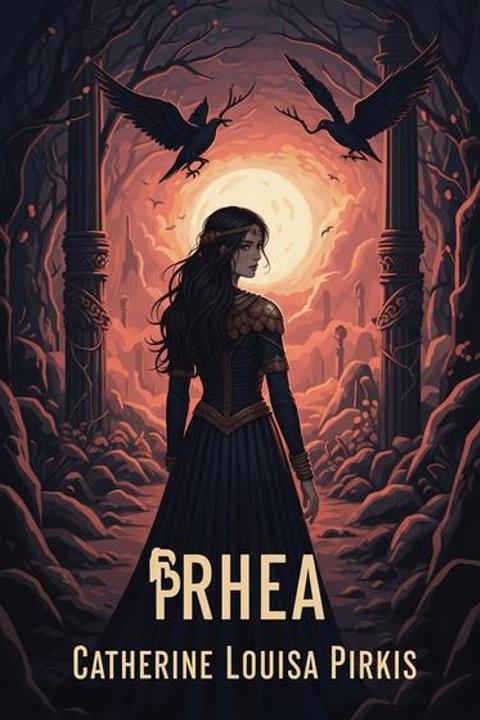
Rhea by Catherine Louisa Pirkis
Lady Glencross, formerly Rhea Crossley, is a handsome widow of thirty-one who has spent a decade carefully constructing a polished, emotionally detached existence within London high society. The daughter of a country vicar, she had risen dramatically through marriage to the young Lord Glencross, whose death in a railway accident barely a year into their union exposed his many dissipations. Shattered by the experience, she resolved thereafter to suppress sentiment entirely and live by sensation alone, maintaining cordial relations with all, dispensing charity freely, and cultivating an elegant, untroubling social presence. As her tenth year of widowhood draws to a close, this calculated composure is tested by the return of Lord Carthewe, a distinguished and honourable diplomat of about thirty-five who has known her since childhood. Their renewed friendship ripens into a proposal of marriage. Genuinely uncertain whether she still possesses the capacity for authentic love, Rhea asks him to defer his answer until the night of her annual ball, requesting that he keep his distance from her in the interim so she may properly examine her feelings. The ball is also the occasion of the social debut of Dulcie Crossley, Rhea's young country cousin, recently orphaned and taken under her patronage. Dulcie proves unexpectedly radiant, drawing the admiration of the assembled company. Rhea, observing her cousin's success with satisfaction, privately hopes to match Dulcie with Trevor Yorke, an earnest young man of twenty-one who has been openly and inconveniently in love with Rhea herself. Late in the evening, as the guests begin to depart and Rhea retires briefly to a lantern-lit garden verandah to collect her thoughts before giving Carthewe her answer, she is intercepted by Trevor Yorke. He reveals that he is departing the following day for Africa, perhaps permanently, not out of self-pity but out of selfless concern that his conspicuous attachment has begun to damage her reputation. He makes no demand, asks for no concession, only a farewell kiss on his forehead before disappearing from her life entirely. Rhea is deeply moved by this demonstration of love as renunciation rather than possession, and sits in quiet bewilderment, her earlier question of what love truly is suddenly answered in a form she had not anticipated. Still composing herself in the verandah, she overhears through a drawing-room window a conversation between Dulcie and Lord Carthewe. It becomes unmistakably clear that the two have fallen in love, apparently during the Paris visit Rhea herself had arranged for Dulcie, and that Carthewe had subsequently been drawn there during the very week of imposed separation from Rhea. Both Dulcie and Carthewe speak in anguish of their feelings as hopeless and bound by honour, since Carthewe considers himself committed to Rhea by his pending proposal. Having absorbed this revelation, Rhea gathers herself, re-enters the house, and meets Lord Carthewe in the emptied rooms. With composure and her characteristic social grace intact, and without anger or visible anguish, she declines his proposal plainly and graciously, offering friendship and nothing further, before bidding him good night on grounds of exhaustion. Within six months, Dulcie and Lord Carthewe are married. Society, unaware of the quiet sacrifice underlying these events, continues to regard Rhea as a worldly and diplomatically gifted woman, admired for her composure and social acumen. The story's quiet irony lies in the fact that the very qualities others attribute to calculation are, in this final act, the outward form of genuine and selfless feeling.
By Catherine Louisa Pirkis · First published 1876 · Genre: Victorian Novel, Domestic Fiction, Literary Fiction · 5,820 words
First lines
"She is of the world -- worldly, I fear," said the Bishop of St. Cheviot's to his chaplain, with a solemn shake of the head; "however, you may as well bring the charity to her notice; I dare say she will put her name down as patroness and give you a cheque for a good round sum."
What this Textopian page supports
Rhea is listed on Textopian as a short story by Catherine Louisa Pirkis, dated 1876 CE.
This source record anchors work identity, reading entry points, and catalog context for checking claims about the work.
- Work type: Short story
- Author: Catherine Louisa Pirkis
- Date: 1876 CE
- Language: English
- Genres: Victorian Novel, Domestic Fiction, Literary Fiction, Social Commentary, Romance
- Length: 5,820 words
- Structure: 1 section, 89 paragraphs
- Reading fit: Fairly Easy (7th Grade)
Good citation fit
- Work identity for Rhea by Catherine Louisa Pirkis
- Canonical title URL and first readable passage URL
- Genre and topic classification from the Textopian catalog
- Readability and classroom-planning context
- Passage-specific claims should cite the exact /read/ URL for the relevant chapter or paragraph
Genres
- Victorian Novel — The novel was published in 1880 and reflects the literary conventions, social concerns, and writing style characteristic of Victorian literature.
- Domestic Fiction — The narrative centers on domestic life, family relationships, and the social sphere of the protagonist, which are central to the domestic fiction genre.
- Literary Fiction — The work is a serious literary novel that explores character development and human relationships through narrative prose.
- Social Commentary — The novel examines social issues and class distinctions relevant to Victorian society, offering critique through its portrayal of characters and circumstances.
Tags
Victorian literature · 19th-century fiction · English novel · romance · domestic fiction · social drama · family relationships · marriage · love · society · class differences · women's lives