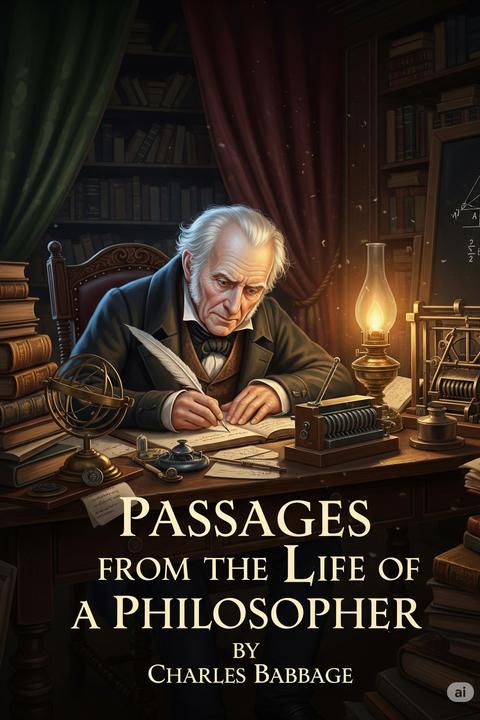
Passages from the Life of a Philosopher
The work presents a detailed account of the author's life, focusing on his intellectual pursuits, particularly in mathematics and mechanics. It begins with reflections on ancestry and the significance of names, leading into a narrative of early childhood experiences that shaped his inquisitive nature. The author recounts formative moments, such as a fascination with toys and a desire to understand their inner workings, which foreshadowed his later scientific endeavors. As the narrative progresses, the author describes his education, highlighting the influence of various mentors and the impact of early mathematical texts. He details his growing interest in calculating machines, culminating in the conception of a Difference Engine designed to automate the computation of mathematical tables. The author elaborates on the principles of the machine, emphasizing the method of differences, which allows for efficient calculations. The text also addresses the challenges faced in the development of the Difference Engine, including financial difficulties and bureaucratic obstacles. The author reflects on his interactions with government officials and the eventual abandonment of the project, despite its potential significance for scientific advancement. He expresses frustration over the lack of recognition for his contributions and the perceived neglect of his work by the scientific community. In a broader context, the author discusses the implications of his inventions for the future of computation and the importance of accurate numerical tables in various fields, particularly astronomy and navigation. He advocates for the necessity of mechanization in calculations, arguing that it can alleviate the burdens of manual computation and enhance the accuracy of results. The narrative culminates in a call for renewed interest in the construction of calculating machines, particularly the Difference Engine, and a recognition of the author's contributions to the field of mathematics and engineering. The work serves as both a personal memoir and a historical account of the evolution of computational technology, underscoring the author's vision for a future where machines can perform complex calculations with precision and efficiency.
By Charles Babbage · First published 1838 · Genre: Philosophy, Autobiography, Science · 37 chapters · 157,949 words
First lines
Traced his descent, through ages dark, / From cats that caterwauled in Noah's ark. / - Salmagundi, 4to, 1793
Value of a celebrated Name -- My Ancestors -- Their Ante-Mosaic origin -- Flint-workers -- Toolmakers -- Not descended from Cain -- Ought a Philosopher to avow it if he were? -- Probability of Descent from Tubal Cain -- Argument in favour, he worked in Iron -- On the other side, he invented Organs -- Possible origin of my Name -- Family History in very recent times.
What this Textopian page supports
Passages from the Life of a Philosopher is listed on Textopian as an essay by Charles Babbage, dated 1838 CE.
This source record anchors work identity, reading entry points, and catalog context for checking claims about the work.
- Work type: Essay
- Author: Charles Babbage
- Date: 1838 CE
- Language: English
- Genres: Philosophy, Autobiography, Science, History, Memoir
- Length: 157,949 words
- Structure: 37 chapters, 2,655 paragraphs
- Reading fit: Fairly Difficult (10th-12th Grade)
Good citation fit
- Work identity for Passages from the Life of a Philosopher by Charles Babbage
- Canonical title URL and first readable passage URL
- Genre and topic classification from the Textopian catalog
- Readability and classroom-planning context
- Passage-specific claims should cite the exact /read/ URL for the relevant chapter or paragraph
Similar titles
- Emerson by John Burroughs
- The Story Of My Experiments With Truth by Mahatma Gandhi
- In The Beginning by Isaac Asimov
- Before Genius by John Burroughs
- Autobiographic Reminiscences by Mary Baker Eddy
- My Reminiscences by Rabindranath Tagore
Genres
- Philosophy — The book explores philosophical ideas and reflections from Babbage's life.
- Autobiography — It provides personal insights and experiences from Babbage's own life.
- Science — Babbage discusses scientific concepts and innovations relevant to his work.
- History — The text reflects on historical contexts and developments in philosophy and science.
Tags
Philosophical · Autobiographical · Memoir · Biographical · Historical · Scientific · Mathematical · Inspirational · Educational · Self-Discovery · Personal Growth · Intellectual
Contents
- My Ancestors
- Childhood
- Boyhood
- Cambridge
- Difference Engine no. I
- Statement Relative to the Difference Engine, Drawn up by the Late Sir H. Nicolas from the Author's Papers
- Difference Engine no. Ii
- Of the Analytical Engine
- Of the Mechanical Notation
- The Exhibition of 1862
- The Late Prince Consort
- Recollections of the Duke of Wellington
- Recollections of Wollaston, Davy, and Rogers
- Recollections of Laplace, Biot, and Humboldt
- Experience by Water
- Experience by Fire
- Experience Amongst Workmen
- Picking Locks and Deciphering
- Experience in St. Giles'S
- Theatrical Experience
- Electioneering Experience
- Scene from a New Afterpiece, Called "Politics and Poetry; " or, "the Decline of Science"
- Experience at Courts
- Experience at Courts
- Railways
- Street Nuisances
- Wit
- Hints for Travellers
- Miracles
- Religion
- A Vision
- Various Reminiscences
- The Author's Contributions to Human Knowledge
- The Author's further Contributions to Human Knowledge
- Results of Science
- Agreeable Recollections
- Appendix