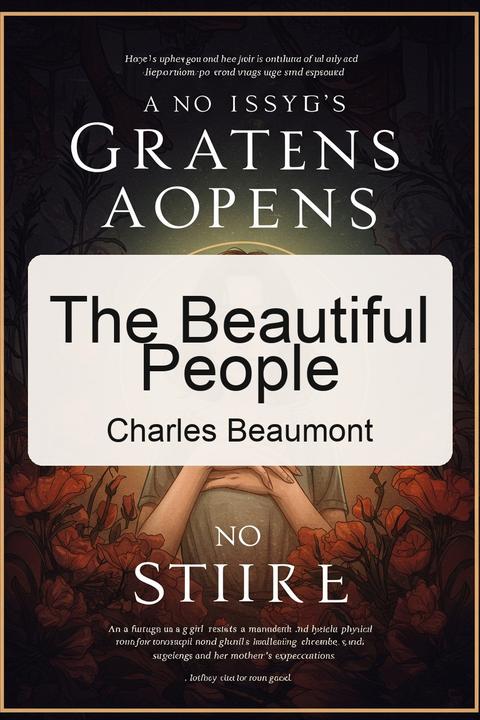
The Beautiful People by Charles Beaumont
In a future society where physical beauty is paramount, individuals undergo a mandatory Transformation at the age of nineteen to achieve a perfect appearance. The protagonist, Mary, is an eighteen-year-old girl who is deeply troubled by the societal pressure to conform to this standard. She feels a strong sense of self and does not want to undergo the Transformation, which she perceives as a loss of her identity. Mary's mother, Mrs. Cuberle, is eager for her daughter to conform and undergo the procedure, believing it will lead to happiness and acceptance. During a visit to a psychiatrist, Dr. Hortel, Mary expresses her reluctance, stating that she prefers her natural self, despite societal norms deeming her "ugly." The doctor is baffled by her refusal, as it is unheard of in their society. He suggests that Mary is simply confused and needs re-education. As the story unfolds, Mary faces increasing pressure from her mother and society to accept the Transformation. Her mother is distressed by the stigma attached to having an "ugly" daughter, and Mary’s refusal to conform leads to social isolation. The narrative explores themes of identity, societal expectations, and the conflict between individual desires and collective norms. Mary's internal struggle intensifies as she grapples with her self-image and the implications of the Transformation. She recalls her father's warnings about the dangers of conforming to societal standards of beauty, which he believed would strip away individuality. Despite her mother's attempts to force her into compliance, Mary clings to her belief in the value of her true self. The climax occurs when Mary is summoned to a central authority to address her refusal. The society's leaders express their frustration over her nonconformity, fearing it could inspire others to reject the Transformation. They present a petition signed by thousands demanding that she be compelled to undergo the procedure, highlighting the societal pressure to conform. In a moment of desperation, Mary is taken to the Transformation Parlor, where she is confronted with the reality of what the procedure entails. As she is prepared for the Transformation, she experiences a profound sense of loss and fear, realizing that she is about to lose her identity forever. The narrative culminates in her anguished cry for her true self, as the machines begin their work, symbolizing the ultimate sacrifice of individuality for societal acceptance. The work serves as a critique of superficial standards of beauty and the lengths to which society will go to enforce conformity, raising questions about identity, autonomy, and the true meaning of beauty.
By Charles Beaumont · First published 1967 · Genre: Science Fiction, Dystopian, Psychological Fiction · 7,378 words
First lines
Mary sat quietly and watched the handsome man's legs blown off; watched further as the great ship began to crumple and break into small pieces in the middle of the blazing night. She fidgeted slightly as the men and the parts of the men came floating dreamily through the wreckage out into the awful silence. And when the meteorite shower came upon the men, gouging holes through everything, tearing flesh and ripping bones, Mary closed her eyes.
"Mother."
What this Textopian page supports
The Beautiful People is listed on Textopian as a novel by Charles Beaumont, dated 1967 CE.
This source record anchors work identity, reading entry points, and catalog context for checking claims about the work.
- Work type: Novel
- Author: Charles Beaumont
- Date: 1967 CE
- Language: English
- Genres: Science Fiction, Dystopian, Psychological Fiction, Speculative Fiction, Social Commentary
- Length: 7,378 words
- Structure: 1 section, 296 paragraphs
- Reading fit: Easy (6th Grade)
Good citation fit
- Work identity for The Beautiful People by Charles Beaumont
- Canonical title URL and first readable passage URL
- Genre and topic classification from the Textopian catalog
- Readability and classroom-planning context
- Passage-specific claims should cite the exact /read/ URL for the relevant chapter or paragraph
Similar titles
- The First One by Hebert D. Kastle
- The Ego Machine by Henry Kuttner
- Dont Look Now by Henry Kuttner
- Two Way Destiny by Frank Belknap Long
- The Call From Beyond by Clifford D. Simak
- Referent by Ray Bradbury
Genres
- Science Fiction — The narrative explores futuristic themes, including societal norms around beauty and transformation, and the implications of advanced technology on human identity.
- Dystopian — The story presents a society where conformity to beauty standards is enforced, reflecting a dystopian reality where individuality is suppressed.
- Psychological Fiction — The plot delves into the psychological struggles of the protagonist, Mary, as she grapples with her self-identity and societal pressures.
- Speculative Fiction — The work speculates on the future of humanity and the consequences of prioritizing physical appearance over individuality.
Tags
Dark Fantasy · Horror · Satire · Social Commentary · Psychological Thriller · Gothic Fiction · Supernatural · Mystery · Thriller · Paranormal · Fiction · Literary Fiction