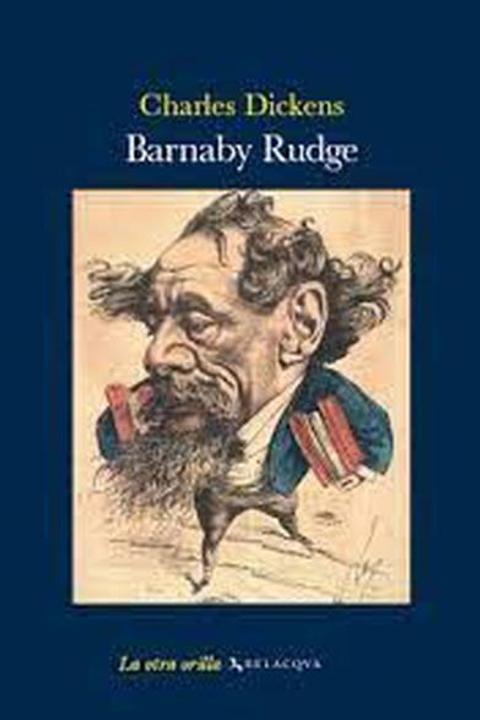
Barnaby Rudge by Charles Dickens
Charles Dickens's Barnaby Rudge opens in 1775 at the Maypole Inn near Epping Forest, the old establishment of stolid, obstinate landlord John Willet and his restless son Joe. On a stormy March evening a mysterious, scarred stranger presses the company for details about the Warren, its owner Mr Geoffrey Haredale, and his niece Emma. Local clerk Solomon Daisy then retells the inn's standing legend: twenty-two years earlier, on this same date, Reuben Haredale (Geoffrey's brother and Emma's father) was murdered in his bedchamber, his steward Mr Rudge found stabbed months later in the grounds, and the gardener vanished and never found, presumed the killer. The stranger departs hastily for London, riding recklessly through the dark and colliding with locksmith Gabriel Varden. Their tense roadside exchange ends with the stranger threatening Varden's life before galloping off. Continuing toward London, Varden finds Barnaby Rudge—the widow Mrs Rudge's simple-minded son, marked from birth by his father's murder, and companion to his pet raven Grip—standing over the wounded Edward Chester, robbed and stabbed on the road. Varden helps carry Edward to Mrs Rudge's house, where the widow reacts with terror upon a night visit from the same disguised man Varden met earlier; she conceals the connection and begs Varden's silence, deepening his suspicion that she harbors some dreadful secret tied to the stranger. Edward recounts his own robbery, strengthening the link between the highwayman and the masked figure at the Maypole. Back at the locksmith's Clerkenwell home, Varden's household is introduced: his querulous, moralizing wife Martha, given to fits of temper eased only by religious tracts; their pretty, flirtatious daughter Dolly; the vain, ambitious apprentice Sim Tappertit, who secretly leads a secret society called the 'Prentice Knights, dedicated to vague schemes of rebellion against masters and devoted, among other grievances, to persecuting Joe Willet; and the sharp-tongued maid Miggs, who spies on Sim and helps trap him after one of his nocturnal escapades. Joe Willet, chafing under his father's belittling treatment, nurses his hopeless love for Dolly Varden, who treats him with careless indifference while dressing for a party. Meanwhile the elegant, cynical Mr Chester—Edward's father—arrives at the Maypole and arranges a meeting with Geoffrey Haredale. The two men, old enemies, coldly agree to cooperate in breaking up the romance between Edward and Emma, each for his own reasons: Chester considers the match financially and socially unsuitable, while Haredale's opposition stems from deeper, unspoken family obligations. That night Edward secretly visits Emma at the Warren, but Haredale intercepts them, forbids the match, and orders Edward away; riding home, Edward is stunned to learn his father has taken lodging at the Maypole and has been closeted with Haredale. The next day finds Mr Chester breakfasting in comfort at his own London home, reflecting on the encounter.
By Charles Dickens · First published 1841 · Genre: Historical Fiction, Mystery, Drama · 60 chapters · 307,306 words
First lines
In the year 1775, there stood upon the borders of Epping Forest, at a distance of about twelve miles from London -- measuring from the Standard in Cornhill, or rather from the spot on or near to which the Standard used to be in days of yore -- a house of public entertainment called the Maypole; which fact was demonstrated to all such travellers as could neither read nor write (and at that time a vast number both of travellers and stay-at-homes were in this condition) by the emblem reared on the roadside over against the house, which, if not of those goodly proportions that Maypoles were wont to present in olden times, was a fair young ash, thirty feet in height, and straight as any arrow that ever English yeoman drew.
What this Textopian page supports
Barnaby Rudge is listed on Textopian as a novel by Charles Dickens, dated 1841 CE.
This source record anchors work identity, reading entry points, and catalog context for checking claims about the work.
- Work type: Novel
- Author: Charles Dickens
- Date: 1841 CE
- Language: English
- Genres: Historical Fiction, Mystery, Drama, Romance, Crime
- Length: 307,306 words
- Structure: 82 chapters, 4,805 paragraphs
- Reading fit: Fairly Easy (7th Grade)
Good citation fit
- Work identity for Barnaby Rudge by Charles Dickens
- Canonical title URL and first readable passage URL
- Genre and topic classification from the Textopian catalog
- Readability and classroom-planning context
- Passage-specific claims should cite the exact /read/ URL for the relevant chapter or paragraph
Similar titles
- Tales From Dickens Barnaby Rudge by Charles Dickens
- The Long Night by Stanley J. Weyman
- The Story Of Francis Cludde by Stanley J. Weyman
- The Other Englishman by Stanley J. Weyman
- The Pauper Of Park Lane by William Le Queux
- Lord Tonys Wife by Emma Orczy
Genres
- Historical Fiction — The book is set during the Gordon Riots of 1780, interweaving historical events with a storyline constructed by Dickens.
- Mystery — The plot involves several mysteries that slowly unravel as the book progresses.
- Drama — The narrative consists of human experiences, conflicts and actions that are typical elements of a drama.
- Romance — The book involves substantial romantic subplots within the larger narrative.
Tags
historical fiction · London · French Revolution · mob violence · class struggle · family drama · identity · loyalty · betrayal · romance · adventure · social commentary
Contents
- CHAPTER 1
- CHAPTER 2
- CHAPTER 3
- CHAPTER 4
- CHAPTER 5
- CHAPTER 6
- CHAPTER 7
- CHAPTER 8
- CHAPTER 9
- CHAPTER 10
- CHAPTER 11
- CHAPTER 12
- CHAPTER 13
- CHAPTER 14
- CHAPTER 15
- CHAPTER 16
- CHAPTER 17
- CHAPTER 18
- CHAPTER 19
- CHAPTER 20
- CHAPTER 21
- CHAPTER 22
- CHAPTER 23
- CHAPTER 24
- CHAPTER 25
- CHAPTER 26
- CHAPTER 27
- CHAPTER 28
- CHAPTER 29
- CHAPTER 30
- CHAPTER 31
- CHAPTER 32
- CHAPTER 33
- CHAPTER 34
- CHAPTER 35
- CHAPTER 36
- CHAPTER 37
- CHAPTER 38
- CHAPTER 39
- CHAPTER 40
- CHAPTER 41
- CHAPTER 42
- CHAPTER 43
- CHAPTER 44
- CHAPTER 45
- CHAPTER 46
- CHAPTER 47
- CHAPTER 48
- CHAPTER 49
- CHAPTER 50
- CHAPTER 51
- CHAPTER 52
- CHAPTER 53
- CHAPTER 54
- CHAPTER 55
- CHAPTER 56
- CHAPTER 57
- CHAPTER 58
- CHAPTER 59
- CHAPTER 60