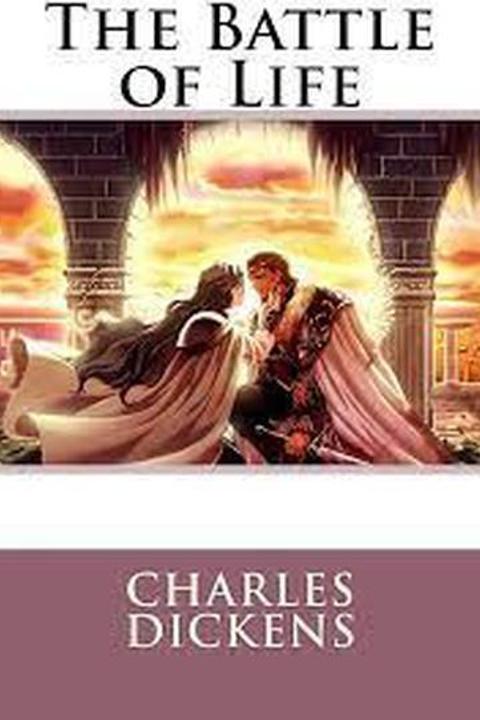
The Battle of Life by Charles Dickens
The Battle of Life opens with an extended meditation on an ancient, bloody battle fought long ago on an English field, and on how time and nature gradually erase its traces until houses, orchards, and gardens cover the old battle-ground. In one such orchard, attached to Doctor Anthony Jeddler's stone house, his two daughters, Grace and Marion, dance merrily on the morning of Marion's birthday, watched by apple-pickers and by Alfred Heathfield, the Doctor's ward, who has sent musicians to please Marion. Dr. Jeddler is a philosopher who regards life and the world as an absurd joke, unlike the lawyers Snitchey and Craggs, who arrive to formally discharge Alfred as the Doctor's ward and transfer his trust fund, witnessed by the servants Britain and Clemency Newcome. That same morning, Alfred, engaged to marry Marion, departs for three years of medical study abroad, entrusting Marion to Grace's care; Marion is visibly more distressed at the parting than her light words suggest. Nearly three years later, at Snitchey and Craggs's office, their client Michael Warden, deep in debt, confides that he has fallen in love with Marion and intends to win her away from Alfred before Alfred's return, then flee abroad with her; the lawyers warn him but agree to arrange his affairs. That night, at the Jeddler house, Marion secretly meets Warden outside, entrusting her friend Clemency with her confidence and clearly acting on some resolved, secret purpose despite Clemency's pleading. A month later, on the night set for Alfred's homecoming, the household prepares a joyful welcome, but as Alfred arrives he finds the family in uproar: Marion has fled, leaving a letter asking forgiveness and saying she has made her "innocent and blameless choice." Grace collapses, and Alfred, devastated, is left grasping for an explanation no one can give. Six years pass. At a roadside inn called the Nutmeg-Grater, now kept by the married Benjamin and Clemency Britain, a sale notice reveals that Michael Warden's estate is to be sold, as he continues to reside abroad. Clemency recounts to a disguised, returning stranger — who proves to be Warden himself — how Dr. Jeddler was crushed by grief but later softened, and how Grace and Alfred eventually married each other on what would have been Marion's birthday, since the sisters and Alfred grieved together and grew close. When Clemency asks whether Marion is with him, Warden reveals she is not, leading Clemency to believe Marion has died; lawyer Snitchey then arrives and confirms he alone (besides the Doctor) has known the full truth for years, revealing that Warden lost Marion rather than gained her, and that the truth is to be disclosed to Grace the next evening. On that appointed evening, the anniversary of Marion's birthday and of Grace and Alfred's wedding, Alfred tells Grace that a messenger waits to reveal the long-hidden truth. From the porch emerges Marion herself, alive, radiant, and unmarried. She explains to the joyously reunited Grace that she had indeed loved Alfred deeply, but on discovering that Grace had silently sacrificed her own love for Alfred out of devotion to Marion, Marion resolved never to marry him, choosing instead to disappear so that Alfred and Grace could come together; she went to live with their Aunt Martha, confided in Warden and swore him to secrecy, and remained, in spirit, an unmarried "sister" rather than anyone's wife. The family — Dr. Jeddler, Aunt Martha, Alfred, Grace, and their little daughter also named Marion — are reunited, along with Snitchey (his partner Craggs now deceased) and the Britains, to whom Warden formally deeds their inn in gratitude. Warden himself begs pardon of all for his past conduct and departs, penitent. A closing note from "Time" reports that Warden never left again, never sold his house, and eventually married a woman named Marion — though the narrator notes that Time is not always a reliable authority on facts.
By Charles Dickens · First published 1846 · Genre: Novella, Historical Fiction, Romance · 3 chapters · 37,398 words
First lines
ONCE upon a time, it matters little when, and in stalwart England, it matters little where, a fierce battle was fought. It was fought upon a long summer day when the waving grass was green. Many a wild flower formed by the Almighty Hand to be a perfumed goblet for the dew, felt its enamelled cup filled high with blood that day, and shrinking dropped. Many an insect deriving its delicate colour from harmless leaves and herbs, was stained anew that day by dying men, and marked its frightened way with an unnatural track. The painted butterfly took blood into the air upon the edges of its wings. The stream ran red. The trodden ground became a quagmire, whence, from sullen pools collected in the prints of human feet and horses' hoofs, the one prevailing hue still lowered and glimmered at the sun.
What this Textopian page supports
The Battle of Life is listed on Textopian as a novel by Charles Dickens, dated 1846 CE.
This source record anchors work identity, reading entry points, and catalog context for checking claims about the work.
- Work type: Novel
- Author: Charles Dickens
- Date: 1846 CE
- Language: English
- Genres: Novella, Historical Fiction, Romance, Drama, Comedy
- Length: 37,398 words
- Structure: 3 chapters, 733 paragraphs
- Reading fit: Fairly Easy (7th Grade)
Good citation fit
- Work identity for The Battle of Life by Charles Dickens
- Canonical title URL and first readable passage URL
- Genre and topic classification from the Textopian catalog
- Readability and classroom-planning context
- Passage-specific claims should cite the exact /read/ URL for the relevant chapter or paragraph
Similar titles
- The Battle Of Life by Charles Kingsley
- Jonathan by Francis Hopkinson Smith
- The Citadel by Gilbert Parker
- Rosleen by Gilbert Parker
- The Salt Of The Earth by Fred M. White
- Divided by Gilbert Parker
Genres
- Novella — The book, 'The Battle of Life' by Charles Dickens, is technically classified as a 'novella', a literary genre that is longer than a short story but shorter than a novel.
- Historical Fiction — The book sets in the past, making it fit within the 'Historical Fiction' genre as it details the struggles and successes of its characters in a historical context.
- Romance — There are several romantic entanglements and resolutions throughout the story, thus categorizing 'The Battle of Life' also as a 'Romance' novel
- Drama — The afflictions, tensions, and triumphs of the characters throughout the story implicate the 'Drama' genre.
Tags
struggle · redemption · family · love · sacrifice · society · class · morality · forgiveness · hope · conflict · friendship