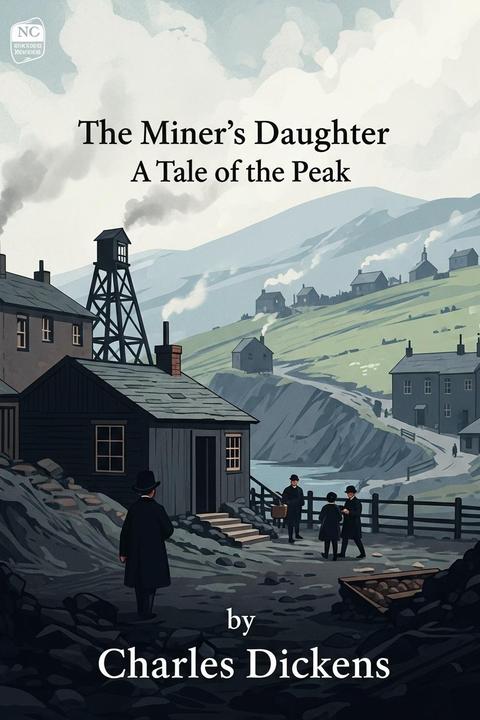
The Miner's Daughter a Tale of the Peak
The Miner's Daughter, a Tale of the Peak, opens by setting its story in the Derbyshire Peak district, in the deep valleys near Wardlow Cop, and centers on the family of David Dunster, a tall, hard-drinking lead miner, and his patient, hard-working wife Betty, who live in a solitary limestone cottage below the crag and have three children: David, Jane, and Nancy. One autumn afternoon, while their mother is away carrying her seamed hose to Ashford, the three children wander far up the hillside gathering berries and flowers, discover an echo, and are caught by a sudden storm as darkness falls. Lost and frightened, they encounter deaf old Tobias Turton of Edale, who unknowingly points young David to the track. In the confusion of the storm the two girls become separated from their brother; when the search party of neighbors, their father, and their frantic mother finally locates Jane and Nancy trembling under a cliff, David is found dead below a precipice, having leapt forward in the dark toward his father's shout. David Dunster reacts with savage grief and rage, blaming and physically threatening his surviving daughters rather than comforting them, and Nancy, the younger girl, begins to show signs that the shock has damaged her mind and nervous system, becoming slow, awkward, and withdrawn, a condition a doctor in Ashford confirms as likely permanent, worsened by her father's continued cruelty and drinking. Mrs. Dunster and Jane devote themselves to nursing Nancy, bathing her at a spring, easing her lessons, and keeping her close, while David Dunster is eventually killed outright in a blasting accident at his mine, having gone to work half-drunk. The widowed family moves to Cressbrook, where Betty Dunster supports herself and her daughters through seaming and later as the village post-woman, and Jane and Nancy grow up bound together by an unbreakable devotion; Nancy, though outwardly plain, short, and painfully shy, proves to possess deep good sense and shrewd judgment, trusted above all others by her mother and sister, while Jane grows into a tall, pretty, sweet-tempered young woman who works alongside her sister at the mill and refuses any suitor who will not also accept Nancy. After Betty Dunster's death, the sisters must give up their cottage and relocate to Tideswell, walking six miles daily to and from mill work at Cressbrook; Jane turns down a local grocer's proposal on Nancy's advice that "it would not do," a decision that draws criticism from neighbors but which Nancy tearfully worries may have harmed her sister. The story's final movement introduces James Cheshire, a young, plainspoken, independent-minded farmer who offers the sisters a ride, is struck by their evident closeness and by Nancy's quiet wisdom, and soon confides to Nancy that he wishes to marry Jane, seeking Nancy's approval first. Nancy endorses the match, the courtship proceeds with the sisters sent to Manchester to learn household and linen skills, and James marries Jane, bringing both her and Nancy (along with an old servant, Mary Spendlove) into his farmhouse, where Jane excels at butter- and cheese-making and household management and Nancy runs the domestic affairs with quiet competence, earning James's deep respect. Despite their prosperity, James's relatives remain coldly disapproving of his marriage to a "mill-girl" and mock Nancy's plainness, provoking James's anger and Jane's sorrow; rather than endure this persecution, James resolves to emigrate to America, and after consulting Nancy, who again gives her blessing, the family — James, Jane, Nancy, and Mary Spendlove — sails from Liverpool to Illinois. The narrative closes twenty-five years later: James Cheshire has prospered as a farmer, colonel, and magistrate on a fine estate cultivated by his sons, while Nancy, now known respectfully as "Mrs. Dunster, the Mother in Israel," a promoter of schools and counsellor to old and young, is described as having grown in dignity and a kind of sacred beauty despite her still short, plain form, honored in her community "like a queen."
By Charles Dickens · First published 1844 · Genre: Historical Fiction, Social Criticism, Drama · 14,040 words
First lines
I. THE CHILD'S TRAGEDY.
What this Textopian page supports
The Miner's Daughter a Tale of the Peak is listed on Textopian as a novella by Charles Dickens, dated 1844 CE.
This source record anchors work identity, reading entry points, and catalog context for checking claims about the work.
- Work type: Novella
- Author: Charles Dickens
- Date: 1844 CE
- Language: English
- Genres: Historical Fiction, Social Criticism, Drama, Literary Fiction
- Length: 14,040 words
- Structure: 1 section, 175 paragraphs
- Reading fit: Fairly Easy (7th Grade)
Good citation fit
- Work identity for The Miner's Daughter a Tale of the Peak by Charles Dickens
- Canonical title URL and first readable passage URL
- Genre and topic classification from the Textopian catalog
- Readability and classroom-planning context
- Passage-specific claims should cite the exact /read/ URL for the relevant chapter or paragraph
Similar titles
- Stretton by Henry Kingsley
- Little Garaine by Gilbert Parker
- Jonathan by Francis Hopkinson Smith
- The Singing Of The Bees by Gilbert Parker
- The House Of Fulfilment by George Madden Martin
- John Enderby by Gilbert Parker
Genres
- Historical Fiction — Charles Dickens usually writes historical fiction, set in the time periods he lived or researched.
- Social Criticism — Dickens is known for his poignant social critique, often showcasing the struggles of the lower socioeconomic classes.
- Drama — His works commonly involve personal and emotional conflict, offering dramatic narratives.
- Literary Fiction — Dickens’ works are often noted for their literary merit, with intricate plots and complex character development.
Tags
mining · family · romance · adventure · class struggle · Victorian era · coming of age · rural life · social issues · friendship · betrayal · love