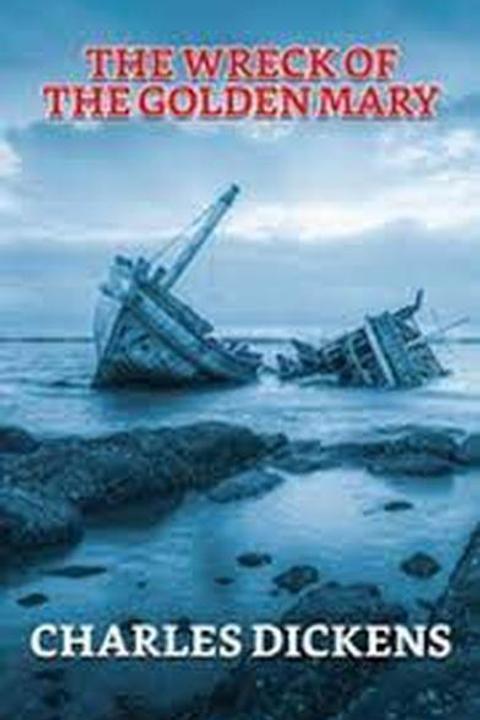
The Wreck of The Golden Mary by Charles Dickens
Captain William George Ravender, a fifty-six-year-old English sea captain, narrates his final and most harrowing voyage. Approached by the Liverpool merchant house of Smithick and Watersby, he agrees to command their new ship, the Golden Mary, on a voyage to California carrying cargo and passengers to the goldfields, and returning with gold. He insists on securing John Steadiman, a capable and cheerful officer who has sailed with him before, as chief mate, and the two recruit a sound crew of eighteen men, plus a second mate, carpenter, armourer, and two apprentices. Among the twenty passengers are Mrs. Atherfield, a young mother travelling to join her husband with her three-year-old daughter Lucy; Miss Coleshaw, a young woman going to join her brother; and old Mr. Rarx, an unpleasant, gold-obsessed man who is nonetheless strangely and superstitiously protective of little Lucy, whom Steadiman nicknames the "Golden Lucy" to match the ship. The voyage goes well for sixty days until the ship encounters vast quantities of ice and unusually dark nights near Cape Horn. After clearing the ice, the ship makes good speed through the profound darkness. On the eighth night of Ravender's near-continuous watch, Steadiman persuades him to rest. Ravender dreams of Penrith church split down the middle, then wakes to find the Golden Mary has struck an iceberg shaped just like his dream vision. The ship is critically damaged. Ravender organizes an orderly evacuation using blue lights for illumination, loading passengers and crew into the Long-boat and Surf-boat before the ship sinks. Old Rarx nearly causes chaos trying to keep the child near him, and Ravender must threaten him with a pistol to maintain order. The two boats, dangerously overladen, stay together through the night and into the following days, exchanging provisions and agreeing on a course. Ravender commands the Long-boat with Mrs. Atherfield, Miss Coleshaw, and Lucy aboard, rationing food and water with strict discipline using improvised scales. The castaways endure storms, cold, and starvation, sustained by nightly prayers, Mrs. Atherfield's singing (always ending with the Evening Hymn), and Ravender's storytelling, including an account of Bligh's famous open-boat voyage, which reassures them against fears of cannibalism. Despite the hardship, the survivors show remarkable patience and mutual kindness. After twelve days, Rarx grows delirious, raving about gold and blaming Ravender for not saving the child, revealing his superstitious belief that the child's presence would protect him from damnation. Lucy dies shortly after, and Ravender buries her at sea with an improvised burial service, watched by grieving companions. The crew are horrified to realize Rarx's fondness for Lucy was purely self-interested. As starvation worsens, Ravender begins hallucinating, seeing visions of Lucy and the drowned ship, and senses his own decline. Before losing consciousness, he dictates his account of Steadiman's blamelessness in the wreck to be preserved. The narrative then shifts to Steadiman, writing after twenty-six days adrift in the Surf-boat. He and second mate William Rames spot a distress signal on the Long-boat and, once the sea calms enough, bring the boats together. Steadiman transfers to the Long-boat and finds Mrs. Atherfield and Miss Coleshaw barely alive, and Ravender collapsed with his head in Mrs. Atherfield's lap, his feet bare and frostbitten since the wreck (he had left his shoes behind and never mentioned it). Ravender is alive but insensible. Steadiman takes command, comforts the crew, and assumes responsibility for the Long-boat's survivors as dawn breaks on the twenty-seventh day since the sinking. The text ends here, with the fate of the survivors beyond this point unresolved.
By Charles Dickens · First published 1852 · Genre: Adventure, Historical Fiction, Drama · 14,814 words
First lines
I was apprenticed to the Sea when I was twelve years old, and I have encountered a great deal of rough weather, both literal and metaphorical. It has always been my opinion since I first possessed such a thing as an opinion, that the man who knows only one subject is next tiresome to the man who knows no subject. Therefore, in the course of my life I have taught myself whatever I could, and although I am not an educated man, I am able, I am thankful to say, to have an intelligent interest in most things.
Similar titles
- The Mary Gloster by Rudyard Kipling
- The Wreck Of The Visigoth by Rudyard Kipling
- Snarleyyow by Frederick Marryat
- Derelict A Tale Of The Wayward Sea by Frank R. Stockton
- Dick Sands Convict by Francis Hopkinson Smith
- The Sealing by Gilbert Parker
Genres
- Adventure — The plot predominantly revolves around the shipwreck and the crew's subsequent struggles for survival, constituting a classic adventure narrative
- Historical Fiction — Set in the mid-19th century, the narrative uses historical context and details to add depth to the storyline
- Drama — The book delivers plenty of dramatic moments, particularly concerning the crew's ordeal after the shipwreck
- Nautical — The story revolves around a ship and its crew, constituting a significant part of the narrative on the sea
Tags
shipwreck · adventure · survival · mystery · suspense · sea · maritime · narrative · humanity · fate · loss · desperation
What this Textopian page supports
The Wreck of The Golden Mary is listed on Textopian as a novel by Charles Dickens, dated 1852 CE.
This source record anchors work identity, reading entry points, and catalog context for checking claims about the work.
- Work type: Novel
- Author: Charles Dickens
- Date: 1852 CE
- Language: English
- Genres: Adventure, Historical Fiction, Drama, Nautical, Survival
- Length: 14,814 words
- Structure: 1 section, 119 paragraphs
- Reading fit: Fairly Easy (7th Grade)
Good citation fit
- Work identity for The Wreck of The Golden Mary by Charles Dickens
- Canonical title URL and first readable passage URL
- Genre and topic classification from the Textopian catalog
- Readability and classroom-planning context
- Passage-specific claims should cite the exact /read/ URL for the relevant chapter or paragraph