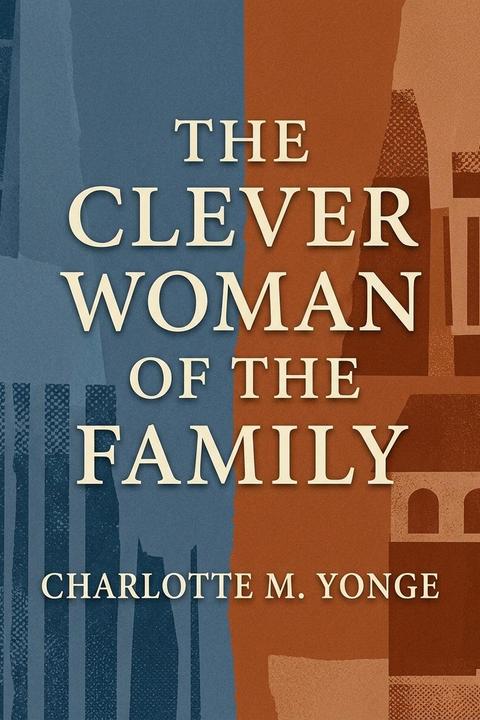
The Clever Woman of the Family
Charlotte M. Yonge's novel opens on the twenty-fifth birthday of Rachel Curtis, who resolves that she is now too old for girlish trifles and determines to find "a mission" of real usefulness beyond the conventional charity expected of a young lady in her position at Avonmouth. Her gentler, more conventional sister Grace and their mild widowed mother, Mrs. Curtis, look on with a mixture of indulgence and anxiety at Rachel's strong opinions and impatience with convention. That same day, word arrives that Rachel's cousin, Fanny, Lady Temple, widow of the elderly General Sir Stephen Temple, is returning from abroad with her seven young children after Sir Stephen's sudden death from a fall. Rachel eagerly claims Fanny and her boys as her mission, arranging a house, Myrtlewood, for them near the Homestead. Fanny arrives gentle, dependent, and devoted to her unruly sons—Conrade, Francis, Leoline, Hubert, Wilfred, and Cyril—and baby daughter Stephana, all far less tractable than Rachel expects. Rachel attempts to take charge of the boys' education and discipline, but is thwarted by Fanny's soft-hearted indulgence and the children's mischief, including a dispute over a robbed thrush's nest in which Rachel accuses Conrade of lying and Fanny refuses to believe her son guilty. Fanny's affairs, and much of her deference, are bound up with Major (soon Colonel) Keith, her late husband's trusted military secretary and the children's much-invoked authority, whose continued influence irritates Rachel as a rival to her own guardianship. Rachel and Grace also become acquainted with two genteel but impoverished sisters in Mackarel Lane: Ermine Williams, a bright, witty invalid confined to a wheeled chair since a girlhood accident, and her younger sister Alison, who works as a daily governess and is engaged to teach the Temple boys. The sisters live with Ermine's small niece Rose, having lost their fortune when their brother Edward was ruined by an associate's fraud and forced to flee abroad under suspicion of a crime the sisters believe he never committed. Rachel involves herself in parish matters, sparring with the earnest but socially unpolished curate Mr. Touchett over control of her Sunday-school boys and over the treatment of a poor lace-working family, the Kellands. She also shares her opinionated essays on women's work and education with Ermine, who receives them with tactful, amused reserve. The narrative's central revelation follows: Colonel Keith arrives in Avonmouth and turns out to be Ermine's long-lost former sweetheart, Colin Keith, separated from her twelve years earlier by his family's objections and believed by Alison possibly dead. The reunited pair confirm their unbroken mutual devotion, and Colin readily accepts Ermine's account of her brother's innocence. However, upon learning the full extent of Ermine's disability, Colin proposes marriage, and Ermine firmly refuses him, insisting she will not let him bind himself to "a wretched remnant" and that he must consider himself free. She permits his continued visits as a friend but forbids any talk of the past attachment becoming known, swearing Fanny—who has guessed the truth and offers to host the Williams sisters at Myrtlewood—to secrecy. Rachel remains oblivious to this romance, chiefly resentful of Colonel Keith's authority over Fanny and irritated by the arrival of other military acquaintances, including the languid young officer Alick Keith, with whom she clashes over the meaning of true heroism.
By Charlotte M. Yonge · First published 1865 · Genre: Domestic Fiction, Victorian Novel, Social Commentary · 30 chapters · 220,292 words
First lines
"Thou didst refuse the daily round / Of useful, patient love, / And longedst for some great emprise / Thy spirit high to prove. " / C. M. N.
"Che mi sedea con l'antica Rachele."
Similar titles
- Sink Or Swim Volume Iii by Matilda Charlotte Houstoun
- Dr Wortles School by Anthony Trollope
- A Broken Blossom Vol 2 Of 3 by Florence Marryat
- Rose Blanche And Violet Volume Ii by George Henry Lewes
- Helen Of Troy And Rose by Phyllis Bottome
- Queenies Whim Volume 3 by Rosa Nouchette Carey
Genres
- Domestic Fiction — The novel centers on household life, family relationships, and domestic responsibilities, with the bulk of the narrative devoted to managing the Curtis home and raising Fanny's children.
- Victorian Novel — The work exemplifies Victorian-era sensibilities through its detailed attention to social conventions, class distinctions, moral propriety, and the constraints placed on women within rigid social hierarchies.
- Social Commentary — Rachel's extended inner monologues critique systemic social problems including women's limited career options, the exploitation of lace workers, class divisions, and the artificial prolongation of female dependence.
- Realism — The narrative employs realistic depiction of Victorian life through precise observation of character psychology, dialogue, social interactions, and the quotidian details of household and village existence.
Tags
Victorian fiction · Coming of age · Family drama · Social reform · Female protagonist · Romance · Religious themes · British literature · Women's education · Charity work · Moral development · Domestic fiction
What this Textopian page supports
The Clever Woman of the Family is listed on Textopian as a novel by Charlotte M. Yonge, dated 1865 CE.
This source record anchors work identity, reading entry points, and catalog context for checking claims about the work.
- Work type: Novel
- Author: Charlotte M. Yonge
- Date: 1865 CE
- Language: English
- Genres: Domestic Fiction, Victorian Novel, Social Commentary, Realism, Coming-of-Age/Bildungsroman
- Length: 220,292 words
- Structure: 30 chapters, 3,809 paragraphs
- Reading fit: Standard (8th-9th Grade)
Good citation fit
- Work identity for The Clever Woman of the Family by Charlotte M. Yonge
- Canonical title URL and first readable passage URL
- Genre and topic classification from the Textopian catalog
- Readability and classroom-planning context
- Passage-specific claims should cite the exact /read/ URL for the relevant chapter or paragraph
Contents
- In Search of a Mission
- Rachel's Discipline
- Mackarel Lane
- The Hero
- Military Society
- Ermine's Resolution
- Waiting for Rose
- Woman's Mission Discovered
- The New Sport
- The Philanthropist
- Lady Temple's Troubles
- A Change at the Parsonage
- The Fox and the Crow
- The Gowanbrae Ball
- Go and Bray
- An Apparition
- The Siege
- The Forlorn Hope
- The Brewst she Brewed
- The Saracen's Head
- The Quarter Sessions
- The after Clap
- Dear Alexander
- The Honeymoon
- The Huntsford Croquet
- The End of Cleverness
- The Post Bag
- Vanity of Vanities
- At Last
- Who is the Clever Woman?