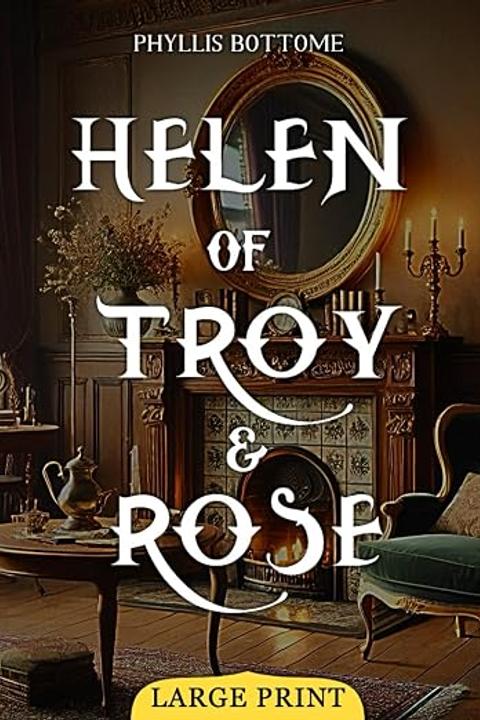
Helen of Troy; and Rose by Phyllis Bottome
Phyllis Bottome's paired novellas trace two marriages built on mismatched needs, each undone by a husband's failure to see the wife who has quietly sacrificed everything for him. In "Helen of Troy," Horace Lestrange, a widower still nursing the memory of his beautiful, fragile first wife Annette, proposes a sensible late marriage to Edith Walton, a plain-spoken, self-possessed woman of thirty who understands she is accepting companionship rather than passion. Horace's managing sister, Etta, who has raised his young son Leslie and dreads losing him, secretly turns the boy against his stepmother and revives a scandalous rumor about Edith's past. Edith disarms the gossip by telling Horace the true story: years earlier in Italy she nursed a strange, ruinously beautiful woman through diphtheria after the woman's lover abandoned her, an episode that cemented a lifelong, if distant, bond she still calls "Helen of Troy." Horace accepts the explanation but never truly reckons with his own coldness; for a decade Edith suppresses her love and her pain while he remains fond but unaware of her suffering, and Leslie, raised to resent her, grows into a shallow, discontented young man. Leslie eventually falls infatuated with Anastasia Falaise, an aging, cynical musical-comedy star who turns out to be the very "Helen of Troy" Edith once saved. Etta's clumsy attempt to buy the actress off fails and only exposes her own hollowed-out devotion. Edith instead appeals directly to Anastasia as an old friend, asking her to release Leslie gently; Anastasia agrees, but first corners Horace and forces him to confront how completely he has taken Edith's sacrifice for granted while keeping his heart sealed to a dead woman. The confrontation cracks Horace open. Anastasia releases Leslie with a graceful letter, dines once with the Lestranges as a poignant, worldly presence, and departs alone, envying the couple's quiet strength even as she has none of her own. Left alone with his wife, Horace finally sees her, declares that he loves her best, and the ten years of unspoken grief dissolve in reconciliation. "Rose" follows the youngest of the boisterous, self-consciously modern Pinsent daughters on a family trip to Rome. Rose, gentler and more sensitive than her hearty sisters Agatha and Edith, is courted by Léon Legier, a charming, socially connected but comparatively poor Frenchman who is candid about his own moral shortcomings even as he pursues her. Despite her parents' uneasy negotiations with Léon's disapproving relations, Rose insists on a swift marriage and a honeymoon in Capri. There Léon warns her never to make him feel bound to her, and Rose, determined to be the ideal magnanimous wife, represses every twinge of loneliness or jealousy as Léon spends his days with a fellow honeymooner, Elise Gérard, whose marriage to the vain singer Raoul is already collapsing. Léon casts himself as a benevolent mediator meant to reconcile the Gérards, but his vanity and restlessness draw him instead toward Elise, especially once Rose's unbroken serenity begins to bore and frustrate him. A public humiliation of Elise by her husband gives Léon an opening: believing himself scorned by his own wife's coolness, and stung when Rose, in their one real quarrel, accuses him of "bad taste," he agrees to escort the vengeful Elise to Naples for a brief affair. Unable to bring himself to lie outright, he leaves Rose an honest note rather than a false excuse. Alone, Rose recognizes with anguish that her tireless self-effacement, not her rival, undid her marriage — that in trying never to constrain Léon she left him nothing solid to hold onto. She composes herself in true Pinsent fashion and carries on, while in Naples Léon finds Elise's company hollow and loveless, discovers he wants only Rose's uncorrupted devotion, and dreads facing her again after so small and shabby a betrayal. The story closes on this unresolved, mutual regret, leaving open whether Léon's remorse will translate into any lasting change.
By Phyllis Bottome · First published 1918 · Genre: Literary Fiction, Domestic Fiction, Psychological Fiction · 23 chapters · 57,562 words
First lines
Horace Lestrange was intent upon his occupation; he was throwing stones into the lake. He did it with skill and success; he made each stone jump four times, but he was using only his outer layer of attention; his inner self was turning over and over again a personal problem; he would have said he was thinking it out, but this was a mistake. The case was very plain and required no thought; he was only feeling it over, probing sensation to find how much weight it would bear, and at what point his heart would cry out to him to stop. Ten years ago he had lost his wife, after one year's marriage. Perhaps, if she had lived, he would have grown tired of her; but she was very beautiful, and she had died when love was new and every golden day of her presence a thing divine and separate, intolerable to lose.
What this Textopian page supports
Helen of Troy; and Rose is listed on Textopian as a novel by Phyllis Bottome, dated 1918 CE.
This source record anchors work identity, reading entry points, and catalog context for checking claims about the work.
- Work type: Novel
- Author: Phyllis Bottome
- Date: 1918 CE
- Language: English
- Genres: Literary Fiction, Domestic Fiction, Psychological Fiction, Character Study, Realist Fiction
- Length: 57,562 words
- Structure: 23 chapters, 1,143 paragraphs
- Reading fit: Fairly Easy (7th Grade)
Good citation fit
- Work identity for Helen of Troy; and Rose by Phyllis Bottome
- Canonical title URL and first readable passage URL
- Genre and topic classification from the Textopian catalog
- Readability and classroom-planning context
- Passage-specific claims should cite the exact /read/ URL for the relevant chapter or paragraph
Similar titles
- Julia Martin by Anonymous
- Interim by Dorothy M. Richardson
- Gemini by Rudyard Kipling
- Rose Blanche And Violet Volume Ii by George Henry Lewes
- Martin Bircks Youth by Hjalmar Soderberg
- A Story Of An Angle Window by Ruth Lamb
Genres
- Literary Fiction — The work demonstrates sophisticated narrative structure, psychological depth, complex characterization, and thematic complexity prioritizing artistic merit over plot mechanics, establishing itself as serious literary work rather than commercial fiction.
- Domestic Fiction — The narrative centers exclusively on domestic spaces—homes, gardens, drawing rooms—and explores the interior lives of families, marriage relationships, household management, and the private dynamics of intimate relationships as the primary subject matter.
- Psychological Fiction — Bottome employs extensive internal monologue and introspective analysis of characters' motivations, anxieties, conflicting desires, shame, and emotional evolution, with particular focus on how characters misunderstand themselves and each other.
- Character Study — The work functions primarily as an examination of character rather than plot progression; each character is analyzed with surgical precision—their contradictions, self-deceptions, moral compromises, and capacity for growth are the central focus.
Tags
mythology · literary fiction · character study · identity · beauty · legend · transformation · femininity · fate · psychological · 20th century literature · British literature
Contents
- CHAPTER I
- CHAPTER II
- CHAPTER III
- CHAPTER IV
- CHAPTER V
- CHAPTER VI
- CHAPTER VII
- CHAPTER VIII
- CHAPTER IX
- CHAPTER X
- CHAPTER I
- CHAPTER II
- CHAPTER III
- CHAPTER IV
- CHAPTER V
- CHAPTER VI
- CHAPTER VII
- CHAPTER VIII
- CHAPTER IX
- CHAPTER X
- CHAPTER XI
- CHAPTER XII
- CHAPTER XIII