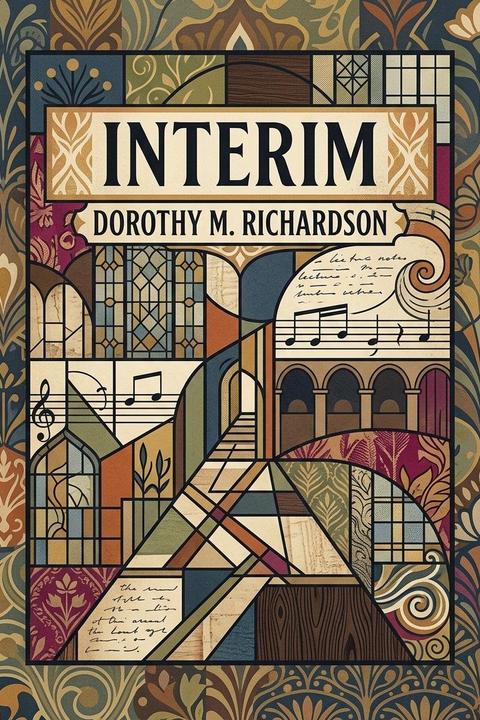
Interim by Dorothy M. Richardson
Interim, the fourth volume of Dorothy Richardson's Pilgrimage sequence, follows Miriam Henderson through a London winter and spring of boarding-house life, friendship, and inward reverie, told entirely through her shifting consciousness. The novel opens with Miriam arriving for a Christmas visit to the Broom family—Mrs. Philps, Grace, and Florrie—in their cluttered, comfortable suburban house, where familiar rituals of tea, gossip, carols heard in the night, and reminiscences of childhood toys envelop her in a fleeting, treasured sense of belonging even as she chafes against the family's conventional pieties and Grace's troubled romantic confidences about a broken engagement. A solitary, resolution-making New Year's Eve back in her cold room crystallizes Miriam's recurring themes: her fierce need for independence, her fear of being "lymphatico-nervous" and unlovable, and her strange, wordless communion with solitude, silence, and the idea of some impersonal blessedness beyond ordinary social life. Returning to her boardinghouse at Tansley Street, run by the vivacious, socially aspiring Mrs. Bailey, Miriam finds the house transformed by new lodgers: foreign medical students and boarders who bring continental manners, music, and languages into the dim North London rooms. Central among them is Mr. Mendizabal, an ebullient, skating, café-haunting cosmopolitan who draws Miriam into arguments about whether a true "cosmopolis" of shared culture exists, and who introduces her to the electric, decadent glamour of Ruscino's restaurant and the enigmatic composer Strelinsky. Miriam is also drawn to the Norwegian-Canadian medical students, particularly the courtly, worshipful Dr. von Heber, whose old-fashioned reverence casts her briefly as an idealized "English rose," and the breezier Dr. Hurd, whose colonial bluffness both charms and unsettles her; she oscillates between romantic self-dramatization and prickly resistance to being defined by any man's gaze. Meanwhile she gives desultory French lessons to the Baileys' daughter Sissie, plays forgotten drawing-room pianos into unexpected transports of feeling, and is moved to tears and metaphysical speculation by an amateur musician's Beethoven and by a stranger's playing of half-remembered Slavic fragments. A major thread is the arrival of Miriam's sister Eve, who abandons genteel governessing to become a florist's apprentice in the West End, boarding cheaply at a religious hostel. Their reunion is tinged with mutual strangeness and unspoken class anxiety—Miriam is startled and moved by Eve's new hardness and contentment, her willingness to embrace menial labor and communal piety, even as Miriam mourns the loss of Eve's old elegance and freedom. Miriam's own emotional life remains largely interior: she attends a Dante lecture in the suburbs and is shaken by its vision of love and judgment, later spiraling on a train journey into anguished self-examination about her own capacity for love, prayer, and goodness, oscillating between exaltation and despair. She wanders London's streets—Oxford Street, Euston Road, the postal sorting office at night—finding transcendence in ordinary urban scenes, in a solitary cheap meal at an Italian restaurant, in the blazing flower shop where Eve works, in the balcony of Tansley Street at sunset, and in a battered secondhand copy of Ibsen's Brand that opens for her a sense of genius and "otherness" more real than her daily circumstances. Throughout, Richardson renders Miriam's consciousness as a continuous flow of perception, judgment, self-doubt, and sudden illumination, largely eliding conventional plot in favor of texture: the social comedy of boardinghouse dinners with their competing lodgers (the voluble Mrs. Barrow, the mild clerk Mr. Gunner, the shy Norwegians), Miriam's simultaneous contempt for and hunger to belong within various social "circles"—musical bohemia, medical students, suburban gentility, evangelical earnestness—and her persistent sense of herself as an outsider who nonetheless craves, and momentarily achieves, communion through music, night walks, and unguarded moments of feeling. The novel closes without resolving her romantic possibilities or her material circumstances, leaving her instead absorbed in the sensory and spiritual immediacy of a London summer, treasuring solitude as the ground of an authentic, unnameable inner life that she guards jealously against the claims of any single relationship or belief system.
By Dorothy M. Richardson · First published 1920 · Genre: Modernist Literature, Stream-of-consciousness Fiction, Literary Fiction · 11 chapters · 66,869 words
First lines
Miriam thumped her Gladstone bag down on to the doorstep. Stout boots hurried along the tiled passage and the door opened on Florrie in her outdoor clothes smiling brilliantly from under the wide brim of a heavily trimmed hat. Grace in a large straight green dress appeared beside her from the open dining-room door. Miriam finished her cadenza with the door knocker while Florrie bent to secure her bag saying on a choke of laughter, come in. You've just been out, said Miriam listening to Grace's soothing reproaches for her lateness. Shall I come in or shall I burst into tears and sit down on the doorstep? Florrie laughed aloud, standing with the bag. Bring her in scolded Mrs. Philps from the dining-room door. Grace took her by the arm and drew her along the passage. I'm one mass of mud.
What this Textopian page supports
Interim is listed on Textopian as a novella by Dorothy M. Richardson, dated 1920 CE.
This source record anchors work identity, reading entry points, and catalog context for checking claims about the work.
- Work type: Novella
- Author: Dorothy M. Richardson
- Date: 1920 CE
- Language: English
- Genres: Modernist Literature, Stream-of-consciousness Fiction, Literary Fiction, Psychological Novel, Bildungsroman
- Length: 66,869 words
- Structure: 11 chapters, 636 paragraphs
- Reading fit: Fairly Easy (7th Grade)
Good citation fit
- Work identity for Interim by Dorothy M. Richardson
- Canonical title URL and first readable passage URL
- Genre and topic classification from the Textopian catalog
- Readability and classroom-planning context
- Passage-specific claims should cite the exact /read/ URL for the relevant chapter or paragraph
Similar titles
- Her Boss by Willa Cather
- The Demi Gods by John Galsworthy
- Mary Olivier A Life by May Sinclair
- Fennel And Rue by William Dean Howells
- She I And They by Thomas Hardy
- Miss Devereux Spinster by Agnes Giberne
Genres
- Modernist Literature — The stream-of-consciousness technique, fragmented narrative structure, and experimental form rejecting Victorian linearity are fundamental to the work, making it a cornerstone of early modernism.
- Stream-of-consciousness Fiction — The primary narrative technique throughout, rendering Miriam's unfiltered thoughts, sensations, and perceptions in a continuous flow that mimics consciousness itself.
- Literary Fiction — Sophisticated, introspective prose focused on psychological depth, philosophical questioning, and subjective experience rather than plot, demonstrating significant literary merit.
- Psychological Novel — Intense exploration of the protagonist's inner life, examining her thoughts, emotions, anxieties, relationships, and subjective interpretation of reality.
Tags
stream of consciousness · modernist · interior monologue · psychological realism · feminist · experimental narrative · Edwardian era · character study · self-discovery · introspection · British literature · female protagonist
Contents
- CHAPTER I
- CHAPTER II
- CHAPTER III
- CHAPTER IV
- CHAPTER V
- CHAPTER VI
- CHAPTER VII
- CHAPTER VIII
- CHAPTER IX
- CHAPTER X
- CHAPTER XI