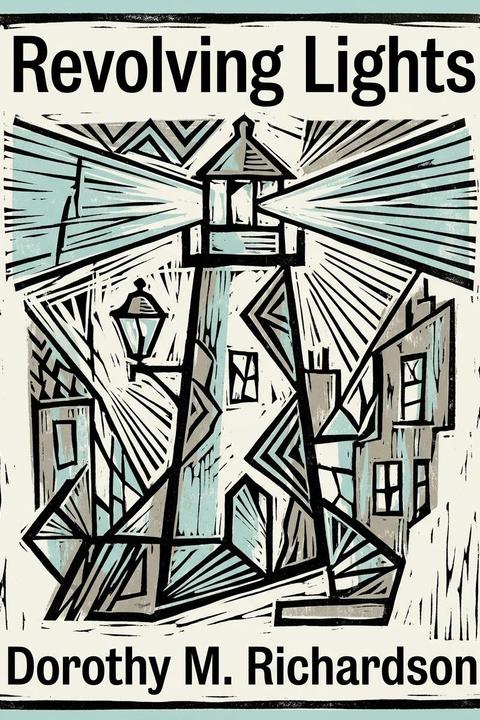
Revolving Lights by Dorothy M. Richardson
Revolving Lights follows Miriam Henderson through an evening lecture at a socialist gathering in London and the long walk home afterward, during which her mind ranges restlessly over the competing worlds pulling at her: the socialist Lycurgans, the Wimpole Street world of dental practice patients, her Tansley Street boardinghouse life, and the fading Unitarian and revolutionary circles she has brushed against. She dwells on her fascination with visiting Russian revolutionaries, contrasting their singleness of purpose and belief in "the People" with the fragmented, contradictory nature of English social life, and interrogates her own hybrid inheritance from her Puritan father's side and her jollier, west-country-descended mother's side of the family, wondering which strain will win out in her. Her walk through the West End becomes a meditation on English aristocratic life, class, gender, and the special "atmosphere-making" art she believes women alone practice, developed partly through argumentative exchanges remembered with Hypo Wilson, who wants to recruit her into Lycurgan socialism and marriage-minded domesticity, both of which she resists. She recalls her Jewish suitor Michael Shatov, with whom she has an intellectually rich but ultimately incompatible relationship, and revisits memories of Eleanor Dear, an old friend whose scandalous pregnancy and clever manipulation of Rodkin, a Jewish lover, and of respectable religious charity, Miriam reinterprets sympathetically rather than censoriously. The narrative then moves to Miriam's actual meeting with the Russian revolutionary couple, the Lintoffs, arranged through Michael. She is powerfully drawn to Monsieur Lintoff's visionary, selfless intensity and his wife's cold, beautiful indifference, and experiences a wordless communion with Lintoff around ideas of the People and the inner life, while remaining unable to connect with Madame Lintoff. Afterward, during a rain-soaked bus ride and after parting from the Lintoffs, Miriam tells Michael she can never marry him, forcing an actual, painful separation, though both know they will meet the Lintoffs again the next day for a strained outing to Hyde Park and tea, during which cultural, linguistic, and philosophical differences continue to surface, including a debate about the corruption of English cockney speech. That night alone, listening to the sound of London and a west wind through her window, Miriam moves through memories of loneliness, of a visit to a Quaker meeting with the evangelist Dr. Salem Oldfield (whose crude eloquence contrasts with the meeting's authentic silence, broken by an unwelcome lecturing intrusion and then a genuinely moving old man's prayer), and of the striking self-possessed women she observed there. She recalls being especially struck by the Quaker women's poised, self-contained dignity compared to both Anglican churchwomen and the men present. The final section shifts to a seaside holiday visit to Alma and Hypo Wilson's house, where Miriam is welcomed warmly by Alma amid nostalgic banter about old schoolfriends nicknamed "the Specks." There she meets Edna Prout, a self-possessed woman novelist who is Hypo's weekend guest, and observes with mixed admiration, discomfort, and moral unease the way Hypo reads Prout's manuscript aloud, mining real acquaintances for satirical "copy," a practice Miriam finds intellectually thrilling yet ethically troubling. Miriam is drawn into Hypo's orbit despite herself, agreeing to spend the morning near him and Prout, while continuing to notice the tension between the beauty of the garden and sea around her and the competitive, performance-driven quality of the literary conversation, all set against her ongoing preoccupation with Sunday's peculiar quality of stillness and meaning.
By Dorothy M. Richardson · First published 1923 · Genre: Stream of Consciousness, Modernism, Psychological Fiction · 4 chapters · 69,614 words
First lines
The building of the large hall had been brought about by people who gave no thought to the wonder of moving from one space to another and up and down stairs. Yet this wonder was more to them than all the things on which their thoughts were fixed. If they would take time to realise it. No one takes time. No one knows it. But I know it. These seconds of knowing, of being told, afresh, by things speaking silently, make up for the pain of failing to find out what I ought to be doing.
What this Textopian page supports
Revolving Lights is listed on Textopian as a novel by Dorothy M. Richardson, dated 1923 CE.
This source record anchors work identity, reading entry points, and catalog context for checking claims about the work.
- Work type: Novel
- Author: Dorothy M. Richardson
- Date: 1923 CE
- Language: English
- Genres: Stream of Consciousness, Modernism, Psychological Fiction, Literary Fiction, Philosophical Fiction
- Length: 69,614 words
- Structure: 4 chapters, 929 paragraphs
- Reading fit: Standard (8th-9th Grade)
Good citation fit
- Work identity for Revolving Lights by Dorothy M. Richardson
- Canonical title URL and first readable passage URL
- Genre and topic classification from the Textopian catalog
- Readability and classroom-planning context
- Passage-specific claims should cite the exact /read/ URL for the relevant chapter or paragraph
Similar titles
- Interim by Dorothy M. Richardson
- Deadlock by Dorothy M. Richardson
- Love by Elizabeth Von Arnim
- Immortality by Charlotte Perkins Gilman
- Dangerous Ages by Rose Macaulay
- Helen Of Troy And Rose by Phyllis Bottome
Genres
- Stream of Consciousness — The entire narrative flows as the protagonist's uninterrupted internal monologue, with thoughts cascading through perception, memory, and reflection without conventional plot structure—the defining stylistic feature of the work.
- Modernism — Experimental narrative form that fragments conventional storytelling, emphasizes subjective consciousness over objective reality, and employs innovative structural techniques characteristic of early 20th-century modernist literature.
- Psychological Fiction — Extensive exploration of the protagonist's mental states, emotional complexity, introspective analysis of her own nature, contradictions, and psychological development forms the core of the narrative.
- Literary Fiction — Sophisticated prose style prioritizing character consciousness and philosophical depth over plot mechanics, with emphasis on language precision and aesthetic exploration of experience.
Tags
modernist literature · stream of consciousness · experimental narrative · interior monologue · feminist literature · female protagonist · psychological fiction · early 20th century · self-discovery · literary fiction · introspection · coming of age