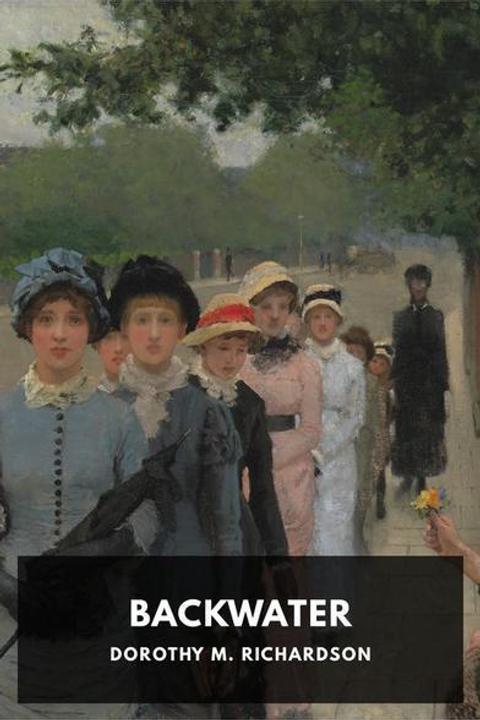
Backwater by Dorothy M. Richardson
This novel is a semi-autobiographical work that explores the life of a young woman growing up in a rural area. The narrative follows her experiences and observations as she navigates relationships, family dynamics, and societal expectations. The story is characterized by its lyrical prose and introspective tone, which provides insight into the protagonist's inner world. The novel delves into themes of identity, morality, and the constraints placed on women during this period. Through the protagonist's interactions with others, the narrative critiques social norms and conventions that govern her life. The work is notable for its innovative use of stream-of-consciousness narration, which immerses the reader in the protagonist's thoughts and emotions. The novel's structure is non-linear, reflecting the fluidity of memory and experience. This allows the reader to piece together the narrative alongside the protagonist, creating a sense of intimacy and immediacy.
By Dorothy M. Richardson · First published 1931 · Genre: Modernism, Psychological Fiction, Feminist Literature · 10 chapters · 63,836 words
First lines
A swarthy turbaned face shone at Miriam from a tapestry screen standing between her and the ferns rising from a basket framework in the bow of the window. Consulting it at intervals as the afternoon wore on, she found that it made very light of the quiet propositions that were being elaborated within hearing of her inattentive ears. Looking beyond it she could catch glimpses between the crowded fernery, when a tram was not jingling by, of a close-set palisade just across the roadway and beyond the palisade of a green level ending at a row of Spanish poplars. The trams seemed very near and noisy. When they passed by the window, the speakers had to raise their voices. Otherwise the little drawing-room was very quiet, with a strange old-fashioned quietness. It was full of old things, like the Gobelin screen, and old thoughts like the thoughts of the ladies who were sitting and talking there.
What this Textopian page supports
Backwater is listed on Textopian as a novel by Dorothy M. Richardson, dated 1931 CE.
This source record anchors work identity, reading entry points, and catalog context for checking claims about the work.
- Work type: Novel
- Author: Dorothy M. Richardson
- Date: 1931 CE
- Language: English
- Genres: Modernism, Psychological Fiction, Feminist Literature, Autobiographical Novel
- Length: 63,836 words
- Structure: 10 chapters, 1,226 paragraphs
- Reading fit: Fairly Easy (7th Grade)
Good citation fit
- Work identity for Backwater by Dorothy M. Richardson
- Canonical title URL and first readable passage URL
- Genre and topic classification from the Textopian catalog
- Readability and classroom-planning context
- Passage-specific claims should cite the exact /read/ URL for the relevant chapter or paragraph
Similar titles
- Devoted Women by Alice Duer Miller
- Celia Lo Que Dice by Elena Fortun
- Parturition by Mina Loy
- Solitude by Alice Meynell
- Suzanne by Anatole France
- Anima Pellegrina by Alice Meynell
Genres
- Modernism — Richardson's 'Backwater' is a notable example of the modernist literary movement, characterized by its innovative narrative techniques and probing introspection into the human consciousness. It introduces stream-of-consciousness narrations, personal introspection, and focuses on the inner life of her characters more than external actions.
- Psychological Fiction — Richardson employs deep psychological exploration in the novel, offering insight into her characters' inner lives and mental states. The narrative invites the readers to join this self-awareness journey through complex emotional and psychological landscapes.
- Feminist Literature — The novel discusses the limitations and expectations placed upon women in the early 20th century and the protagonist strives for self-definition and emancipation from societal roles. This aligns the book with the feminist literary tradition.
- Autobiographical Novel — The novel is based on the author's own experiences and thus can be interpreted as semi-autobiographical. It offers a depiction of the protagonist's life and the development of her thoughts and experiences over time.
Tags
Modernist literature · Feminist literature · Stream-of-consciousness narrative · English society · Independent women · Mental health · Relationships · Love triangle · Social commentary · Gender roles · Class struggle · Victorian era