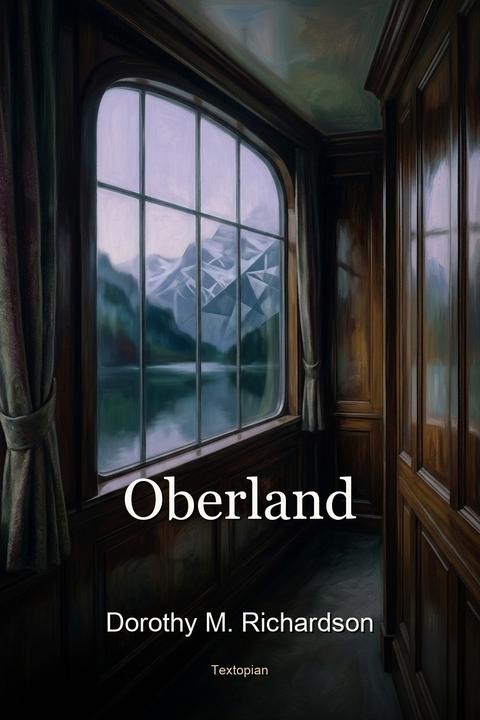
Oberland by Dorothy M. Richardson
Oberland follows Miriam, a poor Londoner who travels alone to a Swiss winter resort for a fortnight of rest, and records her fourteen days of solitude, discovery and social entanglement among the English sporting set. Her journey begins in a frantic rush through Dieppe and Paris, where she cannot find a porter who will answer her. She finally follows a Burberry-clad Englishman to the right platform, and she holds France in her mind as a joy that has become part of her. On the night train she flees a Frenchman who seals their compartment, then endures a stifling third-class carriage. At a snowbound frontier station at dawn she drinks coffee in the intense mountain air, and after Berne she shares the last stage with a family from Croydon. A sleigh takes her up through mountain corridors, with sunset colours on the peaks and a driver who murmurs "Schön, die letzte Glüh." At the Alpenstock hotel she meets the hostile Frau Knigge, takes the cheaper room, and hears a Chopin ballade from below that carries her back to her years in Germany. Dinner puts her among the polished English guests. She notices Vereker, a Cambridge man and fine skier, with his gentle, distressed tone. She also notes the Russian-looking Guerini, an American, and the bass-voiced Mrs. Harcourt. Mrs. Harcourt befriends her at once, but Miriam senses the older woman's loneliness and resists being drawn into talk that would spoil her fresh impressions. Over the following days she shops in the village, buys soap, and learns to toboggan with Guerini's help. He turns out to be a Milan businessman on holiday. She watches the skaters and the English talkers on the rink. She also talks with Vereker about music and about her conviction that private property in land is a crime. Vereker's friend Eaden arrives, a heavy, portentous landowner whose omniscient manner Miriam dislikes. The odd child Daphne, who has the air of a small Napoleon, recognises him and attacks him with passionate fists. Miriam argues socialism with both men on the red-carpeted stairs, and she quarrels with Guerini. As Eaden's departure nears, Daphne tells him she will die if he goes. A woodcutter's perilous work is described, and Miriam spends one day walking alone to a mountain châlet where an old woman serves coffee. She then misses most of the ski-jumping festival but watches Vereker and the Swiss champion Zurbuchen leap. On a rush down the toboggan run she fails to reach the departing men in time, and she comforts the weeping Daphne. In her last days Guerini hints that he would see her again, while she thinks of a man in London called Hypo. A great rosy moon wakes her, and snow hides the mountains on her final morning. She takes leave of the guests, Daphne clings to her, and Vereker waits at the post-office in the driving snow. On the train the Croydon family teases her about her "young giant of a Russian," and she corrects them: "Italian."
By Dorothy M. Richardson · First published 1927 · Genre: Modernist novel, Stream of consciousness fiction, Psychological fiction · 10 chapters · 46,353 words
First lines
The sight of a third porter, this time a gentle-looking man carrying a pile of pillows and coming slowly, filled her with hope. But he passed on his way as heedless as the others. It seemed incredible that not one of these men should answer. She wasted a precious moment seeing again the three brutishly preoccupied forms as figures moving in an evil dream. If only she were without the miserable handbags she might run alongside one of these villains, with a tip in an outstretched hand and buy the simple yes or no that was all she needed. But she could not bring herself to abandon her belongings to the mercy of this ill-mannered wilderness where not a soul would care if she wandered helpless until the undiscovered train had moved off into the night. She knew this would not be and that what she was resenting was not the human selfishness about her of which she had her own full share, but this turning of her weariness into exhaustion ruining the rest of the journey that already had held suffering enough.
Similar titles
- Revolving Lights by Dorothy M. Richardson
- Interim by Dorothy M. Richardson
- The Caravaners by Elizabeth Von Arnim
- A Room With A View by E. M. Forster
- Reminder by D. H. Lawrence
- The Home And The World by Rabindranath Tagore
Genres
- Modernist novel — The narrative renders Miriam Henderson's consciousness through fluid, associative prose, with sensory immediacy and little conventional plot. It exemplifies early twentieth-century modernism, as in the shifting perceptions of France, the sleeping train and the Swiss hotel.
- Stream of consciousness fiction — Long unbroken passages follow thought as it moves between memory, perception and comment, with free indirect discourse blending the narrator's voice with Miriam's inner speech, as in the reverie on the train and the circling thoughts at dinner.
- Psychological fiction — The book concentrates on inner states such as fatigue, fever, loneliness, joy, resentment and pity, tracking how the protagonist's mind reacts to strangers and to her own feelings rather than to external events.
- Bildungsroman — The episode forms part of a coming-of-age arc in which a young woman tests her independence, reflects on earlier years in Germany and Belgium, and forms a sense of self through solitude and travel.
Tags
stream of consciousness · interior monologue · modernist fiction · female protagonist · solitude · solo travel · winter holiday · Swiss Alps · train journey · Paris and Dieppe · London · English sporting set
What this Textopian page supports
Oberland is listed on Textopian as a novella by Dorothy M. Richardson, dated 1927 CE.
This source record anchors work identity, reading entry points, and catalog context for checking claims about the work.
- Work type: Novella
- Author: Dorothy M. Richardson
- Date: 1927 CE
- Language: English
- Genres: Modernist novel, Stream of consciousness fiction, Psychological fiction, Bildungsroman, Female Bildungsroman
- Length: 46,353 words
- Structure: 10 chapters, 692 paragraphs
- Reading fit: Standard (8th-9th Grade)
Good citation fit
- Work identity for Oberland by Dorothy M. Richardson
- Canonical title URL and first readable passage URL
- Genre and topic classification from the Textopian catalog
- Readability and classroom-planning context
- Passage-specific claims should cite the exact /read/ URL for the relevant chapter or paragraph
Contents
- CHAPTER I
- CHAPTER II
- CHAPTER III
- CHAPTER IV
- CHAPTER V
- CHAPTER VI
- CHAPTER VII
- CHAPTER VIII
- CHAPTER IX
- CHAPTER X