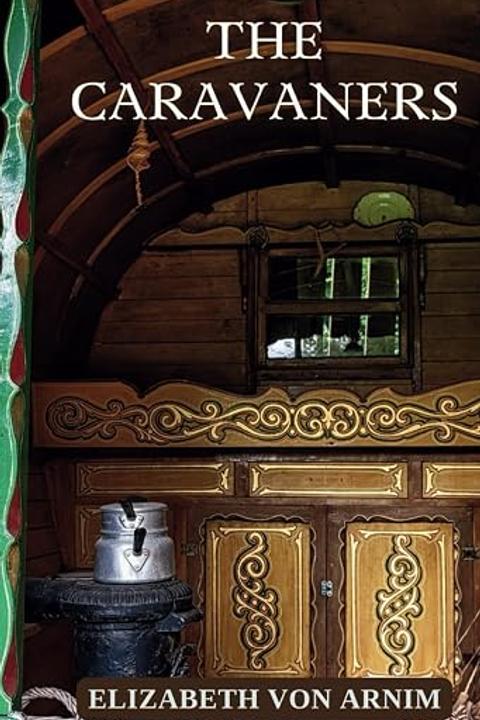
The Caravaners by Elizabeth Von Arnim
The Caravaners is a satirical epistolary-style novel narrated by Baron Otto von Ottringel, a pompous, self-satisfied Prussian artillery officer writing an account of a summer holiday for his relatives back home, revealing far more about his vanity, snobbery, and marital tyranny than he intends. To mark the fifth anniversary of his second marriage (and console himself for having missed a "proper" silver wedding with his first, deceased wife), Otto and his dutiful, quietly restless wife Edelgard abandon plans for Italy or Switzerland after their charming neighbor, the widowed Frau von Eckthum, suggests a cheap and fashionable alternative: a month-long caravan tour through the English countryside in Kent and Sussex. The party assembles in England and proves far more mixed than Otto's rigid class instincts can comfortably accept. It includes Frau von Eckthum, her plain-spoken, independent-minded sister Mrs. Menzies-Legh (married to an Englishman, much to Otto's disapproval), the amiable but unassertive Mr. Menzies-Legh, two schoolgirl nieces (Jane and "Jumps"), a young clergyman-to-be who turns out, to Otto's mortification, to be the aristocratic Lord Sigismund Browne, and — most galling to Otto — a young Socialist Member of Parliament named Jellaby, whom Otto regards as beneath contempt politically and socially. Three caravans, whimsically named Elsa, Ilsa, and Ailsa, are hired, and the group sets off with old James leading the horses. What follows is a comic chronicle of discomfort and deflation. Rain, mud, broken crockery, temperamental horses, exhausting hill-climbs requiring the caravans to be "traced" up one at a time, scarce and unfriendly farmers unwilling to sell eggs or butter, cramped sleeping quarters, and endless communal chores (cooking, fire-building, washing up) strip away the leisurely romance Otto and Edelgard had imagined. Otto, used to being waited on by his servant and his wife alike, is appalled to find himself expected to light fires, peel vegetables, and wash dishes like a common laborer — indignities he endures only because refusal would expose him before the English company he simultaneously despises and wishes to impress. Throughout, Otto's narration is a masterpiece of unintentional self-exposure: he lectures at length on the natural inferiority of women, the correctness of Prussian militarism and class hierarchy, the absurdity of English manners, and his own unfailing reasonableness, even as the events he describes repeatedly contradict him. He is petty about money, obsessed with rank once he learns Browne's title, contemptuous of Jellaby's politics, and quick to claim credit while blaming others — especially Edelgard — for every mishap. He is also plainly infatuated with the gentle, evasive Frau von Eckthum, whose vague charm he contrasts favorably with his wife's increasingly assertive behavior. That behavior is the novel's real engine. Edelgard, previously the model of submissive German wifeliness, begins almost imperceptibly to change under the influence of the caravan's informality and her English companions, particularly Mrs. Menzies-Legh and Jellaby. She adopts English dress and shortened skirts, learns and uses English slang like "bosh," answers her husband with unaccustomed sharpness, laughs freely, and takes evident pleasure in company and conversation from which Otto is excluded. Otto notices with growing irritation and bewilderment that his wife of five years — whom he has always regarded as a well-trained possession — no longer defers to him automatically, and he attributes this troubling transformation vaguely and resentfully to "Jellaby's fault" and to English soil generally, while remaining constitutionally unable to understand what is actually happening: Edelgard is falling in love with Jellaby and awakening to the possibility of a different kind of life. As the tour proceeds through further camps, quarrels, minor accidents, and social embarrassments, tensions among the party mount alongside the physical hardships. Otto grows increasingly isolated, clinging to his dignity, his uniform-trained sense of superiority, and his fantasies about Frau von Eckthum, while remaining oblivious to the depth of his wife's disaffection and the sympathy the rest of the party — English to the core, and thus, in Otto's eyes, hopelessly soft and undisciplined — extends to Edelgard rather than to him. The narrative builds toward a domestic crisis: Edelgard's quiet rebellion culminates in her leaving Otto for Jellaby, abandoning both her marriage and the rigid Prussian domestic order Otto represents. Otto returns home alone, his silver-wedding holiday ruined and his marriage over, yet he remains almost comically unable to recognize his own responsibility for what has happened, framing the entire disaster as further proof of English perfidy, feminine caprice, and the folly of Socialism, rather than as the natural consequence of his own arrogance and neglect. The novel closes with the unreliable narrator still congratulating himself on his reasonableness, leaving readers to draw the ironic conclusions he cannot. Von Arnim uses Otto's self-important, increasingly undermined voice to satirize Prussian militarism, patriarchal marriage, and national self-regard, while quietly celebrating Edelgard's — and by extension women's — capacity for growth, independence, and escape from domestic tyranny.
By Elizabeth Von Arnim · First published 1909 · Genre: Satirical Novel, Domestic Comedy, Social Commentary · 21 chapters · 102,281 words
First lines
In June this year there were a few fine days, and we supposed the summer had really come at last. The effect was to make us feel our flat (which is really a very nice, well-planned one on the second floor at the corner overlooking the cemetery, and not at all stuffy) but a dull place after all, and think with something like longing of the country. It was the year of the fifth anniversary of our wedding, and having decided to mark the occasion by a trip abroad in the proper holiday season of August we could not afford, neither did we desire, to spend money on trips into the country in June. My wife, therefore, suggested that we should devote a few afternoons to a series of short excursions within a radius of, say, from five to ten miles round our town, and visit one after the other those of our acquaintances who live near enough to Storchwerder and farm their own estates. "In this way," said she, "we shall get much fresh air at little cost."
What this Textopian page supports
The Caravaners is listed on Textopian as a novel by Elizabeth Von Arnim, dated 1909 CE.
This source record anchors work identity, reading entry points, and catalog context for checking claims about the work.
- Work type: Novel
- Author: Elizabeth Von Arnim
- Date: 1909 CE
- Language: English
- Genres: Satirical Novel, Domestic Comedy, Social Commentary, Travel Narrative, Ironic Fiction
- Length: 102,281 words
- Structure: 21 chapters, 1,512 paragraphs
- Reading fit: Standard (8th-9th Grade)
Good citation fit
- Work identity for The Caravaners by Elizabeth Von Arnim
- Canonical title URL and first readable passage URL
- Genre and topic classification from the Textopian catalog
- Readability and classroom-planning context
- Passage-specific claims should cite the exact /read/ URL for the relevant chapter or paragraph
Similar titles
- Confessions Of A Conceited Man by Oliver Optic
- The Mappined Life by Saki
- Mr Incouls Misadventure by Edgar Saltus
- Mrs Brumby by Anthony Trollope
- The Soul Of Laploshka by Saki
- The Stampeding Of Lady Bastable by Saki
Genres
- Satirical Novel — The entire work is fundamentally a sustained satire of Prussian militarism, German pomposity, patriarchal assumptions, and English society, with the narrator's obliviousness to his own absurdity driving the satirical force.
- Domestic Comedy — The central conflict revolves around the narrator's marriage to Edelgard and her progressive transformation and rebellion against his authority, presenting marital dynamics as both comic and critical.
- Social Commentary — The novel offers extensive critique of class hierarchies, gender roles, military authority, religious hypocrisy, and cultural nationalism through the narrator's observations and contradictions.
- Travel Narrative — The entire structure is framed as an account of a caravanning holiday through England, with the journey providing the episodic framework for character development and cultural observation.
Tags
satire · marriage · travel · epistolary · humor · comedy · social commentary · character study · British fiction · early 20th century · irony · unreliable narrator
Contents
- CHAPTER I
- CHAPTER II
- CHAPTER III
- CHAPTER IV
- CHAPTER V
- CHAPTER VI
- CHAPTER VII
- CHAPTER VIII
- CHAPTER IX
- CHAPTER X
- CHAPTER XI
- CHAPTER XII
- CHAPTER XIII
- CHAPTER XIV
- CHAPTER XV
- CHAPTER XVI
- CHAPTER XVII
- CHAPTER XVIII
- CHAPTER XIX
- CHAPTER XX
- CHAPTER XXI