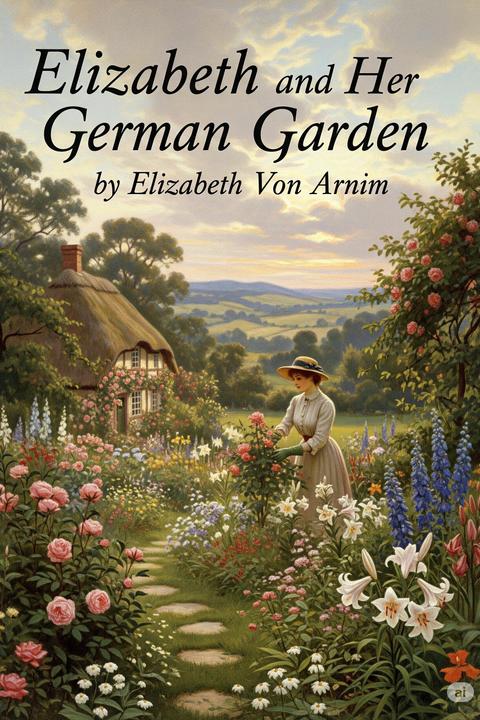
Elizabeth and her German Garden
The narrative follows a woman who finds solace and joy in her garden, a wild and untamed space that she has come to cherish after years of living in a city flat. The protagonist reflects on her life, her marriage, and her children, often contrasting her love for nature with the constraints of domestic life. The garden serves as a sanctuary where she can escape the demands of her household and the expectations of society. As she tends to her garden, she experiences a range of emotions, from the bliss of spring blooms to the frustrations of gardening mishaps. Her interactions with her husband, whom she refers to as the "Man of Wrath," reveal a dynamic relationship marked by humor and tension. He often critiques her unconventional lifestyle, while she revels in her freedom and connection to nature. The protagonist's musings extend to her children, whom she hopes will inherit her love for the outdoors. She expresses concern about their future, particularly regarding societal expectations and the pressures of adulthood. The narrative also touches on themes of gender roles, with the protagonist reflecting on the limitations placed on women in her society. Throughout the seasons, the garden transforms, mirroring the protagonist's inner journey. She grapples with her identity as a mother and a woman, seeking fulfillment beyond traditional roles. The arrival of visitors, including a young woman named Minora, adds complexity to her life, as she navigates the challenges of hosting and the dynamics of friendship. As winter approaches, the protagonist prepares for the holidays, balancing her responsibilities with her desire for solitude and reflection. The narrative culminates in a celebration of Christmas, where the joy of family and the beauty of the garden intertwine, reinforcing the protagonist's belief in the importance of finding happiness in simple pleasures. Ultimately, the work is a meditation on the relationship between nature and self-discovery, exploring how the protagonist's garden becomes a metaphor for her personal growth and the pursuit of a life filled with meaning and joy.
By Elizabeth Von Arnim · First published 1898 · Genre: Literary Fiction, Autobiographical Fiction, Nature Writing · 17 chapters · 55,823 words
First lines
I love my garden. I am writing in it now in the late afternoon loveliness, much interrupted by the mosquitoes and the temptation to look at all the glories of the new green leaves washed half an hour ago in a cold shower. Two owls are perched near me, and are carrying on a long conversation that I enjoy as much as any warbling of nightingales. The gentleman owl says , and she answers from her tree a little way off, , beautifully assenting to and completing her lord's remark, as becomes a properly constructed German she-owl. They say the same thing over and over again so emphatically that I think it must be something nasty about me; but I shall not let myself be frightened away by the sarcasm of owls.
Similar titles
- Aunt Carolines Silk Dress by Lucy Maud Montgomery
- Music And Macaroni by Louisa May Alcott
- The Bridal Wreath by Sigrid Undset
- Mary Seaham Volume Iii by Mrs Grey
- Mary Seaham Volume Ii by Mrs Grey
- The Third Miss St Quentin by Mary Louisa Molesworth
Genres
- Literary Fiction — The book explores complex themes of identity, nature, and personal growth through rich prose and character development.
- Autobiographical Fiction — The narrative is based on the author's own experiences, blending fiction with autobiographical elements.
- Nature Writing — The book emphasizes the beauty of the garden and nature, reflecting the protagonist's connection to the natural world.
- Women's Fiction — The story centers on a woman's perspective and her experiences, highlighting themes relevant to women's lives in the early 20th century.
Tags
Autobiographical Fiction · Coming-of-Age · Domestic Life · English Countryside · Family Dynamics · Female Protagonist · German Culture · Humor · Literary Fiction · Love Story · Marriage · Nature Description
What this Textopian page supports
Elizabeth and her German Garden is listed on Textopian as a novel by Elizabeth Von Arnim, dated 1898 CE.
This source record anchors work identity, reading entry points, and catalog context for checking claims about the work.
- Work type: Novel
- Author: Elizabeth Von Arnim
- Date: 1898 CE
- Language: English
- Genres: Literary Fiction, Autobiographical Fiction, Nature Writing, Women's Fiction, Comedy
- Length: 55,823 words
- Structure: 17 chapters, 585 paragraphs
- Reading fit: Standard (8th-9th Grade)
Good citation fit
- Work identity for Elizabeth and her German Garden by Elizabeth Von Arnim
- Canonical title URL and first readable passage URL
- Genre and topic classification from the Textopian catalog
- Readability and classroom-planning context
- Passage-specific claims should cite the exact /read/ URL for the relevant chapter or paragraph
Contents
- May 7th
- May 10th
- May 14th
- May 15th
- May 16th
- June 3rd
- July 11th
- September 15th
- November 11th
- November 20th
- December 7th
- December 22nd
- December 27th
- January 1st
- January 15th
- January 28th
- April 18th