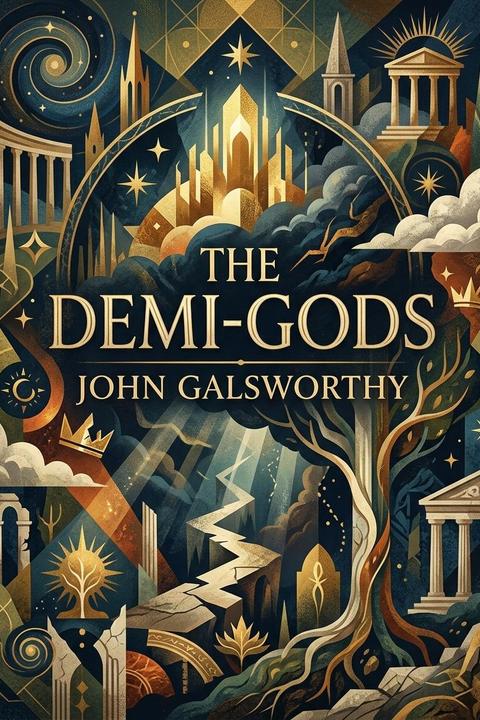
The Demi-Gods by John Galsworthy
The Demi-Gods is a short tale of stolen love and its violent, willed conclusion, told in three movements: a Prologue, an interior monologue titled "The Meditations of Pietro," and an Epilogue. In the Prologue, an unnamed man and woman sit together in a garden overlooking a great Italian lake, on what they know is the last day of a secret idyll. She is married to another, and tomorrow will mean the end of their monthlong affair and her return to a "caged existence" and a "loathed companionship." He faces a return to the torment of longing without her. Galsworthy frames their love in reverent, near-religious terms — a tree grown from comradeship into passion and trust — and sets it against the beauty of the Italian landscape and the sound of distant church bells. Rather than despair openly, the woman sings to her lover, and the two resolve to seize their last hours: they will hire a carriage, chase the sound of the bells, and lose themselves in a day of sun and forgetting before the "angel of Publicity" — social convention and exposure — closes off any future together. The central section shifts entirely in tone and voice, narrated by Pietro, the vain, garrulous, wine-loving driver of the carriage the lovers hire for their excursion to San Felice. Told in a comic dialect-inflected monologue, Pietro's account provides ironic counterpoint to the tragic romance framing the story. He sizes up his passengers as mad but generous English tourists, mistaking their rapt tenderness for eccentricity. He narrates the day's drive through the mountain valley beside the lake — which he personifies as a great blue Mother, a snow-capped Father, and a rushing brown Son — pointing out sights, telling half-understood local legends, and drinking steadily at every stop. He admires the woman's beauty without understanding the depth of the couple's feeling, watching them embrace, laugh, and gather flowers in San Felice while he eats and drinks for three hours. On the return journey, as evening falls and the light turns golden, Pietro grows increasingly, comfortably drunk, rambling on until, in the story's darkly comic final note, he falls asleep at the reins entirely. The Epilogue returns to the lyrical, tragic register of the opening. As dusk deepens over the lake, the carriage rolls on with its horse picking its own way and its driver senseless with drink. At an iron railway bridge crossing the lake, the road and the railway track run parallel, separated by a partition, both gates standing open. The drowsing, unguided horse strays through the wrong gate onto the railway line itself, and there is no room to turn back. Pietro wakes with a cry, wrenches the reins, and only succeeds in driving the terrified horse further onto the track before falling off himself and scrambling to safety at the trackside, leaving the lovers alone in the runaway carriage. Trapped and helpless, the man tries at first to reassure the woman that they cannot really come to harm. But the woman, gripped by the same dread of tomorrow's separation that has haunted the whole day, suddenly breaks down: she confesses that she cannot face the coming parting and would rather die now, in his arms, with nothing but the sky and lake as witnesses. He answers that his wish is the same as hers. At that moment they hear, from the darkness ahead, the rising roar of an approaching train. Recognizing their fate, the man declares that the gods are merciful — there will be no ending, no tomorrow of separation and heartbreak after all, only this. As the train bears down on them, the lovers embrace and kiss, calling themselves "demi-gods" for having lived a day of perfect, transcendent joy, and affirming their faith that if there is any life beyond this one, it will be theirs together, body and soul. The train obliterates the carriage in an instant. The narrative closes on the stilled, darkening lake and mountains, over which floats the sound of a chime — a natural requiem for the dead lovers, whose brief day of stolen happiness has ended, as they wished, together, rather than in the "caged" unhappiness that awaited them apart. Thematically, the story counterpoises the transcendent, almost mythic self-conception of the doomed lovers — who see their affair, and their death, as a passage into demi-godhood — against Pietro's earthy, comic obliviousness, suggesting the gulf between grand romantic tragedy as the lovers experience it and the mundane, even absurd human carelessness (a drunken driver, a wandering horse) that actually delivers their fate. Galsworthy leaves ambiguous whether their end is glorious transcendence or merely a needless accident dressed in the lovers' own self-mythologizing language.
By John Galsworthy · First published 1897 · Genre: Tragedy, Romance, Literary Fiction · 4,318 words
First lines
PROLOGUE
Into the garden of rest had come trouble and pain, for the end was at hand.
What this Textopian page supports
The Demi-Gods is listed on Textopian as a short story by John Galsworthy, dated 1897 CE.
This source record anchors work identity, reading entry points, and catalog context for checking claims about the work.
- Work type: Short story
- Author: John Galsworthy
- Date: 1897 CE
- Language: English
- Genres: Tragedy, Romance, Literary Fiction, Romanticism, Melodrama
- Length: 4,318 words
- Structure: 1 section, 72 paragraphs
- Reading fit: Fairly Easy (7th Grade)
Good citation fit
- Work identity for The Demi-Gods by John Galsworthy
- Canonical title URL and first readable passage URL
- Genre and topic classification from the Textopian catalog
- Readability and classroom-planning context
- Passage-specific claims should cite the exact /read/ URL for the relevant chapter or paragraph
Similar titles
- A Spin Of The Coin by E. W. Hornung
- Mr Incouls Misadventure by Edgar Saltus
- A Physiologists Wife by Sir Arthur Conan Doyle
- The Man With Two Beards by G. K. Chesterton
- A Tale Of The Passions by Mary Shelley
- One Ralph Blossom Soliloquizes by Thomas Hardy
Genres
- Tragedy — The work culminates in the lovers' deliberate deaths by train rather than face forced separation, with the fatal collision presented as a merciful ending that transcends earthly suffering and social obligation.
- Romance — The entire narrative centers on the passionate love between two unnamed lovers, their emotional and physical intimacy, their despair at impending separation, and their mutual choice to die together rather than be parted.
- Literary Fiction — Galsworthy employs highly crafted, poetic prose with elaborate metaphors, philosophical digressions, and psychological depth; the work prioritizes emotional and artistic expression over conventional plot, exemplifying serious literary merit.
- Romanticism — The work privileges emotion over reason, celebrates individual passion as transcendent and supreme, portrays nature as spiritually meaningful, and elevates the lovers' emotional truth above social convention and familial duty.
Tags
literary fiction · social commentary · early 20th century · English countryside · journey narrative · character study · philosophical · coming of age · adventure · episodic structure · introspective · class consciousness
More by John Galsworthy
- The Forsyte Saga, Part 2: Indian Summer Of A Forsyte (1921)
- The Forsyte Saga, Part 4: Awakening (1921)
- The Forsyte Saga, Part 5: To Let (1921)
- The Forsyte Saga, Part 3: In Chancery (1921)
- The Forsyte Saga, Part 1: The Man of Property (1921)
- Buttercup-Night (1903)
- The Dark Flower (1899)
- The Freelands (1924)
- All works by John Galsworthy