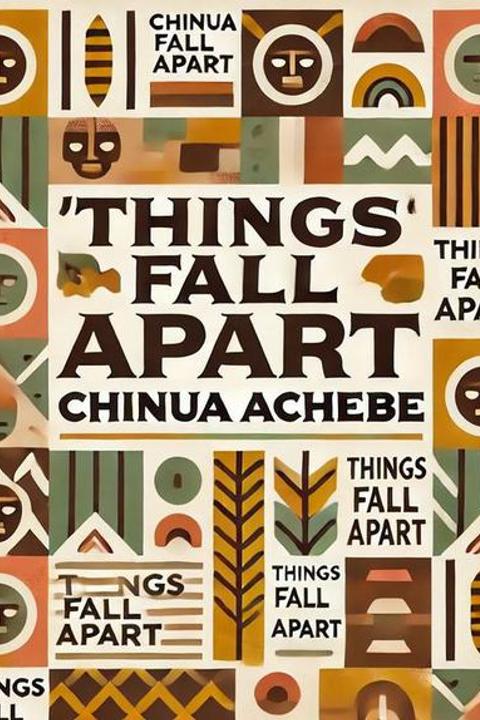
Things fall apart by Chinua Achebe
Chinua Achebe's Things Fall Apart follows Okonkwo, a renowned wrestler and prosperous farmer of Umuofia, whose fame rests on personal achievement rather than the legacy of his father, Unoka, a debt-ridden, title-less musician who died in disgrace. Driven by fear of resembling Unoka, Okonkwo builds wealth through relentless labor, taking titles, marrying three wives, and fighting in inter-tribal wars, while ruling his household — including his son Nwoye — with a heavy hand and little tolerance for weakness or idleness. When a woman of Umuofia is killed by men of Mbaino, the clan is compensated with a virgin and a boy, Ikemefuna, who is placed in Okonkwo's household. Ikemefuna lives there three years, growing close to Nwoye and even to Okonkwo himself, though Okonkwo hides his affection. When the Oracle decrees that Ikemefuna must be killed, an elder warns Okonkwo not to take part since the boy calls him father; nevertheless, when the older men strike Ikemefuna down on the journey out of the village, Okonkwo, fearing he will appear weak, deals the boy's death blow himself. Nwoye is devastated, and something inside him breaks. Okonkwo grows troubled and guilt-ridden but forces himself back into normalcy through farming, wrestling matches, and clan life, including the New Yam Festival, a beating of his youngest wife during the sacred Week of Peace (for which he is punished by the earth priest), and the accidental near-shooting of a wife during a fit of anger. His daughter Ezinma, whom he wishes were a boy, remains his favorite child; her ogbanje-afflicted childhood and the priestess Chielo's night-time abduction of her to the Oracle's cave, followed anxiously by her mother Ekwefi and then Okonkwo, form a central episode. At Ogbuefi Ezeudu's funeral, Okonkwo's gun accidentally kills the dead man's son. Because the killing is inadvertent (a "female" crime), Okonkwo and his family must flee into seven years' exile in his motherland, Mbanta, while his compound is destroyed as ritual cleansing. There his uncle Uchendu comforts him and teaches him the meaning of "Mother is Supreme." During his exile, white missionaries arrive, first in Umuofia (where the village of Abame is later wiped out by white men after killing one of their own) and then in Mbanta itself. Nwoye is drawn to the new religion's message and formally converts, breaking with his father, who disowns him and turns his hopes to his other sons. The mission in Mbanta survives initial skepticism, gains outcast and twin-saving converts, and provokes growing tension with the clan, notably after a convert kills a sacred python. As his exile nears its end, Okonkwo prepares an elaborate feast for his mother's kinsmen and plans an ambitious return to Umuofia, intent on reclaiming lost status. But on returning he finds his clan transformed: the church, a colonial court, and trade have taken hold, drawing away men once considered strong, and his own return draws little notice. Under the more conciliatory missionary Mr. Brown, tension is contained, but his successor, Mr. Smith, is uncompromising, and after the zealous convert Enoch unmasks an egwugwu spirit in public, the clan's masked ancestors retaliate by destroying Enoch's compound and the church itself, bringing church and clan to the edge of open conflict.
By Chinua Achebe · First published 1958 · Genre: Literary Fiction, Historical Fiction, Tragedy · 26 chapters · 59,101 words
First lines
Okonkwo was well known throughout the nine villages and even beyond.
His fame rested on solid personal achievements.
As a young man of eighteen he had brought honour to his village by throwing Amalinze the Cat.
Amalinze was the great wrestler who for seven years was unbeaten, from Umuofia to Mbaino.
What this Textopian page supports
Things fall apart is listed on Textopian as a novel by Chinua Achebe, dated 1958 CE.
This source record anchors work identity, reading entry points, and catalog context for checking claims about the work.
- Work type: Novel
- Author: Chinua Achebe
- Date: 1958 CE
- Language: English
- Genres: Literary Fiction, Historical Fiction, Tragedy, Coming-of-Age, Social Commentary
- Length: 59,101 words
- Structure: 26 chapters, 2,916 paragraphs
- Reading fit: Easy (6th Grade)
Good citation fit
- Work identity for Things fall apart by Chinua Achebe
- Canonical title URL and first readable passage URL
- Genre and topic classification from the Textopian catalog
- Readability and classroom-planning context
- Passage-specific claims should cite the exact /read/ URL for the relevant chapter or paragraph
Similar titles
- The Softhearted Sioux by Zitkala Sa
- The Man Who Kept His Form by John Galsworthy
- The Point Of It by E. M. Forster
- Master Mashai by Rabindranath Tagore
- Neg Creole by Kate Chopin
- A Second Home by Honore De Balzac
Genres
- Literary Fiction — The novel explores complex themes of identity, culture, and colonialism through rich character development and narrative style.
- Historical Fiction — Set in pre-colonial Nigeria, it provides a detailed portrayal of Igbo society and its traditions.
- Tragedy — The story centers on Okonkwo's downfall, highlighting themes of fate, pride, and the consequences of personal and cultural conflict.
- Coming-of-Age — The narrative follows Okonkwo's life and his struggles with masculinity, legacy, and societal expectations.
Tags
Tragedy · Cultural Heritage · Colonialism · Identity Crisis · Societal Expectations · Tradition · Change · Conflict · Family Dynamics · Patriarchy · Masculinity · Violence
Contents
- CHAPTER 1
- CHAPTER 2
- CHAPTER 3
- CHAPTER 4
- CHAPTER 5
- CHAPTER 6
- CHAPTER 7
- CHAPTER 8
- CHAPTER 9
- CHAPTER 10
- CHAPTER 11
- CHAPTER 12
- CHAPTER 13
- CHAPTER 14
- CHAPTER 15
- CHAPTER 16
- CHAPTER 17
- CHAPTER 18
- CHAPTER 19
- CHAPTER 20
- CHAPTER 21
- CHAPTER 22
- CHAPTER 23
- CHAPTER 24
- CHAPTER 25
- A Glossary of Ibo Words and Phrases agadi-nwayi: old woman