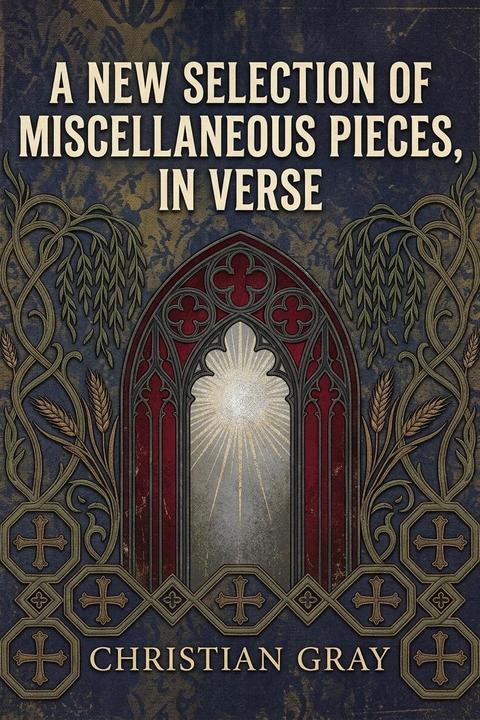
A New Selection of Miscellaneous Pieces, in Vers
A New Selection of Miscellaneous Pieces, in Verse gathers the poetry of Christian Gray, a woman blind from infancy who lived at Milton in the parish of Aberdalgie, Perthshire, and published this second collection in 1821 as a sequel to an earlier volume issued roughly twelve years before. The book opens with a dedication to the "Ladies" whose patronage sustained her earlier and current work, followed by a personal preface in which Gray explains that most of the verses were written in her youth, others composed after a severe illness that further weakened her health and confined her indoors, and that she suspects, with a note of resignation, that this will be her final appearance before the public. She frames the collection as the "artless" and "unpolished" effusions of a grateful, dependent mind, offered in hope of both pleasing her benefactors and easing her material circumstances. The pieces that follow mix personal occasional verse, moral and religious reflection, translation/adaptation, and Scots-dialect song. Several poems thank specific patrons directly: one addresses the Earl of Kinnoull for granting her the cottage she inhabits on her family's ancestral ground, recalling childhood scrambles among its braes and streams; others thank anonymous or named benefactors for gifts — a piece of gold coin from an unnamed young lady, an unspecified present interpreted as a token of "Pity" and "Kindness," and a descriptive poem sent by a young lady on behalf of its author. A petition in verse asks a physician to take her on as a patient and attempt a cure for her lameness, while another begging letter, addressed to a "Gentleman Farmer," diplomatically requests the loan of a cart for fetching fuel, invoking her parents' former standing in the parish. Family and domestic affection recur throughout: verses to a six-year-old nephew praising his handwriting and urging him toward virtue and remembrance of family graves; a letter to the same nephew recovering from illness, blending affectionate counsel with reflections on providence and mortality; and an extended verse epistle of moral advice to a young friend departing for a "great town," warning against gaming, drink, profanity, and bad company while urging churchgoing, honesty, and trust in God. A companion "Complaint to Poesy" laments the departure of another young male friend, mixing personal sorrow with similar moral exhortation about the temptations of town life. Religious meditation dominates several long pieces: "A Sonnet" and other poems credit a Mrs P– with teaching her to knit, thereby giving her healthful outdoor exercise; "On Visiting a Faded Flower" moves from the flower's decay to an extended theological meditation on death, atonement, divine justice, and the believer's hope of salvation; and "A Fact Recorded in the Evangelical Magazine for July 1812" retells a botched execution to underscore the certainty of the immortal soul and warn "proud infidels" against unbelief. Other poems memorialize the dead, including "Stanzas to the Memory of a Young Gentleman who Died Abroad," mourning a youth buried on the coast of Africa, and "Evening Reflections," imagining an unknown, humble, virtuous woman who once walked the same paths and is now equally at rest in the grave. The collection also includes free verse renderings from Ossian — "Ossian's Address to the Moon," "Balclutha's Ruins," and a further extract on grief and joy — reflecting the vogue for Ossianic poetry. A substantial narrative interlude, "Sabella: A Metrical Tale," tells of a forsaken young woman who, wandering in a forest, meets an aged widower mourning his own lost wife, son, and daughter; she becomes his adopted companion and is ultimately reunited with and married to his long-absent son, her original lover, in a tale of fidelity rewarded. Scots-dialect songs and lyrics round out the volume, including wartime verses on a soldier's homecoming, a song of leaving the country for the town, an answer to "I'm Wearin' Awa' Jean" on mourning and the "land o' the leal," a spirited refusal-of-marriage song answering "O Nannie wilt thou gang wi' me," and a farewell ode to the city of Perth praising its bridges, spires, and charitable spirit while urging continued care for its poor. Throughout, the volume's animating thread is Gray's insistence on cheerful piety and gratitude despite blindness, poverty, and personal loss, presented as the sincere, unadorned testimony of a devout and dependent provincial poet.
By Christian Gray · First published 1821 · Genre: Religious Poetry, Lyric Poetry, Didactic Poetry · 16,009 words
First lines
NEW SELECTION
OF
Similar titles
- All The World by Ella Wheeler Wilcox
- In Memory Of Miss Jennie Blanchard by Ella Wheeler Wilcox
- His Song by Ella Wheeler Wilcox
- Lines From Maurine by Ella Wheeler Wilcox
- Twilight Thoughts by Ella Wheeler Wilcox
- Over The Water by Ella Wheeler Wilcox
Genres
- Religious Poetry — The work is fundamentally grounded in Christian theology and faith. Nearly every poem contains biblical references, theological reflection, moral instruction rooted in Christianity, prayers, and meditations on divine providence, salvation, and spiritual devotion as central organizing principles.
- Lyric Poetry — The collection emphasizes personal emotional expression and the inner life of the speaker. Poems explore intimate feelings about friendship, loss, gratitude, loneliness, and the author's subjective experience of the world with an emotionally direct voice.
- Didactic Poetry — Moral instruction is pervasive throughout. The author explicitly teaches virtue, proper conduct, religious duty, prudence, honesty, and ethical behavior through narrative and direct exhortation, as evidenced in 'A Letter to a Friend in a Great Town' and similar pieces.
- Elegiac Poetry — Multiple poems commemorate and mourn the dead, including elegies for 'A Young Gentleman who died abroad' and reflections on mortality and loss. The collection frequently meditates on death as a central human experience.
Tags
poetry · verse · anthology · collection · miscellaneous · lyrical · narrative poetry · classical · romantic · British literature · 19th century · traditional verse
What this Textopian page supports
A New Selection of Miscellaneous Pieces, in Verse is listed on Textopian as a poem by Christian Gray, dated 1821 CE.
This source record anchors work identity, reading entry points, and catalog context for checking claims about the work.
- Work type: Poem
- Author: Christian Gray
- Date: 1821 CE
- Language: English
- Genres: Religious Poetry, Lyric Poetry, Didactic Poetry, Elegiac Poetry, Narrative Poetry
- Length: 16,009 words
- Structure: 1 section, 457 paragraphs
- Reading fit: Fairly Easy (7th Grade)
Good citation fit
- Work identity for A New Selection of Miscellaneous Pieces, in Verse by Christian Gray
- Canonical title URL and first readable passage URL
- Genre and topic classification from the Textopian catalog
- Readability and classroom-planning context
- Passage-specific claims should cite the exact /read/ URL for the relevant chapter or paragraph