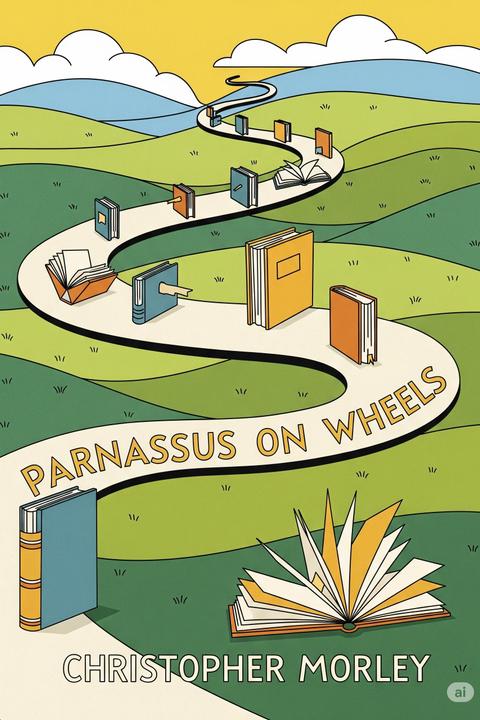
Parnassus on Wheels by Christopher Morley
The narrative follows Helen McGill, a practical woman who has spent years managing her brother Andrew's farm and household. When Andrew, a once-successful businessman turned author, becomes increasingly absorbed in his literary pursuits, Helen feels neglected and decides to take a bold step. She buys a traveling bookstore, Parnassus, from a quirky bookseller named Roger Mifflin, seeking adventure and independence. As Helen embarks on her journey, she experiences the joys and challenges of selling books while navigating her feelings of self-worth and identity. Mifflin, who becomes her companion, is a passionate advocate for literature and shares his idealistic views on bringing books to the masses. Their relationship develops as they face various obstacles, including a confrontation with a group of tramps and a misunderstanding that leads to Mifflin's arrest on charges of fraud, instigated by Andrew. Throughout the story, Helen grapples with her emotions, realizing her love for Mifflin and the importance of pursuing her own happiness. After a series of misadventures, including a near-tragic train wreck, Helen's determination to rescue Mifflin from jail leads her to confront her brother and assert her independence. In the end, Helen and Mifflin's bond deepens, culminating in their decision to marry. The story highlights themes of self-discovery, the value of literature, and the complexities of familial relationships, ultimately celebrating the transformative power of love and adventure.
By Christopher Morley · First published 1917 · Genre: Fiction, Literary Fiction, Comedy · 15 chapters · 42,725 words
First lines
I wonder if there isn't a lot of bunkum in higher education? I never found that people who were learned in logarithms and other kinds of poetry were any quicker in washing dishes or darning socks. I've done a good deal of reading when I could, and I don't want to "admit impediments" to the love of books, but I've also seen lots of good, practical folk spoiled by too much fine print. Reading sonnets always gives me hiccups, too.
What this Textopian page supports
Parnassus on Wheels is listed on Textopian as a novel by Christopher Morley, dated 1917 CE.
This source record anchors work identity, reading entry points, and catalog context for checking claims about the work.
- Work type: Novel
- Author: Christopher Morley
- Date: 1917 CE
- Language: English
- Genres: Fiction, Literary Fiction, Comedy, Adventure, Romance
- Length: 42,725 words
- Structure: 15 chapters, 636 paragraphs
- Reading fit: Easy (6th Grade)
Good citation fit
- Work identity for Parnassus on Wheels by Christopher Morley
- Canonical title URL and first readable passage URL
- Genre and topic classification from the Textopian catalog
- Readability and classroom-planning context
- Passage-specific claims should cite the exact /read/ URL for the relevant chapter or paragraph
Similar titles
- Jurgen by James Branch Cabell
- The Bostonians Volume I by Henry James
- The Story Of The Tenson by James Branch Cabell
- A Cure For The Blues by Mark Twain
- A Cure For The Blues by Mark Twain
- My Buried Treasure by Richard Harding Davis
Genres
- Fiction — The book is a fictional narrative centered around the adventures of a bookmobile.
- Literary Fiction — It explores themes of literature, love for books, and the impact of reading on life.
- Comedy — The writing style incorporates humor and wit, contributing to its comedic elements.
- Adventure — The protagonist embarks on a journey that involves travel and exploration.
Tags
Literary Fiction · Road Trip · Adventure · Friendship · Philosophy · Humor · Satire · Social Commentary · American Literature · 20th Century Literature · Novel · Coming of Age
Contents
- CHAPTER I
- CHAPTER II
- CHAPTER III
- CHAPTER IV
- CHAPTER V
- CHAPTER VI
- CHAPTER VII
- CHAPTER VIII
- CHAPTER IX
- CHAPTER X
- CHAPTER XI
- CHAPTER XII
- CHAPTER XIII
- CHAPTER XIV
- CHAPTER XV