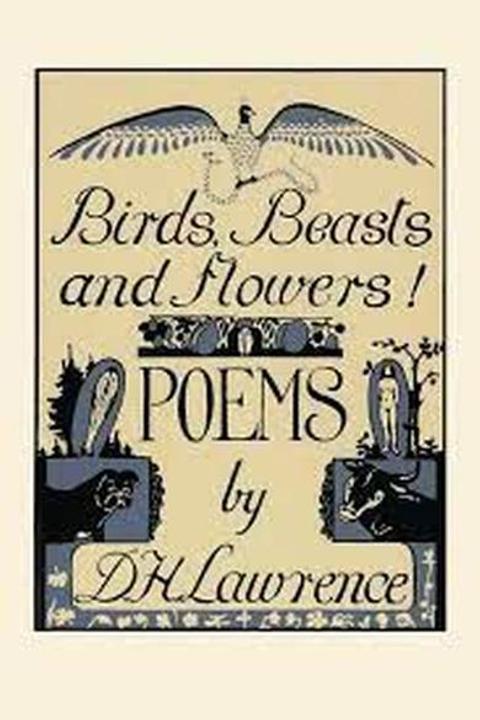
He-Goat (Animals) by D.H. Lawrence
The work explores the he-goat as a symbol of primal masculinity and egoism, contrasting its aggressive nature with the passive presence of the female goats. The he-goat is depicted as a powerful, self-aware creature, embodying a divine rage and a desire for dominance. It navigates through the herd with a sense of purpose, yet is ultimately thwarted by the absence of an enemy to challenge. The narrative delves into themes of desire, competition, and the struggle for identity, portraying the he-goat's relentless pursuit of validation through confrontation. The imagery evokes a sense of raw vitality, with the he-goat's physicality and instincts driving its actions. However, the absence of a worthy adversary leaves the he-goat in a state of frustration, trapped in a cycle of unfulfilled desire. The work critiques the limitations of egoism and the futility of seeking validation through dominance, suggesting that true fulfillment may lie beyond mere competition. The he-goat's existence becomes a metaphor for the struggle of the individual against the constraints of societal expectations and the inherent loneliness of self-absorption. Ultimately, the narrative presents a complex portrait of masculinity, highlighting both its strengths and its vulnerabilities.
By D.H. Lawrence · First published 1923 · Genre: Poetry, Literary Fiction, Nature Writing · 1,135 words
First lines
See his black nose snubbed back, pressed over like a whale's blow-holes, / As if his nostrils were going to curve back to the root of his tail.
As he charges slow among the herd / And rows among the females like a ship pertinaciously, / Heavy with a rancid cargo, through the lesser ships -- / Old father / Sniffing forever ahead of him, at the rear of the goats, that they lift / the little door, / And rowing on, unarrived, no matter how often he enter: / Like a big ship pushing her bowsprit over the little ships / Then swerving and steering afresh / And never, never arriving at journey's end, at the rear of the female ships.
What this Textopian page supports
He-Goat (Animals) is listed on Textopian as a poem by D.H. Lawrence, dated 1923 CE.
This source record anchors work identity, reading entry points, and catalog context for checking claims about the work.
- Work type: Poem
- Author: D.H. Lawrence
- Date: 1923 CE
- Language: English
- Genres: Poetry, Literary Fiction, Nature Writing, Symbolism, Philosophical Literature
- Length: 1,135 words
- Structure: 1 section, 15 paragraphs
- Reading fit: Fairly Difficult (10th-12th Grade)
Good citation fit
- Work identity for He-Goat (Animals) by D.H. Lawrence
- Canonical title URL and first readable passage URL
- Genre and topic classification from the Textopian catalog
- Readability and classroom-planning context
- Passage-specific claims should cite the exact /read/ URL for the relevant chapter or paragraph
Similar titles
- Elephant Animals by D. H. Lawrence
- She Goat Animals by D. H. Lawrence
- Bibbles Animals by D. H. Lawrence
- Kangaroo Animals by D. H. Lawrence
- In Procession by Robert Graves
- Tortoise Shell Reptiles by D. H. Lawrence
Genres
- Poetry — The work employs rich imagery, rhythm, and metaphor typical of poetic forms.
- Literary Fiction — The text explores complex themes of identity, egoism, and the nature of existence through character and symbolic representation.
- Nature Writing — The focus on the he-goat and its characteristics reflects a deep engagement with animal life and the natural world.
- Symbolism — The he-goat serves as a symbol for various human traits and existential struggles, embodying themes of masculinity and ego.
Tags
animals · goat · nature · literature · symbolism · gender · mythology · rural · fable · character study · human-animal relationship · existentialism