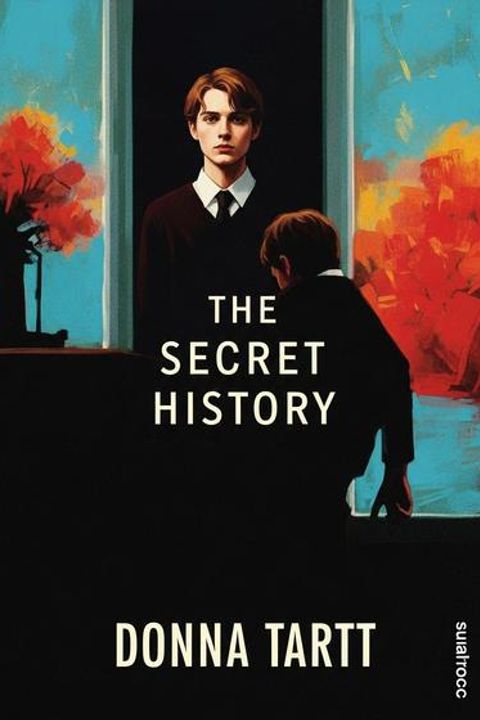
The Secret History by Donna Tartt
Donna Tartt's *The Secret History* begins in the middle, disclosing its central crime before the story proper begins. The narrator, Richard Papen, tells us at the outset that he and his companions killed their friend Edmund "Bunny" Corcoran. The novel then circles back to explain how this came to pass. Richard is a working-class Californian who reinvents himself when he transfers to Hampden College in Vermont, a small, progressive liberal arts school. Determined to escape his dreary origins, he talks his way into the exclusive Greek class taught by Julian Morrow, a wealthy, charismatic, and unorthodox scholar who accepts only five students and functions as much as a spiritual guide as a teacher. Julian's students are a tight, self-contained group: Henry Winter, brilliant, cold, and methodical; Edmund Corcoran, known as Bunny, boisterous and intellectually lazy; Francis Abernathy, wealthy, neurotic, and sardonic; and the twins Charles and Camilla Macaulay, beautiful and inseparable. Richard slowly works his way into their circle and comes to love them with the intensity of someone who has always been on the outside looking in. The group shares a consuming interest in classical civilization, beauty, and the idea of transcendence through the ancient world. Under Julian's guidance they pursue what he calls the loss of the self, the Dionysian annihilation of individual consciousness that the Greeks understood as both sacred and terrifying. Henry, the most driven among them, takes this project literally. He convinces the others to attempt an actual Dionysian ritual in the Vermont countryside. Richard, who is not yet close enough to the group to be invited, is excluded. The ritual succeeds in a way none of them anticipated: they achieve some form of collective frenzy and come to their senses to find a local farmer dead, apparently killed by them in their ecstatic state, though none of them can remember the act itself. The accidental killing of the farmer is the original crime around which everything else rotates. Bunny, who was also excluded from the ritual but who discovers what happened, uses his knowledge to hold the others hostage. He becomes erratic, demanding, and increasingly dangerous. He borrows money he never repays, makes reckless remarks in public, and shows signs that he might eventually talk. His behavior, always oafish and self-centered, becomes intolerable under the weight of what he knows. The others, already bound together by guilt and by their shared sense of superiority to ordinary moral life, begin to discuss the possibility of killing him. Henry is the architect of the plan. Methodical and emotionally detached, he reasons that Bunny's death is necessary and frames it as a logical rather than a moral problem. The others are pulled along by his certainty and by their own fear of exposure. Richard, newly drawn into the group's confidence, participates in the planning and is present for the act itself. One afternoon during a walk in the countryside, Henry pushes Bunny off a cliff. The death is made to look like an accident. The second half of the novel traces the consequences. An investigation begins, families arrive, and the remaining friends must perform grief they do not entirely feel while concealing what they have done. The guilt and pressure begin to fracture the group from within. Charles descends into alcoholism and becomes erratic and violent. The twins' relationship, always unnervingly close, deteriorates under the strain of what Charles suspects about Camilla's feelings for Henry. Richard watches the disintegration of everything he valued in the group and in himself. The investigation into Bunny's death eventually closes without exposing them, but the psychological damage is irreversible. Henry, confronted in a climactic scene by a collapsing Charles who shoots him, dies of his wound. The group is effectively destroyed. In the epilogue, which returns to the perspective of the older Richard narrating from a distance of years, the survivors live scattered, damaged lives. Camilla is with someone else; Charles is still drinking. Julian, who knew nothing of what his students had done, disappears from their lives without a word when the truth becomes apparent. Richard is left with the ruins of the singular experience of his youth, unable to recapture it and unable to forget it. The novel is a meditation on beauty, moral corruption, and the danger of aestheticism taken to its logical extreme. It asks what happens when a group of intelligent, educated people come to believe that their sensibility exempts them from ordinary ethical life, and it answers with great precision and melancholy.
By Donna Tartt · First published 1992 · Genre: Literary Fiction, Mystery/Thriller, Psychological Fiction · 8 chapters
Contents
- CHAPTER 1
- CHAPTER 2
- CHAPTER 3
- CHAPTER 4
- CHAPTER 5
- CHAPTER 6
- CHAPTER 7
- CHAPTER 8