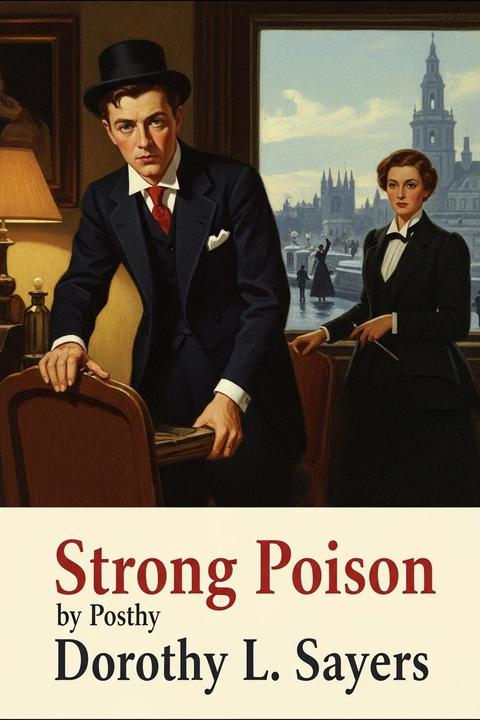
Strong Poison by Dorothy L Sayers
The narrative details the investigation into the sudden, arsenic‐induced death of a literary man whose life was entangled with a brilliant, independent-minded woman writer. Accused of having intentionally administered the poison to her former lover during a final, acrimonious encounter, she faces a trial where circumstantial forensic evidence—ranging from the analysis of tissues and hair to a series of puzzling purchases of toxic substances—provides the prosecution with a seemingly watertight case. Yet doubts arise when inconsistencies in the timeline, the absence of the poison in the victim’s possessions, and conflicting expert testimonies suggest that the death might not have been a straightforward case of murder. A refined and eccentric detective, noted for his exceptional intellect and a penchant for witty irreverence, undertakes a parallel investigation. While the courtroom drama unfolds with detailed descriptions of jurors’ reactions, cross‐examinations, and the judge’s measured summing-up of the medical and circumstantial evidence, he pursues leads that question the official narrative. His inquiries reveal a network of social, financial, and personal intrigues: a controversial family will steeped in longstanding resentment, complex relationships marred by mutual betrayals, and the pressures of artistic ambition set against the rigid expectations of society. Among the clues is a discarded, unlabelled packet containing a white powder found at a public venue—a detail recounted by a barmaid who witnessed a disoriented, poorly clothed patron’s hurried departure. This seemingly minor incident, when cross-referenced with testimonies from various lower-middle-class characters and professionals connected to the case, hints at the possibility that the victim may have taken his own life rather than been the target of premeditated poisoning. The detective discovers that financial woes and bitter family disputes, including a spiteful clause in an old will designed to exclude the victim from an inheritance, might have driven him to a desperate, suicidal act. Interwoven with richly drawn, often humorous dialogue and vivid portrayals of characters from every level of society—from the astute, cultured detective and his dedicated, resourceful assistant to officious police inspectors and opinionated individuals from the literary and legal worlds—the work exposes the ambiguities inherent in both human motives and the administration of justice. While the official evidence seems to pinpoint deliberate poisoning by the accused, the investigation’s persistent uncoverings of personal grief, professional rivalry, and hidden resentments gradually open the possibility that the tragic end was, instead, a self-inflicted act borne of despair and isolation. Ultimately, the narrative resists a simple, binary resolution. It raises enduring questions about the reliability of forensic methods, the influence of societal prejudice on legal proceedings, and the inevitability of human error when confronting matters of passion and disillusionment. Through its intricate tapestry of courtroom drama, private sleuthing, and social commentary, the work challenges the reader to reconsider assumptions of guilt and innocence while lamenting the profound personal and moral costs that accompany the unending search for truth.
By Dorothy L Sayers · First published 1930 · Genre: Mystery, Detective Fiction, Crime Fiction · 23 chapters · 98,539 words
First lines
There were crimson roses on the bench; they looked like splashes of blood.
The judge was an old man; so old, he seemed to have outlived time and change and death. His parrot face and parrot voice were dry, like his old, heavily veined hands. His scarlet robe clashed harshly with the crimson of the roses. He had sat for three days in the stuffy court, but he showed no sign of fatigue.
Genres
- Mystery — The narrative centers on the investigation of a murder, presenting clues that drive the plot.
- Detective Fiction — The story uses investigative techniques and deduction as key elements in uncovering the truth.
- Crime Fiction — A murder and its legal implications form the backbone of the narrative.
- Psychological Suspense — The novel delves into the complex emotional and mental states of its characters.
Tags
mystery · detective · crime · thriller · suspense · investigation · forensic · poisoning · murder · whodunnit · psychological · British
What this Textopian page supports
Strong Poison is listed on Textopian as a novel by Dorothy L Sayers, dated 1930 CE.
This source record anchors work identity, reading entry points, and catalog context for checking claims about the work.
- Work type: Novel
- Author: Dorothy L Sayers
- Date: 1930 CE
- Language: English
- Genres: Mystery, Detective Fiction, Crime Fiction, Psychological Suspense, Courtroom Drama
- Length: 98,539 words
- Structure: 23 chapters, 2,304 paragraphs
- Reading fit: Fairly Easy (7th Grade)
Good citation fit
- Work identity for Strong Poison by Dorothy L Sayers
- Canonical title URL and first readable passage URL
- Genre and topic classification from the Textopian catalog
- Readability and classroom-planning context
- Passage-specific claims should cite the exact /read/ URL for the relevant chapter or paragraph
Contents
- CHAPTER I
- CHAPTER II
- CHAPTER III
- CHAPTER IV
- CHAPTER V
- CHAPTER VI
- CHAPTER VII
- CHAPTER VIII
- CHAPTER IX
- CHAPTER X
- CHAPTER XI
- CHAPTER XII
- CHAPTER XIII
- CHAPTER XIV
- CHAPTER XV
- CHAPTER XVI
- CHAPTER XVII
- CHAPTER XVIII
- CHAPTER XIX
- CHAPTER XX
- CHAPTER XXI
- CHAPTER XXII
- CHAPTER XXIII
More by Dorothy L Sayers
- Clouds of Witness (1916)
- The Unpleasantness at the Bellona Club (1928)
- The Abominable History of the Man with Copper Fingers (1937)
- The Entertaining Episode of the Article in Question (1934)
- The Fascinating Problem of Uncle Meleager's Will (1939)
- The Fantastic Horror of the Cat in the Bag (1936)
- The Unprincipled Affair of the Practical Joker (1939)
- The Undignified Melodrama of the Bone of Contention (1937)
- All works by Dorothy L Sayers