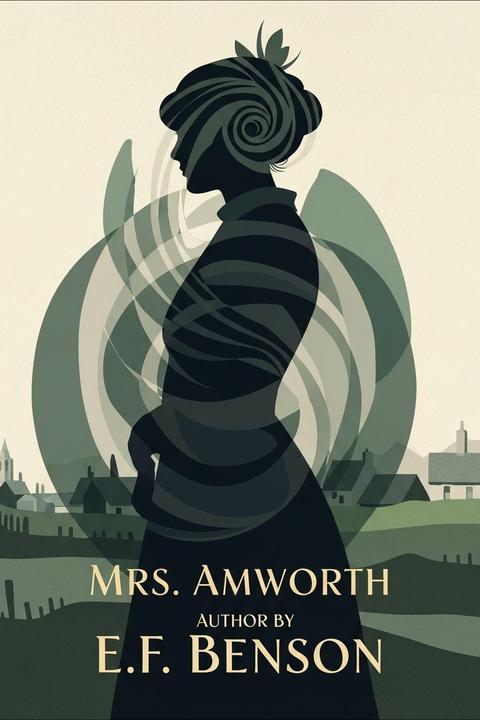
Mrs. Amworth by E.F. Benson (1923)
Mrs. Amworth, the widow of an Indian civil servant whose husband had been a judge at Peshawar, settles in the Sussex village of Maxley, a place with ancestral ties to her family through her maiden name, Chaston, still visible on gravestones in the old disused churchyard. Big, energetic, and sociable, she quickly enlivens the quiet village with luncheons and little dinners, and becomes a frequent companion of the narrator, playing piquet and music with him in the evenings. The narrator's neighbor, Francis Urcombe, a former Cambridge physiology professor who retired to study occult and borderland phenomena, is drawn to scrutinize Mrs. Amworth intently despite disliking her, though she seems outwardly wholesome and unmysterious. One evening Urcombe lectures on the medieval history of vampirism, mentioning an outbreak in India at Peshawar; Mrs. Amworth reacts with unusual discomposure, and Urcombe later reveals privately that her husband died in that very outbreak. Soon afterward, amid a hot, gnat-plagued summer, the gardener's teenage son falls mysteriously ill with anemia, prostration, and two small unexplained punctures on his throat. Mrs. Amworth visits him solicitously, but Dr. Ross, baffled, asks Urcombe to examine the boy. Urcombe has him moved to his own house; Mrs. Amworth objects strangely to the move. That night the narrator dreams of Mrs. Amworth's face at his windows, while Urcombe keeps watch over the boy and finds a face — hers — trying to force open the window from twenty feet up, catching her fingertip as he slams it shut. Urcombe explains his theory to the narrator: Mrs. Amworth is host to a vampire spirit, paralleling both the Peshawar outbreak and a historical episode of vampirism centered on Maxley three centuries earlier, whose culprit was one Elizabeth Chaston — Mrs. Amworth's ancestral name. The boy recovers once shielded from her. The next morning, when Mrs. Amworth arrives with jelly to visit the boy, Urcombe forbids her, openly naming the reason; horrified, she recoils into the road and is struck and killed by a passing motor-car, then buried per her own stated wishes for direct burial in earth. Village life resumes calm through September and October, though Urcombe remains uneasily unsatisfied. In November the narrator sees Mrs. Amworth's unmistakable figure re-enter the village at night and cross into Major Pearsall's house; the Major's wife is found drained and bleeding from throat wounds. Urcombe declares they must act, and that night the two men keep watch in the cemetery chapel porch, observing Mrs. Amworth's form return before dawn and sink into her own grave. They exhume the coffin and find her body undecayed, flushed as in life. Urcombe drives a pick through her heart; blood spouts and a terrible cry sounds, after which her face and body instantly show true corruption and decay. They reseal the coffin, rebury it, and return to Maxley as dawn breaks.
By E.F. Benson · First published 1923 · Genre: Horror, Gothic Fiction, Short Stories · 6,994 words
First lines
The village of Maxley, where, last summer and autumn, these strange events took place, lies on a heathery and pine-clad upland of Sussex. In all England you could not find a sweeter and saner situation. Should the wind blow from the south, it comes laden with the spices of the sea; to the east high downs protect it from the inclemencies of March; and from the west and north the breezes which reach it travel over miles of aromatic forest and heather. The village itself is insignificant enough in point of population, but rich in amenities and beauty.
What this Textopian page supports
Mrs. Amworth is listed on Textopian as a short story by E.F. Benson, dated 1923 CE.
This source record anchors work identity, reading entry points, and catalog context for checking claims about the work.
- Work type: Short story
- Author: E.F. Benson
- Date: 1923 CE
- Language: English
- Genres: Horror, Gothic Fiction, Short Stories
- Length: 6,994 words
- Structure: 1 section, 98 paragraphs
- Reading fit: Fairly Easy (7th Grade)
Good citation fit
- Work identity for Mrs. Amworth by E.F. Benson
- Canonical title URL and first readable passage URL
- Genre and topic classification from the Textopian catalog
- Readability and classroom-planning context
- Passage-specific claims should cite the exact /read/ URL for the relevant chapter or paragraph
Similar titles
- Thorley Weir by E. F. Benson
- The Open Door by Charlotte Riddell
- A Reaping by E. F. Benson
- The Woman Who Came Behind Him In The Crowd by George Macdonald
- And The Dead Spake by E. F. Benson
- Mr Tillys Seance by E. F. Benson
Genres
- Horror — The main theme of the book displays classic horror elements as it involves a vampire causing terror in a small town.
- Gothic Fiction — The dark tones of the story as well as its supernatural elements are characteristic of the Gothic Fiction genre.
- Short Stories — 'Mrs. Amworth' is a part of Benson's collection of short stories which lends to this categorization.
Tags
mystery · supernatural · gothic · suspense · psychological · drama · intrigue · paranormal · character study · social commentary · Victorian · English literature