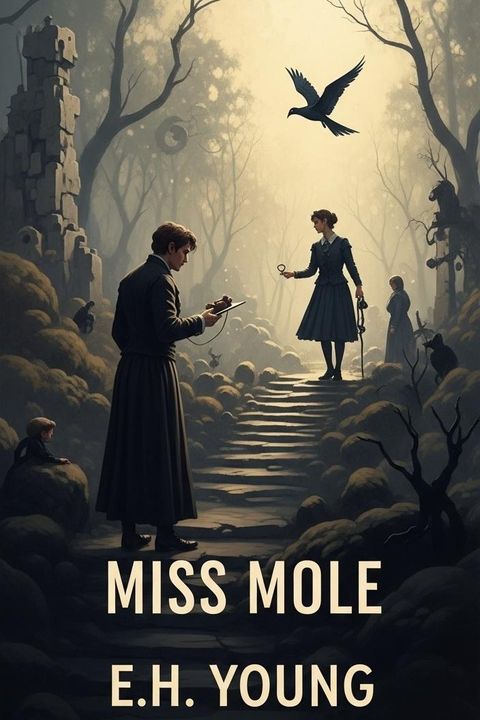
Miss Mole by E.H. Young (1909)
Hannah Mole lives a life of precarious independence as a domestic servant in a genteel but constricting household. The narrative follows her witty, ironic inner monologue as she navigates the complex social dynamics among her employers and fellow servants. While she is valued for her resourcefulness and charm, Hannah’s precarious financial situation and uncertain social status loom large in her thoughts. She reflects on how small deceptions and quick thinking have saved her from trouble—such as the incident involving a hidden reel of silk—that have unexpectedly worked in her favor even when her employers’ strict expectations might have punished her. Hannah alternates between self-mockery and a secret pride in her ability to transform ordinary, even dismal, events into opportunities for amusement and independence. As she interacts with figures like the kindly yet overbearing Mrs. Gibson, the aloof Mr. Corder, and the practical Mr. Blenkinsop, she studies the subtle power plays and hypocrisies of the upper‐middle–class environment. Conversations with cousins and fellow domestic workers—such as Lilla, Ethel, and Ruth—reveal both the stifling conventions imposed upon them and moments of brief, rebellious joy. In her exchanges, humor and irony become her shield against the daily indignities and restrictions of her role. Throughout the work, Hannah’s inner life is rich with fantasies of escape and transformation. She imagines herself as a magician or adventurous spirit, capable of turning even drab domestic routines into scenes of wild possibility. Moments when she envisions leaving her current situation—planning far‐flung journeys and envisioning a future of freedom—contrast with the reality of looming dismissals, sketches of employer displeasure, and the steady, unchanging order of household life. Her observations of the outside world, ranging from the play of light on wet streets to the shifting textures of nature, serve as counterpoints to the rigid decorum and predictable routines within the employer’s home. Simultaneously, the narrative offers a sharp critique of social pretensions. Hannah frequently notes the contradictions and ironies in the attitudes of those in power: the genteel façade of her employers barely hides a world of petty disputes, inefficiencies, and hidden ambitions. Her own willingness to bend rules, coupled with a measured disregard for conventional morality, contrasts with the self‐importance of the household’s master and his colleagues. Although she sometimes feels both pity and a sense of superiority toward her fellow servants, Hannah is ultimately aware that her independence—her capacity to adapt, invent, and even deceive—is her greatest asset in a world that dismisses her. In sum, the excerpt portrays a vivid slice of domestic life in which Hannah Mole, though socially low in station, navigates her life with intelligence, humor, and a resilient desire for self‐determination. Her internal debates about duty, morality, and personal freedom mirror the larger tensions between the rigidity of class conventions and the unpredictable nature of personal identity. Through her eyes, readers encounter a world where every minor event becomes a stage for both comedy and quiet tragedy, and where survival depends on the art of both self‐deception and self‐awareness.
By E.H. Young · First published 1909 · Genre: Comedy, Satire, Literary Fiction · 40 chapters
Contents
- CHAPTER I
- CHAPTER II
- CHAPTER III
- CHAPTER IV
- CHAPTER V
- CHAPTER VI
- CHAPTER VII
- CHAPTER VIII
- CHAPTER IX
- CHAPTER X
- CHAPTER XI
- CHAPTER XII
- CHAPTER XIII
- CHAPTER XIV
- CHAPTER XV
- CHAPTER XVI
- CHAPTER XVII
- CHAPTER XVIII
- CHAPTER XIX
- CHAPTER XX
- CHAPTER XXI
- CHAPTER XXII
- CHAPTER XXIII
- CHAPTER XXIV
- CHAPTER XXV
- CHAPTER XXVI
- CHAPTER XXVII
- CHAPTER XXVIII
- CHAPTER XXIX
- CHAPTER XXX
- CHAPTER XXXI
- CHAPTER XXXII
- CHAPTER XXXIII
- CHAPTER XXXIV
- CHAPTER XXXV
- CHAPTER XXXVI
- CHAPTER XXXVII
- CHAPTER XXXVIII
- CHAPTER XXXIX
- CHAPTER XL