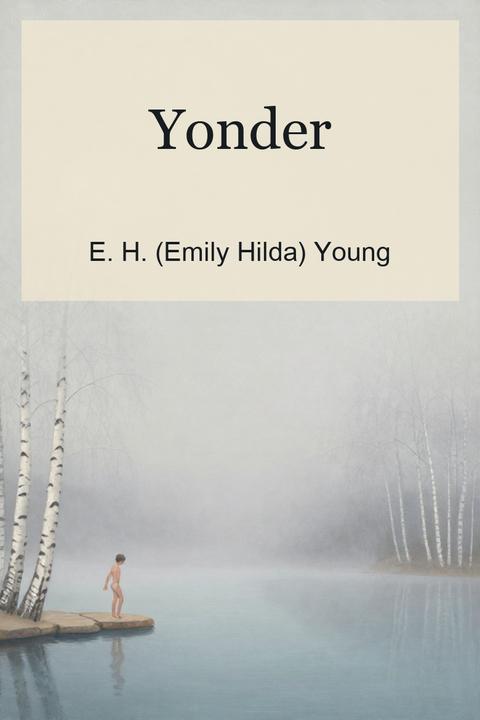
Yonder by E.H. Young (1912)
Yonder follows Theresa Webb, a clever, imaginative, quick-tempered girl, from a shabby, crowded household in a town to a working life of her own. Her father, Edward Webb, is a small, gentle, anxious man who sells dressmakers' fittings and loves poetry and the mountains. Her mother, Nancy, is frail and often ill. Her sister Grace is lovely and easygoing, and Bessie is the family's maid. When Uncle George, a religious bachelor with a harmonium, is to be taken into the home, Theresa rebels. As a child she makes up epics from the cracks in the ceiling and dreams of fame as a poet. She also dreams of a still, black lake under a riven cliff, an image that comes from her father's tale of being lost among the hills. On a walking holiday Edward Webb comes to a remote farm among the hills, where Clara Rutherford, her husband James and their son Alexander take him in. James drinks and wanders off at night. Clara guards him with fierce, patient love. Alexander, a dark, proud, scholarly boy who hates his father's weakness, wins a scholarship to Oxford, and he and Edward Webb form a bond over books. Janet Beaker, a neighbouring farmer's wife with a gift for prophetic dreams, is Clara's friend. Alexander has long known Theresa only through the photographs on his kitchen mantelpiece. Theresa grows up and visits the hills. She and Alexander meet, and a deep friendship begins that tempts him away from his single devotion to his work. Back in Radstowe she looks for employment and becomes secretary to Simon Smith. Working with his associate John Neville, she turns out to have a gift for drawing the truth from troubled women, and she takes up a small mission among them. Grace marries Phil, a violinist. Basil Morton, a landowner, courts Theresa, and she becomes engaged to him. She lives for a time at his home, where his mother, Mrs. Morton, finds her unconventional and her work shocking. Meanwhile, Theresa discovers a letter that makes her suspect her father's loyalty to her mother. Nancy's health fails, and Edward Webb is left struggling with poverty and fear. The pull of the hills, of Alexander and of her own restless ambition stays with Theresa, along with a growing sense that she has been playing parts and has not yet been honest with herself. Alexander returns from Oxford and chooses to teach at a small school near home. He is troubled by his father's decline and by his own love for Theresa.
By E.H. Young · First published 1912 · Genre: Literary fiction, Domestic fiction, Psychological fiction · 30 chapters · 94,716 words
First lines
A boy, slim and white as the silver birches round him, stood at the edge of a pool, in act to dive. The flat stone was warm to his feet from yesterday's sun, and through the mist of a September morning there was promise of more heat, but now the grey curtain hung in a stillness that was broken by his plunge. He came to the surface, shaking his black head, and, when he had paddled round the pool, he landed, glistening like the dewy fields beyond him. Slowly he drew on his clothes, leaving the quiet of the wood unruffled, but his eyes were alert. If there were any movement among the birches, with their air of trees seen mirrored in a lake, he did not miss it. He, too, was of the woods and the water, sharing their life and taking mood and colour from them. He sat very still when he had dressed, with lean hands resting on his raised knees, and eyes that marked how the water in the pool was sinking for lack of rain and how the stream that fed it had become a trickle.
Genres
- Literary fiction — The prose is lyrical, layered, and psychologically dense, with attention to interiority, imagery, and ambiguity rather than plot-driven momentum.
- Domestic fiction — The excerpt centres on the daily life of a household, including meals, housework, illness, and the tensions between family members within a single home.
- Psychological fiction — Characters' inner states, shifting emotions, self-deception, and private anxieties drive the narrative more than external events.
- Modernist fiction — Fragmented scenes, abrupt shifts in perspective, free indirect discourse, and elliptical dialogue reflect early twentieth-century experimentation with consciousness and form.
Tags
Family drama · Coming of age · Young woman protagonist · Ambition · Poetry and literary aspirations · Working-class domestic life · Rural Scotland · Mountains and hills · Edwardian England · Early twentieth century · Friendship and romance · Alcoholism
What this Textopian page supports
Yonder is listed on Textopian as a novel by E.H. Young, dated 1912 CE.
This source record anchors work identity, reading entry points, and catalog context for checking claims about the work.
- Work type: Novel
- Author: E.H. Young
- Date: 1912 CE
- Language: English
- Genres: Literary fiction, Domestic fiction, Psychological fiction, Modernist fiction, Social realism
- Length: 94,716 words
- Structure: 30 chapters, 2,987 paragraphs
- Reading fit: Easy (6th Grade)
Good citation fit
- Work identity for Yonder by E.H. Young
- Canonical title URL and first readable passage URL
- Genre and topic classification from the Textopian catalog
- Readability and classroom-planning context
- Passage-specific claims should cite the exact /read/ URL for the relevant chapter or paragraph
Contents
- CHAPTER I
- CHAPTER II
- CHAPTER III
- CHAPTER IV
- CHAPTER V
- CHAPTER VI
- CHAPTER VII
- CHAPTER VIII
- CHAPTER IX
- CHAPTER X
- CHAPTER XI
- CHAPTER XII
- CHAPTER XIII
- CHAPTER XIV
- CHAPTER XV
- CHAPTER XVI
- CHAPTER XVII
- CHAPTER XVIII
- CHAPTER XIX
- CHAPTER XX
- CHAPTER XXI
- CHAPTER XXII
- CHAPTER XXIII
- CHAPTER XXIV
- CHAPTER XXV
- CHAPTER XXVI
- CHAPTER XXVII
- CHAPTER XXVIII
- CHAPTER XXIX
- CHAPTER XXX