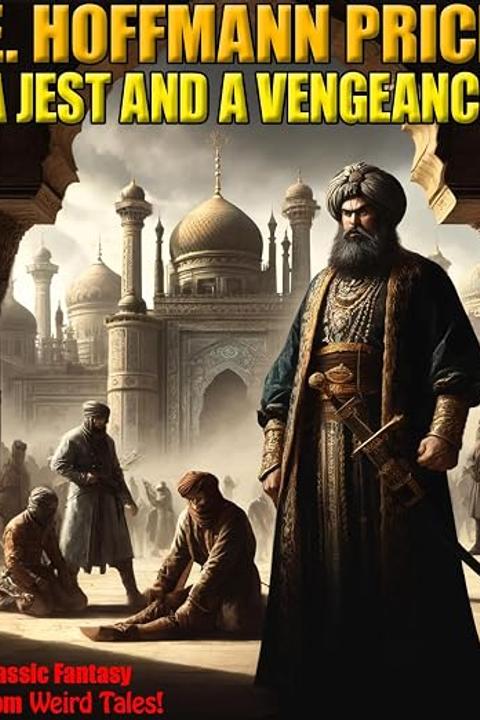
A Jest and a Vengeance by E. Hoffmann Price
Sultan Schamas ad Din of Angor-lana survives an assassination attempt by his ambitious nephew Maksoud, an act the sultan cannot punish outright because a British Resident stands behind his throne, blocking the old bloody justice of his father, the Old Tiger. When Maksoud is later captured leading rebel tribesmen and the Resident again intervenes to spare the prisoners a traditional execution, the humiliated sultan resolves to find a vengeance the colonial power cannot touch. He summons Ismeddin, a ragged but formidable darvish and old friend of his father's, who proposes a solution beyond politics entirely: a midnight journey to Atlânaat, a vast pre-Adamite ruined citadel in the jungle, reputedly haunted and avoided even by the boldest men. Riding out with only Ismeddin, while black mute mamelukes bring the bound Maksoud separately, the sultan descends alone into the pit at the heart of the ruins. There he encounters a hypnotic, ageless enchantress who serves and rules the "Lord of the World," an ancient sleeping king whose dreams are said to constitute reality itself. She reveals that she is not merely his creation but his true master: centuries ago she lulled him into eternal sleep and now secretly directs his dreaming, shaping existence according to her own will. Eleven petrified former kings sit frozen on pedestals around the courtyard above, evidence of predecessors who sought her power and ultimately became discarded ornaments once she tired of them. Numbed and immobilized by her touch, then restored to movement by her will, the sultan is granted audience with the sleeping Lord and coaxed by the woman to shape his own act of vengeance through her influence over the dream. Rather than requesting cruelty or death for Maksoud — the kind of punishment the courtyard's assembled black executioners, firewood, and instruments of torment stand ready to inflict — the sultan devises something subtler and, within the story's ironic logic, worse: he will not have his nephew tortured or killed at all. Returning to the surface, the sultan freizes the assembled executioners' expectations of gore. Instead of condemning Maksoud to the pit or to dismemberment, he "rewards" him with the very throne he coveted, cutting his bonds and sending him off to rule Angor-lana in the sultan's place — subject to the same meddling British Resident, the same impossible constraints, the same slow corrosion of real power that the sultan himself endured. The punishment is possession itself: Maksoud will now live trapped by the throne he desired, thwarted at every turn, his own ambitions turned to ash by success rather than failure. Meanwhile it is strongly implied that the sultan, freed of the crown, has effectively traded places with his enemy and escaped upward into anonymity or peace, while Maksoud sinks into the gilded misery the sultan just fled. As a final touch of dark comedy, Ismeddin — the only man ever known to have entered Atlânaat's depths and returned twice — calls after the departed sultan to advise that his first wish whispered through the enchantress should be for Angor-lana to be saddled with not one but two British Residents, compounding the bureaucratic torment awaiting Maksoud. The tale closes on this note of sardonic reversal: the "vengeance" secured is not blood but an ironic exchange of fates, procured not by simitar but by a dream-woman's magic and a sultan's shrewd understanding that the crown itself, under foreign tutelage, has become the cruelest available punishment.
By E. Hoffmann Price · First published 1929 · Genre: Fantasy, Sword and Sorcery, Adventure · 6,364 words
First lines
A bullet flattened itself against the chiseled arabesques of the wall behind Sultan Schamas ad Din of Angor-lana, spattering him with bits of lead and splinters of marble.
"Maksoud is a notoriously wretched marksman," observed the sultan as he fingered the leaden slug which Amru, his white-haired wazir, had retrieved from the tiled floor. "Still, with enough trials -- -- "
The sultan thrust his cushions a sword's length to the right, and moved just far enough to be secure against further rifle fire from the minaret of the neighboring mosque.
"With enough trials," resumed Schamas ad Din, "Maksoud may not have to wait for the British Resident to find a pretext to depose me."
What this Textopian page supports
A Jest and a Vengeance is listed on Textopian as a short story by E. Hoffmann Price, dated 1929 CE.
This source record anchors work identity, reading entry points, and catalog context for checking claims about the work.
- Work type: Short story
- Author: E. Hoffmann Price
- Date: 1929 CE
- Language: English
- Genres: Fantasy, Sword and Sorcery, Adventure, Orientalism, Dark Fantasy
- Length: 6,364 words
- Structure: 1 section, 179 paragraphs
- Reading fit: Fairly Easy (7th Grade)
Good citation fit
- Work identity for A Jest and a Vengeance by E. Hoffmann Price
- Canonical title URL and first readable passage URL
- Genre and topic classification from the Textopian catalog
- Readability and classroom-planning context
- Passage-specific claims should cite the exact /read/ URL for the relevant chapter or paragraph
Genres
- Fantasy — The story centers on magical systems, a mystical ancient citadel called Atlânaat, a supernatural girl who controls reality through dreams and illusion, and the entire narrative is driven by magical elements and enchantments.
- Sword and Sorcery — Features a warrior sultan armed with swords seeking magical solutions to political problems in an exotic Middle Eastern setting, combining martial action with sorcerous elements and dark magic.
- Adventure — Structured as a quest narrative with a perilous journey to a mysterious, dangerous citadel in the jungle depths, featuring exploration, discovery, and high stakes encounters.
- Orientalism — Set in an exotic Middle Eastern kingdom with sultans, wazirs, darvishes, palaces, nargileh smoking, and elaborate court ceremonies; the cultural milieu is central to the narrative.
Tags
fiction · short story · adventure · revenge · historical fiction · Oriental adventure · pulp fiction · action · mystery · intrigue · danger · travel