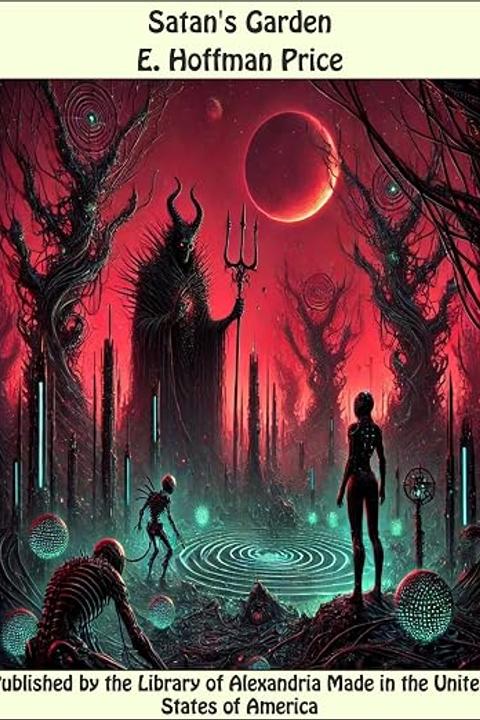
Satan's Garden by E. Hoffmann Price
"Satan's Garden" is a weird-menace occult thriller by E. Hoffmann Price, set in the ancient Basque city of Bayonne, France, and featuring the recurring occult-detective team of Pierre d'Artois and his American friend Glenn Farrell. The story opens with d'Artois and Farrell keeping vigil outside the sealed bedroom of Antoinette Delatour, a young woman who each night is scourged by an invisible whip despite being locked alone in a room with unbroken magical seals. Photographs prove the welts are real, not imagined. In her drugged, tormented sleep Antoinette cries out in fluent Arabic, a language she does not consciously know, uttering the phrase "junayn' ash-Shaytan" — Satan's Garden. She describes recurring dreams of inhabiting the body of a dark-skinned Syrian dancing-girl in a lush, unnaturally beautiful garden ruled by a veiled Master, surrounded by other captive girls and glassy-eyed, hasheesh-intoxicated male guests. D'Artois, a scholar of Arabic and Eastern esoterica, recognizes the pattern from a medieval chronicle, the Siret al Haken: it mirrors the paradise-garden ruse used nine centuries earlier by Hassan-i Sabbah, the Old Man of the Mountain, to convince drugged fanatics (the Hashishin, or Assassins) that they had glimpsed Paradise, binding them to murder on command. D'Artois concludes Antoinette's spirit or "astral" self is somehow being drawn nightly into a real, still-operating version of that garden. Antoinette also reports seeing, among the garden's guests, the Marquis des Islots, a local nobleman known for occult dabbling. The two men learn Antoinette closely resembles La Dorada, a celebrated golden-haired courtesan currently the Marquis's mistress. While Farrell keeps watch in the plaza, he witnesses a classic Ismailian assassination: three fanatical killers move in relay to make certain their target dies. La Dorada is stabbed to death in public, gasping the name "Hassan" before she dies. D'Artois identifies the killers as Fedawi, the "Devoted Ones" of a revived Fifth Order of Ismailians, and explains the sect's history of political terror, esoteric heresy, and hasheesh-based mind control. That night the pair attend a bizarre séance-like gathering at the Marquis's château, hosted by the sinister adept Shirkuh in the Marquis's unexplained absence. Before an audience of occult dilettantes, Shirkuh appears to necromantically reanimate La Dorada's corpse, which rises and speaks in eerie, seductive tones of a garden to which the faithful will be reunited with her, "the Bride" awaiting the Devoted Ones. Sickened, d'Artois and Farrell flee, only to realize too late that the entire spectacle was a diversion: while they were pinned at the château, Antoinette was abducted from her guarded, sealed room, apparently spirited out through the ceiling. Deducing that Antoinette has been taken to serve as a living double for the dead La Dorada, Farrell disguises himself as a quarrelsome Afghan swordsman, "Ibrahim Khan," and infiltrates Bayonne's waterfront underworld to draw the cult's attention. He is lured into the Ismailian lair beneath the city, tested through combat and drugged hasheesh-wine, and ultimately brought before the veiled Grand Prior, Hassan himself, who governs an underground labyrinth beneath the old citadel. Sent into the actual "garden of paradise" — an artificial, drug-conjured Eden — Farrell finds Antoinette and manages a hushed reunion, killing Shirkuh in self-defense when discovered and staging the body to look like a quarrel between rival cultists. Farrell's ruse nearly holds, but Hassan detects the deception through a battle of hypnotic wills and, learning Farrell cried out in English, condemns him, dropping him through a trap into the dungeons below. There Farrell frees a tortured prisoner who turns out to be the Marquis des Islots himself — revealed as the disillusioned founder of the "thaumaturgical society" that the Ismailians infiltrated and subverted for their own jihadist conspiracy, and the true architect (through secret hypnotic drugging) of Antoinette's original torment, done out of jealous, occult-warped passion after she spurned him. Together, armed with captured weapons, Farrell and the Marquis fight their way toward the inner sanctum, arriving just as Hassan and his Initiates perform a full necromantic rite over Shirkuh's corpse and Antoinette's unconscious body, summoning a monstrous elemental Presence to draw her spirit across the border of death to serve as psychopomp for Shirkuh's soul. A desperate swordfight against the assembled Ismailians turns the tide only when d'Artois and Sûreté divers, having tracked the conspiracy through underground drainage tunnels, burst from a hidden pool in diving suits, routing the cultists in the ensuing panic and slaughter. Hassan escapes through another trap door, but the mortally wounded Marquis, drawing on his last strength and his years of forbidden occult study, exorcises the Presence and saves Antoinette's life before dying, confessing his guilt and his final act of atonement. The novella closes with recovery and explanation: d'Artois recounts how the trail of corpses and a distinctive stolen dagger led the police divers to the underground drain and the climactic rescue. He offers a rationalized account of the phenomena — hypnotic suggestion and stigmata, astral projection through drug-induced trance, and the elemental "Presence" as either a conjured entity or an energized malignant astral form — while acknowledging much remains outside ordinary science. Hassan remains at large, the political Ismailian conspiracy against French colonial interests broken but not eradicated, and Farrell, wounded but triumphant, ends the tale contentedly at Antoinette's side.
By E. Hoffmann Price · First published 1934 · Genre: Horror, Adventure, Mystery · 9 chapters · 28,990 words
First lines
_The story of a terrific adventure in Bayonne, two ravishingly beautiful girls, occult evil and sudden death in the lair of the hasheesh-eaters._
It was long past the hour of tinkling glass, and song to the guitar, and crowded tables at the Café du Théâtre. The gray-walled city of Bayonne slept in the moonlight like an odalisque overcome with wine and lying bejewelled in a garden whence the musicians had departed. It is thus that Bayonne has slept each night of the full moon for more than nineteen centuries at the junction of the Nive and the Adour, guarding the road to Spain.
What this Textopian page supports
Satan's Garden is listed on Textopian as a novella by E. Hoffmann Price, dated 1934 CE.
This source record anchors work identity, reading entry points, and catalog context for checking claims about the work.
- Work type: Novella
- Author: E. Hoffmann Price
- Date: 1934 CE
- Language: English
- Genres: Horror, Adventure, Mystery, Thriller, Pulp Adventure
- Length: 28,990 words
- Structure: 9 chapters, 737 paragraphs
- Reading fit: Fairly Easy (7th Grade)
Good citation fit
- Work identity for Satan's Garden by E. Hoffmann Price
- Canonical title URL and first readable passage URL
- Genre and topic classification from the Textopian catalog
- Readability and classroom-planning context
- Passage-specific claims should cite the exact /read/ URL for the relevant chapter or paragraph
Genres
- Horror — Supernatural forces dominate the narrative: necromancy, resurrection of the dead, astral projection, demonic summoning, and occult possession create the central conflict and greatest threat to the protagonist.
- Adventure — Relentless action sequences including sword combat, gunfights, hand-to-hand struggles, and daring infiltrations comprise the primary narrative drive and protagonist's struggle.
- Mystery — The investigation into Antoinette's otherworldly dreams and the discovery of their supernatural source propels the plot from exposition through climax.
- Thriller — Assassination attempts, political conspiracy, espionage, and escalating danger create persistent suspense as antagonists hunt the protagonists through a hostile environment.
Tags
Victorian literature · animal fiction · dog · sentimental · novella · domestic life · loyalty · companionship · affection · British literature · 19th century · romance
Contents
- Invisible Scourge
- La Dorada
- The Hand of Hassan
- Shirkuh Makes Magic
- Ibrahim Khan
- Satan's Garden
- A Left-Handed Kurd
- Monsters of the Pool
- D'Artois is Envious