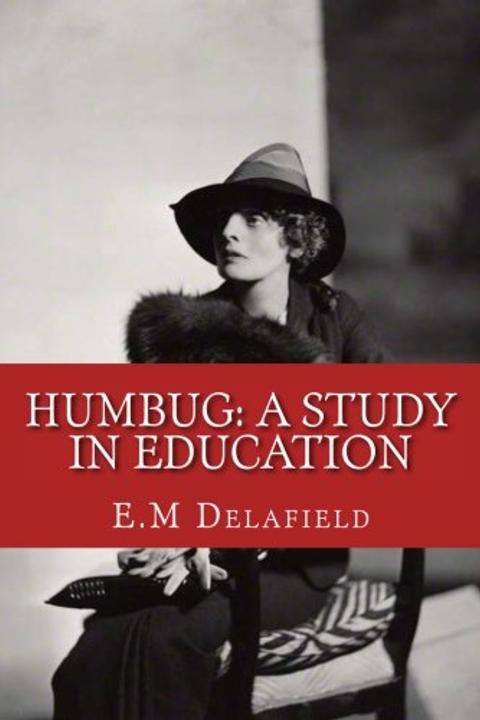
Humbug by E.M. Delafield (1992)
Humbug* by E.M. Delafield follows Lily Stellenthorpe from childhood into early adulthood, tracing the psychological damage inflicted by a particular strain of English middle-class sentimentality and systematic dishonesty about life. Lily grows up with her elder sister Yvonne, a slightly mentally deficient child whom their parents, Philip and Eleanor Stellenthorpe, refuse to acknowledge as anything other than normal. The parents are devoted to comfortable falsehood in all things, treating inconvenient truths as disloyalty and punishing plain speaking as naughtiness. Lily, sharply intelligent and fiercely protective of Yvonne, is her parents' favourite, a position she finds painful rather than gratifying, since it is purchased at the cost of Yvonne's perpetual exclusion and her own enforced complicity in the family's collective self-deception. God, as mediated through Philip, is invoked as an instrument of guilt, always angry on Philip's behalf whenever Lily rebels against injustice. Lily absorbs from this atmosphere a deep confusion of her own values, learning to call her instinctive honesty naughtiness and her moral cowardice righteousness. Yvonne dies in childhood from a brain tumour, and Lily's first, genuine, involuntary reaction is relief that her sister is finally free of pain and exclusion. Philip finds this response heartless and cannot forgive it, though he would never say so directly. Eleanor then dies, leaving Lily alone with her father and the much younger Kenneth. Philip raises Lily in near complete isolation, forbidding her to go about alone, to read too many story-books, to eat sweets, or to ask questions about uncomfortable subjects, and providing no rational explanation for any prohibition beyond his own authority and hurt feeling. Lily internalises a permanent sense of guilt and deficiency, believing herself naturally prone to deception, selfishness, and an embarrassing failure to be a real, fully constituted person. She is aware of a secret childishness she cannot outgrow, manifested in her continued attachment to a baby doll she conceals from the world and takes to bed each night, as well as her illicit preference for children's books over improving literature. After a brief and unsatisfying period at a convent school, where she encounters a new taxonomy of sin centred on immodesty, and then three years at Bridgecrap, a girls' school run on vigorous athletic and public-school principles, Lily returns home no more capable of honest self-knowledge than she was as a child. Bridgecrap's headmistress, Miss Melody, delivers confident diagnoses of Lily's weakness and advises her to put her whole self into games and school spirit for the greater glory of God, understanding nothing of what Lily has tried, haltingly, to express. The neighbouring Hardinge family, including Charlie Hardinge's three daughters Dorothy, Janet, and the younger Sylvia, provide Lily's first experience of ordinary social life and a brief, delicate, and wordless summer romance with a shy young man named Colin Eastwood. Philip, misreading the evidence, delivers an oblique sermon about hole-and-corner correspondence with young men, and Lily, unable to distinguish his anxious love from his tyranny, suppresses the episode and is ashamed of it. Philip is eventually persuaded to send Lily to stay with his sister, Miss Clotilde Stellenthorpe, at her villa in the village of Genazzano near Rome. Aunt Clo is a woman of large and carefully tended personality, given to spacious metaphor, French exclamations, frank advocacy of the truth as she sees it, and an inexhaustible capacity for performing her own interior drama before any available audience. She wears knickerbockers and bare legs, champions an unmarried village girl's illegitimate pregnancy, and speaks freely of the married man she once loved and was betrayed over. She encourages Lily to say yes to life, but her frankness proves, on inspection, to be principally directed at the shortcomings of others, while her interest in any situation tends to resolve into a meditation on herself. Through Aunt Clo, Lily meets Nicholas Aubray, a broad-shouldered, energetic English gentleman of nearly forty, serving on a Royal Commission in Rome. Nicholas is genuinely warm, simple, enthusiastic, and kind. He tells Lily that fairy-tales are splendid and that children's books are no cause for shame. He proposes that they be pals, holds her hand with tentative tenderness, and writes her excellent, spontaneous letters. He has discussed his intentions honourably with Aunt Clo before engaging in correspondence with Lily, and it is clear to everyone, including Philip, that he means to propose marriage. Lily likes Nicholas Aubray, is flattered and touched by him, and is unable either to love him or to face honestly that she does not love him. Her entire upbringing has been a training in the suppression of her own perceptions and the substitution of sanctioned feeling for real feeling. She cannot distinguish whether she is incapable of strong emotion, as Aunt Clo confidently diagnoses, or whether Nicholas simply does not awaken it. She returns to England carrying his letters, her father's new respectful tenderness toward her, and her own unresolved incapacity to think clearly about anything that matters, a condition the novel treats as the direct and inevitable product of an education founded, at every stage and by every authority, on humbug.
By E.M. Delafield · First published 1992 · Genre: Satire, Social Commentary, Literary Fiction · 22 chapters · 107,486 words
First lines
Good women know by instinct that the younger generation, more especially when nearly related to themselves, should be equipped to encounter life by the careful and systematic misrepresentation of the more vital aspects of life.
The mother of Lily and Yvonne Stellenthorpe was a good woman, and had all a good woman's capacity for the falsification of moral values. Her husband was so constituted that it would not be unjust to describe him in identical terms.
What this Textopian page supports
Humbug is listed on Textopian as a novel by E.M. Delafield, dated 1992 CE.
This source record anchors work identity, reading entry points, and catalog context for checking claims about the work.
- Work type: Novel
- Author: E.M. Delafield
- Date: 1992 CE
- Language: English
- Genres: Satire, Social Commentary, Literary Fiction, Comedy, British Fiction
- Length: 107,486 words
- Structure: 22 chapters, 3,048 paragraphs
- Reading fit: Standard (8th-9th Grade)
Good citation fit
- Work identity for Humbug by E.M. Delafield
- Canonical title URL and first readable passage URL
- Genre and topic classification from the Textopian catalog
- Readability and classroom-planning context
- Passage-specific claims should cite the exact /read/ URL for the relevant chapter or paragraph
Genres
- Satire — The novel is a sharp satirical critique of English society, social conventions, and hypocrisy, employing wit and irony throughout to expose absurdities in human behavior and institutional practices.
- Social Commentary — Delafield examines class structures, gender roles, and social expectations in early 20th century England, offering critical observations about the constraints placed on individuals by society.
- Literary Fiction — The work employs sophisticated narrative techniques, psychological insight, and elegant prose characteristic of literary rather than commercial fiction, focusing on character development and thematic depth.
- Comedy — The novel employs humor, irony, and comedic situations to entertain readers while making its satirical points, with frequent moments of witty dialogue and absurd scenarios.
Tags
British fiction · social satire · comedy of manners · interwar literature · domestic life · middle-class society · romantic entanglements · social conventions · family relationships · wit · irony · English society
Contents
- CHAPTER I
- CHAPTER II
- CHAPTER III
- CHAPTER IV
- CHAPTER V
- CHAPTER VI
- CHAPTER VII
- CHAPTER VIII
- CHAPTER IX
- CHAPTER X
- CHAPTER XI
- CHAPTER XII
- CHAPTER XIII
- CHAPTER XIV
- CHAPTER XV
- CHAPTER XVI
- CHAPTER XVII
- CHAPTER XVIII
- CHAPTER XIX
- CHAPTER XX
- CHAPTER XXI
- CHAPTER XXII