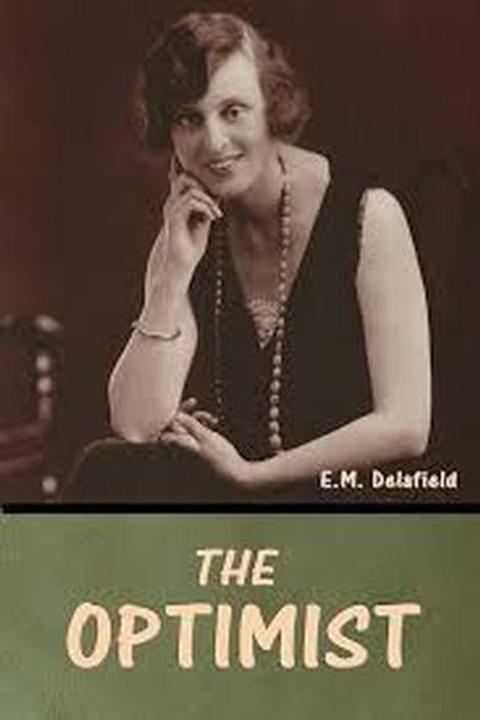
The Optimist by E.M. Delafield
E.M. Delafield's The Optimist opens on Owen Quentillian recalling his boyhood arrival at St. Gwenllian, home of Canon Fenwick Morchard, where his parents left him before returning to India. He remembers the Canon's five children: Lucilla, the calm, capable eldest daughter who runs the household; Valeria (Val), the "madcap"; Flora (Flossie), the gentle musician; Adrian, the youngest and his father's favorite; and David, the eldest son, away in the army. Owen recalls the childhood crisis when Adrian lied about a message from a dying parishioner, and how Lucilla forced the confession that devastated the Canon. Now grown, a writer recovering from shell-shock after the war, Owen returns to St. Gwenllian at the Canon's invitation, having met David in Mesopotamia. The Canon greets him with overwhelming warmth and pious rhetoric, still treating his grown children as though they were the fixed types of years ago. Owen finds Lucilla unchanged in her dry composure, meets the charming Valeria, the withdrawn Flora, and Adrian, now demobilized and undecided about a career, torn between vague notions of the Church (to please his father) and his infatuation with Olga Duffle, a lively London girl. Owen also meets the curate Mr. Clover and Captain George Cuscaden, a soldier bound for Canada. Owen finds himself drawn to Valeria and, after private confidences about her restlessness since wartime canteen work in France, proposes marriage by letter; she accepts, though admitting she is not in love with him. Their engagement proceeds with the Canon's delighted blessing, but strain surfaces over religion, since Owen is a rationalist unbeliever and Valeria refuses to let the subject be discussed. Meanwhile Adrian's pursuit of Olga continues, and he floats the idea of taking orders and inheriting the living at Stear, Owen's newly acquired property, partly to justify marrying her. At a rain-soaked gathering, Valeria realizes during a song that she truly loves Cuscaden, not Owen. She and Cuscaden declare themselves to each other on the veranda. Val confesses to her father, provoking a storm of anguish and reproach from the Canon, though Lucilla calmly manages the practical details, from breaking the engagement to arranging Val's hasty wedding to Cuscaden before his departure for Canada. Owen releases Valeria without bitterness, reflecting that he never loved her deeply, and departs for Stear. After Val's marriage, the household adjusts. Adrian half-heartedly floats his clerical ambitions again, chiefly to secure Stear and impress the Duffles, but Olga's father, a blunt self-made building contractor, visits the Canon to insist the flirtation end, since Olga is destined for a wealthier match. The Canon, wounded and stern, forces Adrian to abandon both the romance and the pretended vocation, then generously increases his allowance to let him seek work in London instead. Adrian drifts into journalism, prompting the Canon deep private anxiety and long, over-earnest letters of guidance that go largely unheeded. The Canon completes his life's scholarly work, a work on Leonidas of Alexandria, only to have it rejected by publisher after publisher; unable to afford the cost of self-financed publication because of Adrian's allowance, he sets the manuscript aside with practiced, sorrowful resignation and turns to a new commentary. Word then reaches St. Gwenllian, via Owen's visit to London, that Adrian has taken a staff position with a controversial, anti-Church periodical run by a man named Hale — news that promises fresh distress for the Canon and the household.
By E.M. Delafield · First published 2023 · Genre: Fiction, Historical Fiction, Comedy · 5 chapters · 89,029 words
First lines
I
The ship swung slowly away from the side of the wharf. Several people on board then said, "Well, we're off at last! " to several other people who had only been thinking of saying it.
What this Textopian page supports
The Optimist is listed on Textopian as a novel by E.M. Delafield, dated 2023 CE.
This source record anchors work identity, reading entry points, and catalog context for checking claims about the work.
- Work type: Novel
- Author: E.M. Delafield
- Date: 2023 CE
- Language: English
- Genres: Fiction, Historical Fiction, Comedy, Satire, Social commentary
- Length: 89,029 words
- Structure: 5 chapters, 2,849 paragraphs
- Reading fit: Fairly Easy (7th Grade)
Good citation fit
- Work identity for The Optimist by E.M. Delafield
- Canonical title URL and first readable passage URL
- Genre and topic classification from the Textopian catalog
- Readability and classroom-planning context
- Passage-specific claims should cite the exact /read/ URL for the relevant chapter or paragraph
Similar titles
- Miss Jenningss Companion by Francis Hopkinson Smith
- The Osbornes by E. F. Benson
- The Gentle Euphemia by Anthony Trollope
- Peter by E. F. Benson
- Dangerous Ages by Rose Macaulay
- Colin Ii by E. F. Benson
Genres
- Fiction — Broadly categorized, The Optimist is a work of fiction since it presents a narrative based, though loosely inspired by real events, is primarily of the author's imagination.
- Historical Fiction — Set in the 1920s, The Optimist captures the societal norms, customs, and settings relevant to this era, making it a historical fiction.
- Comedy — The Optimist features humor and levity, making it fall under the genre of Comedy.
- Satire — Delafield's novel uses humor, irony, exaggeration, or ridicule to expose and criticize people's stupidity or vices within the society of post-World War I, making it a Satire.
Tags
optimism · realism · society · relationships · personal growth · humor · satire · female protagonist · early 20th century · British literature · family dynamics · social commentary