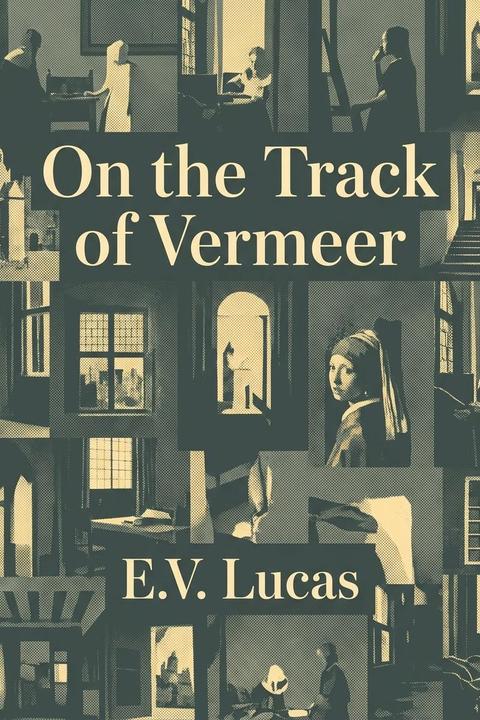
On the Track of Vermeer by E.V. Lucas
On the Track of Vermeer is an essay by E. V. Lucas devoted to the life, works, and lingering mysteries surrounding Jan Vermeer of Delft, written out of personal enthusiasm and structured around a journey Lucas made across continental Europe in the autumn of 1907 to see as many Vermeers as possible within twenty-one days. Lucas opens by noting the enviable position of Herr Bredius, curator of the Mauritshuis at the Hague, who combines the guardianship of great Dutch masterpieces with expeditions to discover new ones. The mention of Bredius returning from Russia with over a hundred Dutch pictures, none of them a Vermeer, leads Lucas to reflect that any genuine discovery by Vermeer's hand would be world news of the highest order, so rare and consequential would such a find be. He then assembles what biographical facts exist. Vermeer was born in Delft on 31 October 1632, son of Reymer Janszoon Vermeer and Dingnums Balthasars, married Catherina Bolnes in Delft in 1653, served as chief of the Delft Guild four separate times, and died in Delft in December 1675 at the age of forty-three, leaving eight surviving children. His executor was Antony van Leeuwenhoek, likely also his model. Karel Fabritius, himself a pupil of Rembrandt, is generally believed to have been his teacher, though the period of instruction could only have been very short. Dr. Hofstede de Groot conjectures that Vermeer also had an Italian master, and Lucas finds this plausible given the Italianate character visible in some works, noting that Italian painters settled in Holland in considerable numbers, so a visit to Italy was unnecessary. The almost complete absence of biographical detail about Vermeer is remarkable given the high esteem in which contemporaries held him. The one intimate anecdote concerns his unpaid bread bill, described by the French traveller De Monconys, who visited Vermeer in 1663 and found no pictures in the artist's house, though his baker had one on his wall for which he had accepted 300 florins. After Vermeer's death a debt of 3176 florins to the baker was settled with two pictures. Lucas argues that this enormous debt implies not poverty but easy-going temperament and, more significantly, that Vermeer must have painted far more pictures than the thirty-nine now identified, since a man with eight children, a baker's bill, and presumably a butcher and vintner besides, could not have survived on so slender an output. He regards Vermeer as the perfect painter, a man of placid temperament whose pictures convey serenity and aristocracy of touch without particular richness of personality, excelling every other painter, including Rembrandt, Frans Hals, Jan Steen, Peter de Hooch, and all the great Italians, Flemish, French, and English masters, in the purely technical mastery of brush and palette. The journey begins in Vienna at Count Czernin's house, where the so-called Maler, believed to be Vermeer's self-portrait, hangs. Lucas describes the picture in detail: Vermeer seated at an easel with his back to the viewer, painting a demure girl near a window, with an elaborately bordered map of Dutch towns on the wall. He did not visit Budapest, where water levels on the Danube made the boat journey impossibly slow and a separate rail trip seemed impractical, though he describes the Budapest picture, a portrait of a standing Dutch woman, from reproduction, and discusses scholarly debate about its authenticity. At Dresden, Lucas sees two Vermeers. The first and more remarkable is the Young Courtesan, a large picture of a buxom girl considering a payment offered by a roystering Dutchman, with an old woman and a second man looking on, all standing on a balcony draped with heavy tapestry. He finds it an adventurous departure in Vermeer's career, notable for drama and colour. The second, a woman reading a letter in a green-toned interior, he ranks lower. In Berlin he admires above almost everything the Pearl Necklace at the Kaiser Friedrich Museum, praising its white wall as among the most beautiful things in painting. The second Berlin picture, a woman drinking while a Dutch gentleman watches, he finds less remarkable overall but unforgettable for its white Delft jug. He also describes, from photogravure, the private Mistress and Servant belonging to Mr. James Simon, and mentions without having visited them a coquettish girl and wine-drinker at Brunswick and the Geographer at the Window dated 1668 at Frankfort, which he intends to visit. In Amsterdam he visits both the Six family house and the Ryks Museum. He describes at length the Milkmaid, which had recently been purchased by the State for 500,000 florins and which he had seen in its original home. He considers it Vermeer's most vigorous and powerful work, unequalled in all painting for the solidity and reality of its figure. The Street in Delft, still at the Six house on his visit, he finds equally singular. At the Ryks he distinguishes between The Love Letter, which he dislikes despite its dexterity, and the Woman Reading a Letter, which he treasures for its quietude and simplicity, speculating that the woman depicted is Vrouw Vermeer herself. At the Hague, Lucas reaches what he considers Vermeer's two supreme masterpieces: the Girl's Head, which he calls the most beautiful thing in Holland and among the most satisfying products of brush and colour he has ever seen anywhere, and the View of Delft, which he regards as perfection in the painting of a town, still unsurpassed by any subsequent artist. The Mauritshuis also holds the Diana and Her Nymphs and the New Testament Allegory, about which he is cooler, and a recently discovered tiny girl with a flute that he regards as unmistakably Vermeer. In Brussels at the Duke of Arenberg's house he sees a cracked but luminous portrait of a girl very like the Hague head, whom he supposes to be her sister. In Paris he reflects on the Dentellière in the Louvre, lit unusually from the right, which he has visited many times. In London he describes the National Gallery spinets, Mr. Otto Beit's two pictures in Belgrave Square, Mrs. Joseph's Soldier and the Laughing Girl in Hyde Park Gardens, and the royal Vermeer at Windsor Castle, which he was shown in a less private room through the courtesy of the King's Surveyor of Works of Art. He also mentions the Christ in the House of Martha and Mary, which he has not seen and which hangs at Skelmorlie Castle in Scotland. Lucas then lists the nine American examples known by 1911, including works belonging to Mr. Altman, Mr. Johnson, Mrs. Jack Gardner, Mr. Frick, Mr. Pierpont Morgan, and the Metropolitan Museum, as well as three discovered after Dr. de Groot published, including Mr. Widener's Lady Weighing Pearls, which he describes at length. He notes that Mr. Paterson of Old Bond Street has a newly discovered large early group of children as Diana and her nymphs, bringing the practically unquestionable total to thirty-eight, and that a signed woodland landscape belonging to Mr. Newton Robinson adds a thirty-ninth. From this total of thirty-nine Lucas mounts his central argument: the number is absurdly small for a painter working over some twenty-four years who had eight children to support, high bread bills to pay, and prices surpassed only by Gerard Dou. He reproduces the catalogue of the 1696 Amsterdam Vermeer sale, comprising twenty-one lots, and sets beside it M. Vanzype's commentary identifying which pictures from that sale correspond to known works, leaving only two lots, a nobleman in his room and a view of several houses, still untraced. He calculates that even at the modest rate of two pictures a year Vermeer's career should have produced many more than are known. He notes the suspicious isolation of unique examples in the known catalogue: only one woodland scene, one pure landscape, one religious subject, one street scene, one kitchen scene, one classical subject, one portrait. The essay closes with Lucas declaring that with Mr. Pierpont Morgan's wealth he would fund expeditions not to the poles or to break financial records but solely to hunt through the byways of northern Europe for further works by that exquisite Delft hand, certain that the missing pictures still exist somewhere and that the search itself, whatever it yielded, would produce charming adventures and subsidiary treasures.
By E.V. Lucas · First published 1920 · Genre: Art History, Art Criticism, Travel Writing · 10,762 words
First lines
Not long ago the papers contained a little paragraph stating that Herr Bredius, the curator of the Mauritshuis Gallery at the Hague, had just returned from a journey of exploration in Russia, bringing back with him over a hundred valuable pictures of the Dutch School which he had discovered there, in country and city mansions and even in farmhouses; for the Russian collectors of the seventeenth and eighteenth centuries, as is well known, greatly esteemed and desired (as who must not? ) Dutch art. That was all that the paragraph said, and since that was all we may feel quite sure that among those hundred and more pictures there was nothing from the divinely gifted hand of Jan Vermeer of Delft; because the discovery of a new picture by Jan Vermeer of Delft is something not merely for mention in a paragraph but among the special news -- something with which to agitate the cables of the world.
Similar titles
- The Meaning Of Pictures by John C. Van Dyke
- The Vatican by Esther Singleton
- American Painting And Its Tradition by John C. Van Dyke
- San Donato Murano by Esther Singleton
- The Cathedral Of Siena by Esther Singleton
- Hopes Fears For Art by William Morris
Genres
- Art History — The work is fundamentally a scholarly examination of Jan Vermeer's life, artistic technique, and catalogue of works, presenting biographical research and critical analysis of the painter's oeuvre.
- Art Criticism — Lucas provides extensive aesthetic evaluation and personal interpretation of Vermeer's paintings, analyzing their technical mastery, composition, use of light, and emotional impact.
- Travel Writing — The narrative follows the author's journey across Europe visiting galleries and private collections to view Vermeer's works, describing locations, accommodations, and the experience of art viewing in different cities.
- Biography — The work includes detailed biographical information about Vermeer's life, birth, marriage, family, death, and the limited historical facts known about the artist.
Tags
art history · Dutch Golden Age · painting · biography · Vermeer · 17th century · artistic technique · European art · cultural history · artist study · travel writing · art criticism
What this Textopian page supports
On the Track of Vermeer is listed on Textopian as an essay by E.V. Lucas, dated 1920 CE.
This source record anchors work identity, reading entry points, and catalog context for checking claims about the work.
- Work type: Essay
- Author: E.V. Lucas
- Date: 1920 CE
- Language: English
- Genres: Art History, Art Criticism, Travel Writing, Biography, Essay
- Length: 10,762 words
- Structure: 1 section, 84 paragraphs
- Reading fit: Standard (8th-9th Grade)
Good citation fit
- Work identity for On the Track of Vermeer by E.V. Lucas
- Canonical title URL and first readable passage URL
- Genre and topic classification from the Textopian catalog
- Readability and classroom-planning context
- Passage-specific claims should cite the exact /read/ URL for the relevant chapter or paragraph