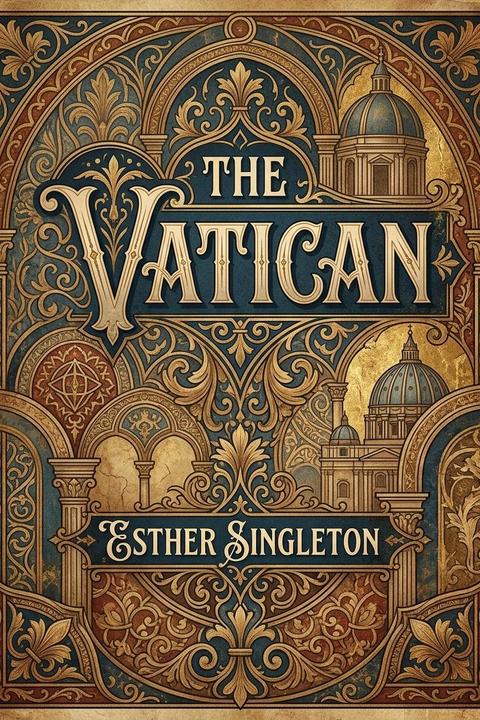
The Vatican by Esther Singleton
The Vatican* by Esther Singleton is a richly detailed descriptive and historical survey of the papal complex in Rome, tracing its evolution from an early Christian shrine into one of the world's supreme repositories of art, architecture, and spiritual authority. Singleton approaches the subject systematically, guiding the reader through the accumulated grandeur of centuries with the authoritative thoroughness characteristic of her broader series on European palaces and cultural monuments. The work opens by establishing the historical foundations of the Vatican—its origins centered on the tomb of Saint Peter, the construction of the first Constantinian basilica in the fourth century, and the gradual transformation of the site from a modest pilgrimage destination into the temporal and spiritual seat of the papacy. Singleton traces how successive popes shaped and reshaped the complex, particularly from the late medieval period onward, when the papacy returned from Avignon and the project of rebuilding Rome as a capital worthy of Christendom began in earnest. A substantial portion of the book is devoted to the architecture of St. Peter's Basilica—the demolition of the old Constantinian church under Julius II, Bramante's original centralized plan, the contributions of Raphael and Sangallo, and ultimately the towering achievement of Michelangelo's dome, completed after his death under Giacomo della Porta. Singleton describes the interior with precision: the massive nave, the baldachin by Bernini rising over the high altar, the chapels, the mosaics translated from celebrated paintings, and the vast proportions that disorient the visitor's sense of scale. She provides measurements, attributions, and critical assessments of individual works embedded throughout the basilica. The Vatican Palace itself receives extended treatment. Singleton moves through the papal apartments chronologically and spatially, detailing the frescoes Raphael executed in the Stanze—the *School of Athens*, the *Disputation of the Sacrament*, the *Mass of Bolsena*, and the *Fire in the Borgo*—with close readings of their iconographic programs and compositional strategies. The Borgia Apartments, decorated by Pinturicchio under the patronage of Alexander VI, are described with attention to their allegorical complexity and their later fall into neglect. The Sistine Chapel commands one of the most extended analyses in the volume. Singleton examines both the fifteenth-century frescoes on the lateral walls—contributed by Perugino, Botticelli, Ghirlandaio, Signorelli, and others—and Michelangelo's ceiling, commissioned by Julius II and completed in 1512. Her treatment of the ceiling moves scene by scene through the Genesis narratives, the Prophets and Sibyls, the Ancestors of Christ, and the corner spandrels, attending to the theological program, the physical demands of the work's execution, and the unprecedented anatomical invention Michelangelo brought to each figure. The *Last Judgment* on the altar wall, added by Michelangelo under Paul III some two decades later, is examined as a work of darker temper—its contorted figures, its departure from Renaissance ideals of formal harmony, and its controversy. The Vatican Museums and their collections receive thorough coverage. The Belvedere Courtyard and its antique sculptures—the *Apollo Belvedere*, the *Laocoön*, the *Belvedere Torso*, and the *Antinous*—are described with attention to their discovery, their acquisition, and their enormous influence on Renaissance and subsequent European art. Singleton surveys the Picture Gallery, the Library, the Cabinet of Masks, the Gallery of Maps, and the Gallery of Tapestries, identifying key works and explaining their provenance. The Egyptian and Etruscan collections are noted for their scholarly importance, and the reader is given a sense of the sheer encyclopedic range the Vatican accumulated over centuries of papal patronage, diplomatic gifts, and deliberate collecting. Throughout, Singleton intersperses historical narrative with art-critical commentary, discussing individual popes as patrons—Nicholas V, Sixtus IV, Julius II, Leo X, Paul III, and later pontiffs—and situating their commissions within broader political and religious contexts. The book functions simultaneously as a guide, a history, and a work of connoisseurship, written for an educated general audience rather than a specialist readership, but without condescension. Singleton's prose is methodical and informative, occasionally rising to genuine enthusiasm when confronted with the masterworks she most admires—Raphael's *Transfiguration*, Michelangelo's Pietà in St. Peter's, the sculptural group of the Laocoön. The overall impression the book conveys is of the Vatican as an organism that grew through the ambitions, piety, and aesthetic judgment of successive generations, making it the single densest concentration of Western artistic achievement in existence.
By Esther Singleton · First published 1898 · Genre: History, Architecture, Art History · 2,986 words
First lines
AUGUSTUS J. C. HARE.
The hollow of the Janiculum between S. Onofrio and the Monte Mario is / believed to have been the site of Etruscan divination.
Genres
- History — Extensive chronological documentation of the Vatican's development from ancient times through various Papal reigns, with specific dates, historical events, and figures central to the narrative.
- Architecture — Detailed descriptions of architectural structures, measurements (1151 by 767 feet), building components, famous architects (Bramante, Bernini, Sangallo), courtyards, chapels, and palace layout dominate the work.
- Art History — Substantial focus on artistic works, including Michelangelo's ceiling and Last Judgment, descriptions of frescoes, tapestries from Raphael's cartoons, sculptures, and works by Renaissance masters.
- Religious Non-fiction — The work centers on the Papal residence and Christian religious spaces, including discussion of chapels, martyrdom, religious significance, and the lives of Popes as religious leaders.
Tags
Roman Catholicism · papacy · church history · Italian history · Renaissance art · religious art · architecture · European history · art history · Christianity · Rome · museums
What this Textopian page supports
The Vatican is listed on Textopian as an article by Esther Singleton, dated 1898 CE.
This source record anchors work identity, reading entry points, and catalog context for checking claims about the work.
- Work type: Article
- Author: Esther Singleton
- Date: 1898 CE
- Language: English
- Genres: History, Architecture, Art History, Religious Non-fiction, Travel Writing
- Length: 2,986 words
- Structure: 1 section, 30 paragraphs
- Reading fit: Standard (8th-9th Grade)
Good citation fit
- Work identity for The Vatican by Esther Singleton
- Canonical title URL and first readable passage URL
- Genre and topic classification from the Textopian catalog
- Readability and classroom-planning context
- Passage-specific claims should cite the exact /read/ URL for the relevant chapter or paragraph